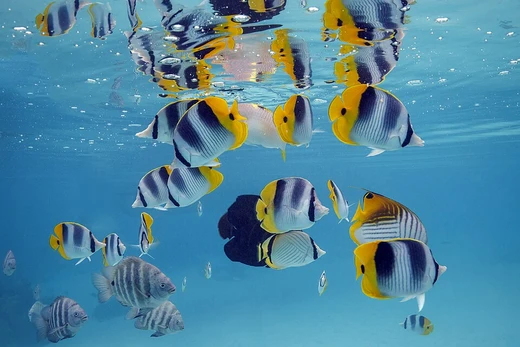
Chaetodon mertensii
A crowned butterflyfish with chevron bands and yellow hindparts.

The atoll butterflyfish, also called the yellowback butterflyfish or Merten's butterflyfish, is a marine ray-finned fish in the family Chaetodontidae. Its scientific name is *Chaetodon mertensii*, and it lives in the western Pacific Ocean.
This species reaches a maximum length of 12.5 centimeters (5 inches). Its body is white, marked with five to seven dark grey, chevron-shaped bands on the sides. The rear part of the trunk, the adjacent dorsal and anal fins, and the rear portion of the tail fin are orange or yellow. A solid vertical black bar runs across the eye and over the nape, unlike similar species where the eye stripe and nape spot are separate.
*Chaetodon mertensii* inhabits deep lagoons and seaward reefs at depths of 10 to 120 meters. It feeds on algae and small benthic invertebrates.
Its range extends across the Pacific from the Ryukyu Islands to the Philippines, and out to Lord Howe Island, Rapa Iti, and the Tuamotus. In 2015, it was first recorded in the Kermadec Islands Marine Reserve north of New Zealand, after researchers reviewed hundreds of hours of unused documentary film footage.
The species was first formally described in 1831 by French anatomist Georges Cuvier. The specific name honors German naturalist and explorer Karl Heinrich Mertens, who showed Cuvier an illustration of the fish.
*Chaetodon mertensii* belongs to the "crowned" butterflyfishes, a group of largely allopatric species that share a striking color pattern: dark, forward-pointing chevrons on a silvery background, a black-and-white crown spot, and yellow to red hindparts. They differ mainly in exact hues and small pattern details. Close relatives include the Eritrean butterflyfish (*C. paucifasciatus*) and Seychelles butterflyfish (*C. madagaskariensis*), as well as the more distant pearlscale butterflyfish (*C. xanthurus*).
The crowned *Chaetodon* form a clear clade, but their broader relationships are less certain. They have often been placed in the subgenus *Exornator* or considered a distinct subgenus *Rhombochaetodon*, with the atoll butterflyfish as the type species. DNA studies suggest that some older, more singular lineages—such as the Asian butterflyfish (*C. argentatus*), blue-striped butterflyfish (*C. fremblii*), and Burgess' butterflyfish (*C. burgessi*)—may also belong here. *C.
Quick Facts
- Genus
- Chaetodon
- Parent
- Chaetodon (Rhombochaetodon)
- Species
- mertensii
Facts from the source article.
Lore & Background
Chaetodon mertensii was first formally described in 1831 by the French anatomist Georges Cuvier. The specific name honors the German naturalist and explorer Karl Heinrich Mertens, who showed Cuvier an illustration of this fish. It grows to a maximum of 12.5 cm long, with a white body marked by 5–7 chevron-shaped dark grey bands on the sides. The posterior portion of the trunk, the adjacent dorsal and anal fins, and the posterior portion of the caudal fin are orange or yellow. A vertical black bar runs across the eye and over the nape without a break, distinguishing it from similar species that have a separate nape spot and eyestripe.
Reader's Guide
Chaetodon mertensii is one of the 'crowned' butterflyfishes, a group of largely allopatric species sharing the overall color pattern of dark forward-pointing chevrons on silvery hues, a black-and-white crown spot, and yellow to red hindparts. Other members of this lineage include the closely related Eritrean butterflyfish (C. paucifasciatus) and Seychelles butterflyfish (C. madagaskariensis), as well as the more distant pearlscale butterflyfish (C. xanthurus). The 'crowned' Chaetodon form a clearly recognizable clade, but their further relationships are less clear. They have often been placed in the subgenus Exornator, or considered a distinct subgenus Rhombochaetodon with the atoll butterflyfish as type species. DNA sequence studies suggest relationships with older and more singular lineages such as the Asian butterflyfish (C. argentatus), the blue-striped butterflyfish (C. fremblii), and Burgess' butterflyfish (C. burgessi). The expanded group's relationship to species like the speckled butterflyfish (C. citrinellus) and the four-spotted butterflyfish (C. quadrimaculatus) remains unresolved, and it may ultimately be better to merge both Rhombochaetodon and Roaops into Exornator.
Did You Know?
- It was first recorded from the Kermadec Islands Marine Reserve north of New Zealand in 2015, after researchers examined hundreds of hours of unused documentary film footage.
- It is one of the 'crowned' butterflyfishes, a group sharing dark forward-pointing chevrons on silvery hues and yellow to red hindparts.
Frequently Asked Questions
Who is Chaetodon mertensii?
The atoll butterflyfish is a small marine ray-finned fish in the family Chaetodontidae, also widely known as the yellowback butterflyfish or Merten's butterflyfish. It is one of the more colorful members of the butterflyfish group native to the western Pacific.
What does Chaetodon mertensii look like?
Its body is predominantly white and crossed by five to seven dark grey chevron-shaped bands along the flanks. The rear trunk, the neighboring dorsal and anal fins, and the back of the tail are a vivid orange or yellow, while a bold vertical black bar stretches across the eye and over the nape.
Where does Chaetodon mertensii live?
This species is native to the western Pacific Ocean, where it can be encountered at depths anywhere from about 10 meters down to 120 meters. It is typically associated with atoll and reef environments within that range.
How big does Chaetodon mertensii get?
Adults top out at roughly 12.5 centimeters (about 5 inches) in total length, making it a modestly sized butterflyfish compared to some of its larger relatives.
Who named Chaetodon mertensii and when?
French naturalist Georges Cuvier first described the species in 1831, giving it the name in honor of the German zoologist Karl Heinrich Mertens. The type locality for the original description is the western Pacific Ocean.
More in Butterflyfish, Part 2 1-24
Spotted an error? Know more?
Reader corrections go straight into our review queue. Suggest an edit · How this site is sourced