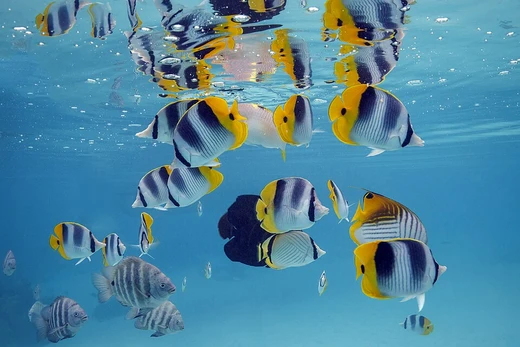
Marquesas butterflyfish
A silvery-white butterflyfish with a black wedge and yellow eye band.

The Marquesas butterflyfish (Chaetodon declivis) is a marine ray-finned fish in the family Chaetodontidae. It has a silvery-white body with black spots, and a blackish, wedge-shaped patch on the upper rear part of the body and fins. A yellow vertical band crosses the eye, the dorsal fin is yellowish-orange, and the caudal fin is yellow. It reaches up to 12 cm (4.7 in) in total length. This species is to the Central Pacific Ocean and is primarily found in the Line Islands in the United States Minor Outlying Islands, Phoenix Islands in French Polynesia and Kiribati and Marquesas in French Polynesia. It lives over rocky and sandy seabeds at depths of 20 to 80 meters (66 to 262 ft). It is oviparous and forms pairs for breeding. Its diet includes coral polyps, fanworms, crustaceans, tunicates, and algae. The species was first formally described in 1975 by American ichthyologist John Ernest Randall, with the type locality recorded as Hanauu Bay on Fatu Hiva in the Marquesas Islands. The specific name *declivis* comes from Latin for "sloping," referring to the diagonal dark patch on its upper body and fins. Populations in the Marshall Islands are thought to be hybrids of *C. declivis* and *Chaetodon burgessi*. Historically collected for the aquarium trade, its commercial demand has declined since 2006.
Quick Facts
- Genus
- Chaetodon
- Parent
- Chaetodon (Rhombochaetodon)
- Species
- declivis
Facts from the source article.
Lore & Background
The Marquesas butterflyfish has a silvery-white body marked with black spots, with the upper posterior section featuring a blackish, wedge-shaped area. A yellow vertical band runs through the eye. The dorsal fin is yellowish-orange while the caudal fin is yellow. It reaches a total length of 12 centimetres (4.7 in). This species is to the Central Pacific Ocean and is primarily found in the Line Islands in the United States Minor Outlying Islands, Phoenix Islands in French Polynesia and Kiribati and Marquesas in French Polynesia. It inhabits rocky and sandy seabeds at depths between 20 and 80 metres (66 and 262 ft). The Marquesas butterflyfish is oviparous and forms pairs for breeding. In the wild, it is omnivorous, feeding on coral polyps, fanworms, crustaceans, tunicates, and algae. Populations of similar fishes in the Marshall Islands are believed to be hybrids of C. declivis and Chaetodon burgessi.
Reader's Guide
The Marquesas butterflyfish was first formally described in 1975 by American ichthyologist John Ernest Randall, with the type locality recorded as Hanauu Bay on Fatu Hiva in the Marquesas Islands. Its specific name declivis, from Latin meaning 'sloping', refers to the diagonally sloping dark patch on its upper body and fins. Historically, this species was collected for the aquarium trade, but its commercial demand has declined since 2006. The species is notable for its limited geographic range, being found only in the Line Islands, Phoenix Islands, and Marquesas Islands. Its biology includes oviparous reproduction with pair bonding, and an omnivorous diet that includes coral polyps, fanworms, crustaceans, tunicates, and algae. The existence of suspected hybrids with Chaetodon burgessi in the Marshall Islands adds to its scientific interest, though this remains a belief rather than a confirmed fact.
Taxonomic Architecture of the Butterflyfishes
The butterflyfishes documented in South African marine records occupy a well-defined position within the vertebrate tree of life. They belong to the parvphylum Osteichthyes, a name derived from the Ancient Greek words for bone and fish, reflecting their defining trait of endoskeletons built primarily from bone tissue. This clade stands in contrast to cartilaginous fish and the now-extinct placoderms and acanthodians. Within Osteichthyes, butterflyfishes fall under the gigaclass Actinopterygii, the class Teleostei, and the order Acanthuriformes. Their family, Chaetodontidae, sits alongside Acanthuridae, which includes surgeonfishes and unicornfishes, and Antigoniidae, the boarfishes, within that same order. The broader bony-fish clade is staggering in scale, encompassing forty-five orders, more than four hundred and thirty-five families, and roughly twenty-eight thousand species, making it by far the dominant group among all living fish.
Geographic Reach Along the South African Coast
The butterflyfishes recorded in South African waters display a remarkable spread of southern range limits, stretching from the Red Sea and Indian Ocean all the way down the eastern coast. Some species, such as the threadfin butterflyfish, reach as far south as Mossel Bay, while others like the pearly butterflyfish extend to Port Elizabeth and the limespot butterflyfish to Port Alfred. A few species show more restricted southern boundaries, with the blackback butterflyfish and several others documented only as far south as Durban. One particularly noteworthy entry is the doublesash butterflyfish, flagged as endemic to the region between Lamberts Bay and Maputo. The list explicitly cautions that the ranges specified represent the known distribution within South African waters and may not capture the full global extent of each species. Sub-taxa are arranged alphabetically as a general rule, and the taxonomy follows the World Register of Marine Species where possible, though it may diverge from the original cited sources, which were consulted primarily for regional record confirmation.
A Tangle of Names and Nomenclature
One of the most striking features of the butterflyfish entries is the richness of common names attached to single species. The Chaetodon guttatissimus, for instance, goes by both gorgeous gussie and peppered butterflyfish, while Chaetodon lunula is known as either the raccoon butterflyfish or the halfmoon butterflyfish. The purple butterflyfish simultaneously carries the alias melon butterflyfish, and the rightangle butterflyfish is also called the chevron butterflyfish. Each entry pairs these vernacular names with a formal scientific binomial and an author citation bearing a date, ranging from Linnaeus in 1758 to more recent descriptions like Ahl's 1923 work. The family is dominated by the genus Chaetodon, though Forcipiger and Hemitaurichthys also appear. Synonyms are noted where relevant, and the list acknowledges that internal links may lead to fuller species details. This layered naming system reflects centuries of taxonomic revision and regional folk tradition coexisting in a single reference.
Butterflyfishes Within the Broader Bony-Fish Mosaic
The butterflyfishes do not exist in isolation within South African marine biodiversity. The list from which they are drawn is itself a sublist of the broader catalogue of bony fishes recorded from the oceans bordering the Republic of South Africa. Within the same order, Acanthuriformes, the Chaetodontidae share company with the surgeonfishes and unicornfishes of Acanthuridae, including species like the palette surgeon, the humpback unicorn, and the sailfin tang, as well as with the solitary boarfish of Antigoniidae. The overarching parvphylum Osteichthyes, in its cladistic interpretation, extends beyond fish entirely to include all tetrapods, from reptiles to mammals, united by their bony endoskeletons. The South African list thus captures a small but vivid slice of a global assemblage that numbers in the tens of thousands of species across dozens of orders, with the vast majority of all extant fish belonging to this single bony-fish clade.
Frequently Asked Questions
What is the Marquesas butterflyfish?
The Marquesas butterflyfish is a small marine ray-finned fish in the butterflyfish family (Chaetodontidae), classified under the scientific name Chaetodon declivis. It was first formally described in 1975 by ichthyologist John Ernest Randall.
What does the Marquesas butterflyfish look like?
It has a silvery-white body peppered with black spots, plus a dark wedge-shaped mark on the upper rear portion of its body and fins. A bold yellow vertical stripe passes through the eye, the dorsal fin is yellowish-orange, and the tail fin is yellow.
Where can the Marquesas butterflyfish be found?
Its range is restricted to the Central Pacific Ocean, specifically the Line Islands, the Phoenix Islands, and the Marquesas archipelago. It generally lives at depths of 20 to 80 meters (about 66 to 262 feet).
How big does the Marquesas butterflyfish get?
Adults of this species top out at roughly 12 centimeters (4.7 inches) in total length, making it a relatively small member of the butterflyfish family.
Where was the Marquesas butterflyfish first identified?
The type locality for Chaetodon declivis is Hanauu Bay on Fatu Hiva, one of the Marquesas Islands in French Polynesia. That is the site from which the original specimen used in the 1975 description was collected.
More in Butterflyfish, Part 2 1-24
Spotted an error? Know more?
Reader corrections go straight into our review queue. Suggest an edit · How this site is sourced