Philippine butterflyfish
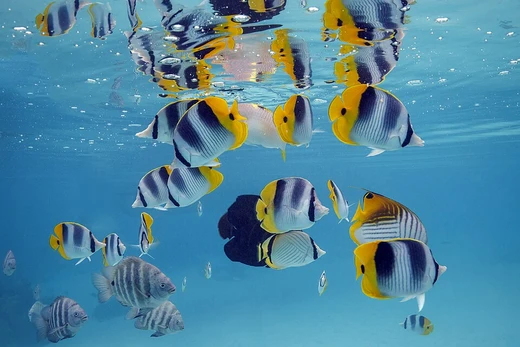
A white-bodied butterflyfish with yellow fins and a panda-like face.

The Philippine butterflyfish or Threadfin butterflyfish (Chaetodon adiergastos), also known as the Bantayan butterflyfish or panda butterflyfish, is a species of marine ray-finned fish in the family Chaetodontidae. It is notable for its distinctive facial markings and its occurrence in the western Pacific, from the Ryukyu Islands and Taiwan to Java and northwestern Australia.
Quick Facts
- Genus
- Chaetodon
- Parent
- Chaetodon (Rabdophorus)
- Species
- adiergastos
Facts from the source article.
Lore & Background
The Philippine butterflyfish was first formally described in 1910 by the American ichthyologist Alvin Seale (1871–1958), with the type locality given as Bantayan Island in the Philippines. Its body is white with diagonal brown stripes on the sides, and its dorsal, caudal, anal and pelvic fins are yellow. The face bears rounded broad black bands covering the eye, but these bands are not continuous from one side to the other; instead, a separate black spot is centered on the forehead.
It belongs to the large subgenus Rabdophorus, which might warrant recognition as a distinct genus. Within this group, it appears to belong to a loose assemblage including the black butterflyfish (C. flavirostris), diagonal butterflyfish (C. fasciatus), raccoon butterflyfish (C. lunula), and perhaps the red-tailed butterflyfish (C. collare). Although coloration varies among these species, they are all largish butterflyfishes with an oval outline, and most have a pattern of ascending oblique stripes on the flanks. Except in the red-tailed butterflyfish, there is at least a vestigial form of the 'raccoon' mask, with a white space between the dark crown and eye areas.
The Philippine butterflyfish is found in coral reefs at depths of 1–30 m and occurs in pairs or groups, usually near soft coral. Juveniles are solitary and found on shallow protected reefs or in estuaries.
Reader's Guide
The Philippine butterflyfish is significant as a representative of the subgenus Rabdophorus, a group that may warrant recognition as a distinct genus. Its inclusion in a loose species group with the black butterflyfish, diagonal butterflyfish, raccoon butterflyfish, and possibly the red-tailed butterflyfish highlights shared morphological traits such as an oval outline and ascending oblique stripes on the flanks. The presence of a vestigial 'raccoon' mask in most members of this group, except the red-tailed butterflyfish, underscores evolutionary relationships within the family Chaetodontidae.
Its ecological role is tied to coral reefs at depths of 1–30 m, where it occurs in pairs or groups near soft coral. Juveniles are solitary and inhabit shallow protected reefs or estuaries, indicating ontogenetic shifts in habitat use. The species' distribution across the western Pacific—from the Ryukyu Islands and Taiwan to Java and northwestern Australia—reflects its adaptability to tropical reef environments. The type locality at Bantayan Island in the Philippines, where Alvin Seale first described it in 1910, anchors its taxonomic history. The species' common names—Philippine butterflyfish, Threadfin butterflyfish, Bantayan butterflyfish, and panda butterflyfish—reflect regional and descriptive traditions.
More in Butterflyfish, Part 2 1-24
Spotted an error? Know more?
Reader corrections go straight into our review queue. Suggest an edit · How this site is sourced