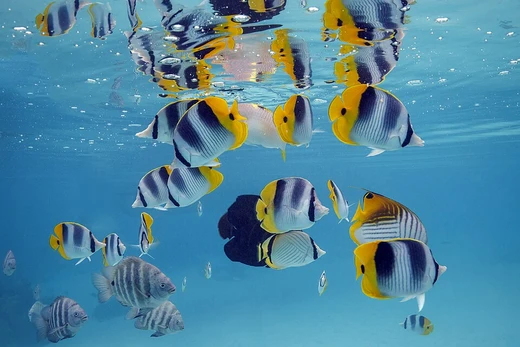
Ornate butterflyfish
Obligate corallivore with distinctive orange bands and black head bars.

The ornate butterflyfish, also called the clown butterflyfish, is a marine ray-finned fish belonging to the Chaetodontidae family. It is closely related to the mailed butterflyfish and the scrawled butterflyfish, and these three species make up a group once named "Citharoedus"—but that name is invalid because it had already been given to a mollusk genus. They are probably quite close to the subgenus *Corallochaetodon*, which includes the melon butterflyfish. If the genus *Chaetodon* is ever split, these species might be placed into *Megaprotodon*.
The easiest way to identify this fish is by its color pattern, which helps protect it from predators. It has a white body with orange to orange-brown oblique bands, two yellow-edged black bars on the head (one across the eyes, another on the snout), and two black bars on the tail. Adults range from 13 to 18 cm in total length, with an average of about 16.2 cm, and members of a pair are nearly always the same size.
Adult ornate butterflyfish are usually found in pairs that defend exclusive territories in clearwater lagoons and seaward reefs with plenty of coral, with territories ranging from about 100 to 1,400 square meters. Juveniles, on the other hand, live alone, are shy, and hide among the branches of corals for safety. Once they reach breeding age, they form pairs, and it is rare to find an adult without a mate. Pairs also establish a home range where they are almost always found.
These fish are monogamous and pair-forming, with many mating for life. Spawning times vary by location: in tropical areas, it peaks in winter and early spring, while in temperate areas it happens in midsummer. Spawning occurs at dusk, and eggs are released and fertilized in the open water.
The ornate butterflyfish is widespread across the tropical Indo-Pacific, from Sri Lanka to Hawaii, the Marquesas, the Pitcairn Islands, north to southern Japan, and south to Lord Howe and Rapa in the Austral Islands. Over three-quarters of the world's fish species live in this region. This fish lives in marine, inshore, tropical waters (between 30°N and 30°S, and 77°E to 124°W), always associated with reefs, at depths of 1 to 36 meters.
Like other coral reef organisms, the ornate butterflyfish faces many natural and human-caused threats to its habitat.
Quick Facts
- Genus
- Chaetodon
- Parent
- Chaetodon (Citharoedus)
- Species
- ornatissimus
Facts from the source article.
Lore & Background
The ornate butterflyfish is most easily identified by its color pattern, which helps protect it from predators. It has a white body with orange to orange-brown oblique bands, two yellow-edged black bars on the head (one across the eyes and one on the snout), and two black bars on the tail. Adults are predominantly found in pairs occupying exclusive territories in clearwater lagoons and seaward reefs rich in coral growth, with territory sizes ranging from approximately 100 to 1400 m². Juveniles are solitary, shy, and hide in the arms of branching corals for protection until they reach breeding age, at which point they form pairs. It is uncommon to find an adult without a mate, and pairs establish a home range where they are likely always to be found.
Reproduction is monogamous, with many individuals mating for life. Spawning occurs at dusk, with eggs released and fertilized in the water column. The timing of spawning varies by biome: tropical spawning peaks in winter and early spring, while temperate spawning occurs in midsummer. The species feeds exclusively on coral polyp tissue and small organisms, and it has the broadest range of coral prey among coral-eating butterflyfish, feeding on ten different coral species. Its fine hair-like teeth allow it to pick small organisms, and it uses its pectoral fins as oars to hover motionless and dart swiftly.
Reader's Guide
The ornate butterflyfish is one of the most popular tropical fishes with divers and aquarists, yet it is nearly impossible to keep successfully in captivity because it is an obligate corallivore. Its reliance on live coral makes it highly vulnerable to habitat degradation. The article notes that over 30 percent of the world's coral reef communities have already been degraded, and projections indicate more than 60 percent will be lost by 2030. Natural disruptions such as tropical storms, unseasonal temperature extremes, and infestations of crown-of-thorn sea stars (Acanthaster planci) are becoming more frequent, while anthropogenic disturbances including overfishing, pollution, and coastal development cause chronic coral depletion. Studies cited in the article document declines in butterflyfish abundance and localized extinctions following coral depletion, primarily due to starvation. Additionally, shifts from coral-dominated to seaweed-dominated benthic communities—driven by overfishing of herbivorous fish and eutrophication—further limit coral expansion and larval settlement, adversely affecting butterflyfish that actively avoid corals in contact with seaweed.
Did You Know?
- The ornate butterflyfish is a close relative of the mailed butterflyfish (C. reticulatus) and the scrawled butterflyfish (C. meyeri).
- Adults are nearly always found in pairs, while juveniles are solitary and hide in branching corals.
- It feeds on ten different coral species, the broadest range among coral-eating butterflyfish.
- Spawning occurs at dusk, with timing varying by biome: tropical peaks in winter/early spring, temperate in midsummer.
More in Butterflyfish, Part 2 1-24
Spotted an error? Know more?
Reader corrections go straight into our review queue. Suggest an edit · How this site is sourced