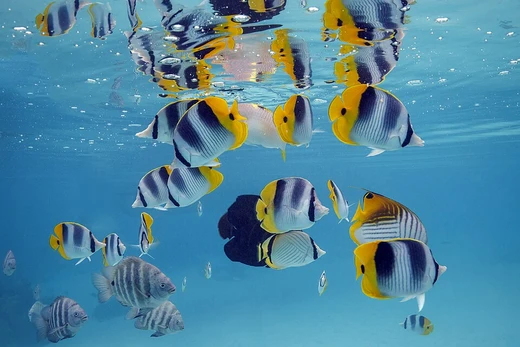
Chaetodon sanctaehelenae
A butterflyfish endemic to St Helena and Ascension Island.

The Saint Helena butterflyfish (Chaetodon sanctaehelenae), also called the cunningfish, is a marine ray-finned fish in the family Chaetodontidae. It lives in the Atlantic Ocean around the islands of St Helena and Ascension Island. Its local name comes from its habit of nibbling bait off a hook without getting caught.
This fish has a silvery-white body with a vertical black band through its eye. Its caudal peduncle, dorsal fin, and anal fin are yellow. The dorsal fin has 13 spines and 21–23 soft rays; the anal fin has 3 spines and 19 soft rays. It can grow up to 18 cm (7.1 in) long.
The species is endemic to the southeastern Atlantic, found only around the British Overseas Territories of Ascension and St Helena. Vagrants have been recorded as far north as Liberia and the Canary Islands.
It is common in shallow waters, usually seen in pairs or large shoals. It is oviparous and monogamous, forming pairs to spawn. Juveniles of *Thalassoma sanctaehelenae* have been observed cleaning parasites off this butterflyfish. The fish often gather in shoals to eat refuse dumped into St Helena’s harbour, and normally feed on benthic invertebrates.
The species was first formally described in 1868 by Albert Günther. Some authorities place it in the subgenus *Exornator*, while others consider it *incertae sedis*.
Quick Facts
- Taxon
- Chaetodon sanctaehelenae
Facts from the source article.
Lore & Background
The Saint Helena butterflyfish has a silvery-white body with a vertical black band running through the eye. Its caudal peduncle is yellow, as are the dorsal and anal fins. The dorsal fin contains 13 spines and 21-23 soft rays, while the anal fin has 3 spines and 19 soft rays. This species attains a maximum total length of 18 centimetres (7.1 in).
It is endemic to the waters around the British Overseas Territories of Ascension and Saint Helena islands in the southeastern Atlantic Ocean, though vagrants have reached as far north as Liberia and the Canary Islands. It is a common species of shallow waters, normally recorded in pairs or big shoals. It is oviparous and monogamous, forming pairs during spawning.
Locally, it is named cunningfish because it is able to nibble the bait from a hook while avoiding the hook. Juveniles of Thalassoma sanctaehelenae have been recorded acting as a cleaner fish, picking parasites off this species. They frequently gather in shoals to feed on refuse tipped into the Saint Helena harbour, though they normally feed on benthic invertebrates.
Reader's Guide
The Saint Helena butterflyfish was first formally described in 1868 by the German-born British zoologist Albert Günther. Some authorities place this species within the subgenus Exornator, but others consider it to be incertae sedis, reflecting ongoing taxonomic uncertainty. Its significance lies in its restricted endemic range, being found only around the remote islands of St Helena and Ascension Island, with occasional vagrants reaching Liberia and the Canary Islands. The species is notable for its local common name, cunningfish, which arises from its observed behavior of nibbling bait from hooks without being caught. Its biology includes monogamous pair spawning and a mutualistic relationship with juvenile cleaner fish of Thalassoma sanctaehelenae. The species also exhibits opportunistic feeding on harbour refuse, alongside its typical diet of benthic invertebrates. These traits contribute to its ecological and cultural importance within its limited Atlantic range.
Did You Know?
- The Saint Helena butterflyfish is also called the cunningfish because it can nibble bait from a hook while avoiding the hook.
- Juveniles of Thalassoma sanctaehelenae act as cleaner fish, picking parasites off this species.
More in Butterflyfish, Part 2 1-24
Spotted an error? Know more?
Reader corrections go straight into our review queue. Suggest an edit · How this site is sourced