Chaetodon pelewensis
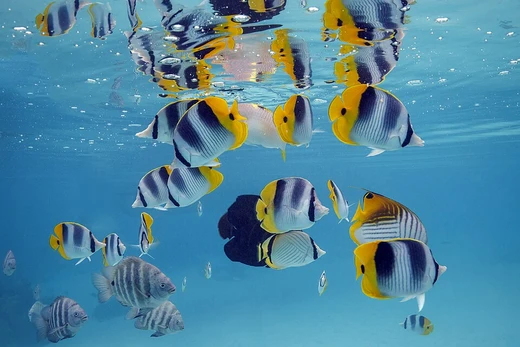
A butterflyfish with dusky yellow body and black-margined gold eye bar.

Chaetodon pelewensis goes by several common names, including dot dash butterflyfish, spotbanded butterflyfish, and punctato butterflyfish. This marine ray-finned fish belongs to the family Chaetodontidae and inhabits the western Pacific Ocean.
The body is a dusky yellow, marked with diagonal stripes that break into spots near the head and on the lower flanks. A black-margined gold vertical bar runs through the eye, and a black spot sits on the head. The fin margins are bright yellow, while the base of the caudal fin is bright orange. The dorsal fin has 13 to 14 spines and 22 to 25 soft rays; the anal fin has 3 spines and 17 to 18 soft rays. Maximum total length reaches 12.5 centimeters (4.9 inches).
Its range spans the southern Pacific from Papua New Guinea to the Tuamotu Archipelago. It is abundant on the Great Barrier Reef and in the Coral Sea, and in Australia it extends south to central New South Wales and Lord Howe Island.
This species lives on coral reefs at depths down to at least 45 meters (148 feet). Its diet consists largely of coral polyps and some benthic invertebrates. It is oviparous and monogamous, breeding in pairs. Occasionally it forms mixed pairs with the spotband butterflyfish (C. punctatofasciatus), and the two species are known to hybridize.
The Austrian ichthyologist Rudolf Kner first formally described Chaetodon pelewensis in 1868, giving the type locality as Palau (Pelew Inseln in German), though this was an error—the correct type locality is probably the Society Islands. The specific name reflects that mistaken designation. If the genus Chaetodon is split, this species is placed in the subgenus Exornator, which might become a subgenus of Lepidochaetodon.
It is commonly traded in the aquarium industry; between 1988 and 2002, over 12,000 individuals were traded.
Quick Facts
- Genus
- Chaetodon
- Parent
- Chaetodon (Exornator)
- Species
- pelewensis
Facts from the source article.
Lore & Background
Chaetodon pelewensis was first formally described in 1868 by Austrian ichthyologist Rudolf Kner, with the type locality given as Palau (Pelew Inseln) in the western Pacific, though this is considered an error and the correct type locality is probably the Society Islands. The specific name reflects this erroneous designation. The species is placed in the subgenus Exornator; if the genus Chaetodon is split up, Exornator might become a subgenus of Lepidochaetodon.
The fish has a dusky yellow body with diagonal stripes across the body and a black-margined gold vertical bar through the eye. A black spot is present on the head, and the stripes break up into spots toward the head and on the lower flanks. The fin margins are bright yellow, and the base of the caudal fin is bright orange. It attains a maximum total length of 12.5 cm. The dorsal fin has 13-14 spines and 22-25 soft rays, while the anal fin has 3 spines and 17-18 soft rays.
Chaetodon pelewensis is found across the southern Pacific Ocean from Papua New Guinea to the Tuamotu Archipelago. It is abundant on the Great Barrier Reef and in the Coral Sea, and in Australia it extends as far south as central New South Wales and Lord Howe Island. It inhabits coral reefs at depths of at least 45 meters, feeding largely on coral polyps and some benthic invertebrates. The species is oviparous and monogamous, breeding in pairs. Occasionally it forms mixed pairs with the spotband butterflyfish (C. punctatofasciatus), and these species are known to hybridise.
Reader's Guide
Chaetodon pelewensis is commonly found in the aquarium trade, with over 12,000 individuals traded between 1988 and 2002. Its popularity in aquaria stems from its striking coloration—dusky yellow body with diagonal stripes, black-margined gold eye bar, and bright yellow fin margins—making it a visually appealing species for marine hobbyists. Ecologically, it plays a role in coral reef ecosystems as a feeder on coral polyps and benthic invertebrates. Its monogamous breeding behavior and occasional hybridization with Chaetodon punctatofasciatus highlight its reproductive and evolutionary dynamics. The species' abundance on the Great Barrier Reef and in the Coral Sea underscores its significance in these regions. The taxonomic uncertainty regarding its type locality and subgeneric placement adds to its scientific interest, reflecting the complexities of butterflyfish classification. Overall, Chaetodon pelewensis is a well-documented species in both natural history and the aquarium trade, contributing to our understanding of reef fish diversity and human interaction with marine life.
Did You Know?
- Chaetodon pelewensis was first described in 1868 by Austrian ichthyologist Rudolf Kner.
- The type locality was erroneously given as Palau (Pelew Inseln); the correct locality is probably the Society Islands.
- This species occasionally forms mixed pairs with the spotband butterflyfish (C. punctatofasciatus) and can hybridize with it.
- Over 12,000 individuals of this species were traded in the aquarium industry between 1988 and 2002.
More in Butterflyfish, Part 2 1-24
Spotted an error? Know more?
Reader corrections go straight into our review queue. Suggest an edit · How this site is sourced