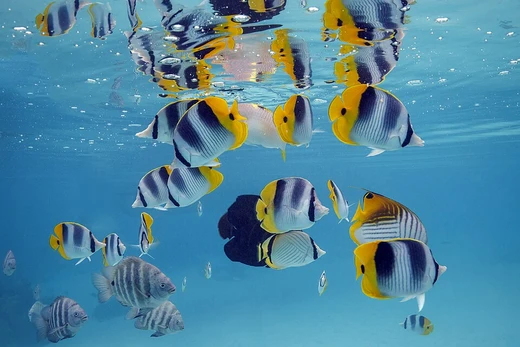
Chaetodon nippon
A common northwest Pacific butterflyfish with studied larval development.

Chaetodon nippon, commonly known as the Japanese butterflyfish, is a species of butterflyfish native to the northwest Pacific Ocean. It is notable for being one of the few butterflyfish species whose larval development has been studied, and for its observed spawning behavior in pairs rather than aggregations.
Quick Facts
- Genus
- Chaetodon
- Parent
- Chaetodon (Lepidochaetodon)
- Species
- nippon
Facts from the source article.
Lore & Background
The Japanese butterflyfish is a deep-bodied, vertically flattened fish with a creamy-brown body rimmed with dark brown. Juvenile fish possess an eyespot on the soft dorsal fin, which fades as they grow. It is particularly common around the Izu Islands and prefers rocky coastal reef habitats at depths between 5 and 20 metres, though it may also inhabit deeper water.
This species is omnivorous and benthic, feeding on polychaete worms, crabs, and other small invertebrates. It often moves in large or small groups. Unlike many butterflyfish that form spawning aggregations, the Japanese butterflyfish has been observed spawning in pairs.
Its larval development has been studied: upon hatching, larvae float upside down near the surface, begin swimming and feeding on zooplankton like oyster larvae after 72 hours, and when ready to settle, they are attracted to lights at night. At that time, their coloring rapidly transforms into that of juvenile fish.
Reader's Guide
Chaetodon nippon holds significance as a species with a fairly wide distribution across Japan, South Korea, the Philippines, and Taiwan, and is common especially around the Izu Islands. Its population appears stable, leading the International Union for Conservation of Nature to assess its conservation status as least concern. The species seldom appears in the aquarium trade, which may contribute to its stable wild population. Its ecological role as a benthic omnivore that consumes polychaete worms, crabs, and other small invertebrates places it within the rocky coastal reef food web. Notably, it is one of the few butterflyfish species whose larval development has been studied in detail, providing insights into early life stages including upside-down floating behavior, rapid onset of swimming and feeding, and nocturnal light attraction during settlement. Its observed pair spawning behavior contrasts with the aggregation spawning common among many other butterflyfish, adding to its biological distinctiveness.
Did You Know?
- Juveniles have an eyespot on the soft dorsal fin that fades as they grow.
- Larvae float upside down near the surface after hatching and begin swimming at 72 hours.
- It has been observed spawning in pairs, unlike many butterflyfish that form spawning aggregations.
Frequently Asked Questions
Who is Chaetodon nippon?
The Japanese butterflyfish is a small reef-dwelling species native to the northwest Pacific, topping out at roughly 15 cm in length. It is one of the more recognizable butterflyfish you'll encounter in that region.
What are Chaetodon nippon's fin counts?
This species carries 12 or 13 dorsal spines paired with 18 to 20 soft dorsal rays, while the anal fin has 3 spines and 15 or 16 soft rays. Those numbers are handy for telling it apart from look-alike species sharing the same reefs.
Where does Chaetodon nippon typically swim?
You'll usually find it hovering between 5 and 20 metres depth on coral reefs in the northwest Pacific. It stays in relatively shallow, sunlit zones rather than venturing into deeper water.
How does Chaetodon nippon reproduce?
Unlike most butterflyfish that gather in large groups to spawn, this species releases its gametes as a pair. That paired spawning strategy makes it a standout among its relatives.
Why do researchers care about Chaetodon nippon?
It is one of the very few butterflyfish whose larval stages have been documented in detail, giving scientists a rare window into early development within the family. That makes it a key reference point for understanding butterflyfish life cycles.
More in Butterflyfish, Part 2 1-24
Spotted an error? Know more?
Reader corrections go straight into our review queue. Suggest an edit · How this site is sourced