Bright Angel Lodge
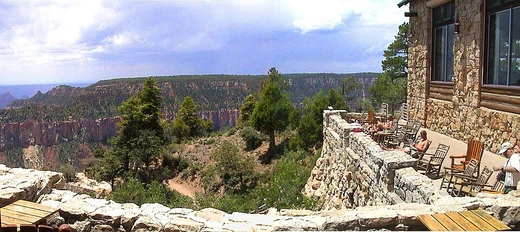
Rustic lodge complex on the South Rim of the Grand Canyon.
Last updated

via Wikipedia: Bright Angel Lodge · see source
Where it is
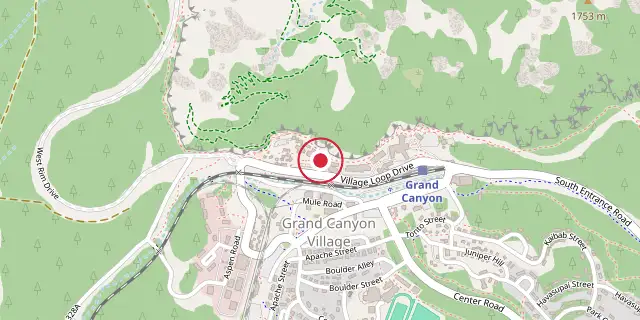
Coordinates: 36°03′25″N 112°08′28″W (36.0570, -112.1410) · Open in OpenStreetMap
Coordinates and connected clubs: the infobox of Wikipedia: Bright Angel Lodge (CC BY-SA 4.0). Map: drawn by Codexery from OpenStreetMap tiles.
Perched on the South Rim of the Grand Canyon in Arizona, Bright Angel Lodge is a rustic hotel complex made up of cabins clustered around a main building. Architect Mary Jane Colter designed the entire complex, which sits directly on the canyon’s edge. The lodge is a key part of the Grand Canyon Village National Historic Landmark District and, as of 2022, belongs to the Historic Hotels of America program.
History
The Bright Angel Lodge story begins in 1896, when James Thurber put up a small wood-frame hotel at the top of the Bright Angel Trail. He also ran a stagecoach line from the Grandview area to this new spot. Around the same time, Buckey O'Neill built a cabin nearby and called it O'Neill's Camp. After O'Neill died in Cuba during the Spanish–American War, Thurber took over the cabin.
He then added a tent camp for tourists and named the whole operation the Bright Angel Hotel and the Bright Angel Camps. Thurber later sold the business to Martin Buggeln, a hotelier from Williams, Arizona, just as the Grand Canyon Railroad was reaching the South Rim in September. The railroad, which controlled most of the land on the South Rim including the Bright Angel site, worked with Buggeln while building its own El Tovar Hotel right next door.
When the El Tovar opened in 1905, the railroad bought out Buggeln, renovated the older hotel, and replaced the tents with cabins. Unlike the El Tovar, which was marketed as a destination hotel, the Bright Angel aimed at a middle-class crowd. Meanwhile, a stagecoach stop called Red Horse Station, originally located about 16 miles south of the South Rim, was taken apart and moved by Ralph Cameron in 1902. He rebuilt it just west of the Buckey O'Neill Cabin, added a wood-frame second floor, and called it Cameron's Hotel.
From 1907, it housed the park's post office. By the 1930s, the Bright Angel needed an overhaul. The Atchison, Topeka and Santa Fe Railway, which owned the railroad and the South Rim concessions, brought in architect Mary Colter to design a replacement. Her first plans looked like her nearby Hermit's Rest and Lookout Studio, but the Park Service didn't want so much stone, so she switched to wood-frame construction.
Colter kept the O'Neill Cabin and the Red Horse Cabin—removing its odd second floor—and swapped the tent cabins for new rustic ones built from logs and local stone. The work was finished in 1935. To make sure the new complex blended into the landscape, Colter studied a scale model of the design.
Description
The main lodge building features a simple, low-pitched gable roof. At the front entrance, the roof extends to create a porch held up by peeled log posts. Shed-roofed additions give the structure a layered look. Inside, the walls use hand-adzed logs, adobe, and local limestone.
The stone in the fireplace is arranged to match the exact sequence of rock layers visible along the Bright Angel Trail in the Grand Canyon. Between the lodge and the canyon rim, semi-detached cabins are placed, some with direct canyon views. The cocktail lounge contains murals by Hopi artist Fred Kabotie.
Historic designation
Bright Angel Lodge and its cabins are significant contributing structures in the Grand Canyon Village National Historic Landmark District. The historic district was created in 1975 without Bright Angel Lodge, but was expanded in 1982 to include the lodge and its cabins. It had initially been left out because it had not reached the 50-year age threshold, but the 1982 nomination stated the complex had such exceptional significance that the requirement was waived.
More in Buildings and Structures in Grand Canyon National Park
Related in Buildings and Structures in Grand Canyon National Park
Links follow this subject's own source article.
Sources
Compiled from Wikipedia and the sources listed below. Text from Wikipedia is available under CC BY-SA 4.0; this entry is adapted from it.
- Wikipedia: Bright Angel Lodge (CC BY-SA 4.0).
Spotted an error? Know more?
Reader corrections go straight into our review queue. Suggest an edit · How this site is sourced