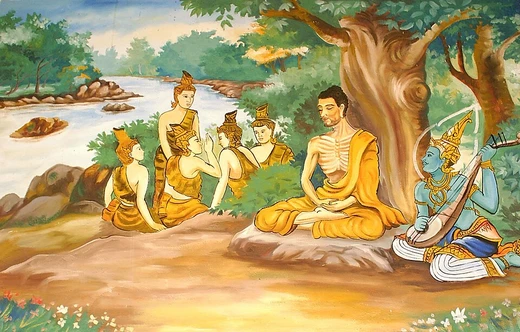
Sumedha
Previous life of Gotama Buddha who vowed to become a Buddha.

Sumedha is the name given to a past existence of Gotama Buddha (also known as Gautama in Sanskrit), during which he formally expressed his aspiration to achieve Buddhahood. According to Buddhist accounts, this event occurs while Gotama is still a bodhisatta (Pāli) or bodhisattva (Sanskrit)—a being on the path to enlightenment. This life is traditionally regarded as the starting point of the long spiritual journey that culminates in Gotama’s final lifetime as a fully awakened Buddha, a process that unfolds across many successive rebirths.
Born into a brahmin family, Sumedha eventually renounces worldly life and becomes an ascetic dwelling in the mountains. While there, he encounters the Buddha Dīpankara (Sanskrit: Dīpaṃkara). In an act of devotion, Sumedha prostrates himself in the mud, spreading his hair, deer skin, and bark garment as a bridge for Dīpankara to walk across. During this self-sacrifice, he makes a solemn vow to become a Buddha himself in a future life. Dīpankara confirms this intention with a prophecy.
This encounter is the earliest known Buddhist story dealing with the bodhisatta path and has been described as the Theravādin interpretation of that ideal. It is the most detailed account of any of the Buddha’s past lives and one of the most frequently depicted narratives in Buddhist art. The story appears in many Theravādin temples and is referenced in countless Buddhist works. Theravāda Buddhists have often cited Sumedha’s story as an example of selfless service.
**Origins**
The life of Sumedha is recorded in the Pāli *Buddhavaṃsa* and *Jātaka*, the latter drawing on the former. Sanskrit textual traditions also contain accounts of Sumedha, and these are very similar to the Pāli versions. This close resemblance has led Indologists Kenneth Norman and Richard Gombrich to argue that the accounts date back to pre-sectarian Buddhism, possibly as early as a century after the Buddha’s death. However, Buddhist studies scholar Jan Nattier points out that Dīpankara Buddha does not appear in the earliest Pāli discourses (suttas), suggesting that traditions about him only emerged several centuries later. Scholar Naomi Appleton notes that parts of the biographical material were “fixed no later than the sixth century CE.”
Chinese Buddhist pilgrims, such as Faxian (337–c.
Quick Facts
- Honorific Prefix
- Ascetic
- Religion
- Buddhism
- Known For
- The previous life of Gotama Buddha, when he first declared the wish to become a Buddha
- Education
- Vedic
- Home Town
- Amaravatī, India
- Teacher
- Dīpankara Buddha
Facts from the source article.
Lore & Background
In Buddhist texts, Sumedha is born in a brahmin family in Amaravatī. After realizing life is full of suffering, he donates his wealth and becomes an ascetic living on Dhammaka mountain in the Himalayas, developing great yogic power. One day, while traveling to Rammavatī, he sees people preparing a road for Dīpankara Buddha. Unable to finish his section in time, Sumedha prostrates himself in the mud, spreading his hair, deer skin, and bark garment as a human bridge for Dīpankara and his monks to cross unsullied. During this sacrifice, he pronounces a vow that he too will become a Buddha in a future lifetime.
Reader's Guide
Sumedha's story is the oldest Buddhist story known that deals with the path of a bodhisatta, and has been described as the Theravādin interpretation of this ideal. It is the most detailed story of a previous life of the Buddha and one of the most popular in Buddhist art, depicted in many Theravādin temples and alluded to in innumerable Buddhist works. Theravāda Buddhists have often raised Sumedha's story as an example of selfless service. The encounter between Sumedha and Dīpankara Buddha is described in the Pāli Buddhavaṃsa and Jātaka, with similar accounts in Sanskrit traditions. Indologists Kenneth Norman and Richard Gombrich argue the accounts date back to pre-sectarian Buddhism, possibly a century after the Buddha, though Jan Nattier notes Dīpankara's absence in earliest Pāli discourses suggests later development. Chinese pilgrims like Faxian identified the meeting place as Nagarāhāra (Afghanistan), and most depictions have been found in Gandhāra, suggesting the story developed there. The motif of spreading hair also appears in Ajantā and Nālandā areas.
Did You Know?
- Sumedha's life is said to have taken place four 'incalculable eons' and a hundred thousand normal eons ago.
- The story is described in the Pāli Buddhavaṃsa and Jātaka, the latter based on the former.
- Chinese pilgrim Faxian (337–c.422 CE) identified the meeting place as Nagarāhāra (Afghanistan), now Nangarhar.
- In several Chinese texts and the Sanskrit Mahāvastu, Sumedha is called Megha.
More in Buddhist mythology 1-24
Spotted an error? Know more?
Reader corrections go straight into our review queue. Suggest an edit · How this site is sourced