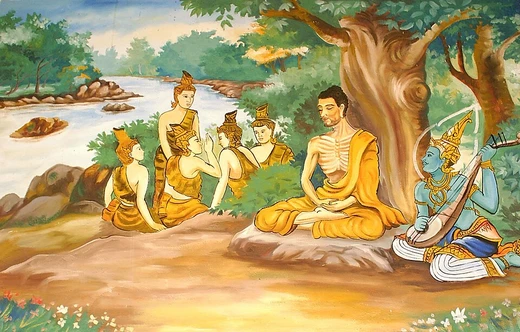
Golden-Nosed White-Haired Mouse Spirit
A mouse spirit who sought to marry Tang Sanzang.

Palgrave, Francis Turner, 1824-1897 · Public domain
The Golden-Nosed White-Haired Mouse Spirit (Chinese: 金鼻白毛老鼠精; pinyin: Jīnbí Báimáo Lǎoshǔ Jīng), also called Lady Earth Flow and Half-Guanyin, is a yaoguai from the 16th-century Chinese novel *Journey to the West*. She tries to seduce and marry the monk Tang Sanzang so she can absorb his yang essence. She also claims Heavenly King Li Jing as her godfather and Nezha as her godbrother.
In the novel, the Mouse Spirit first cultivated her powers at Vulture Peak, where she stole and ate the Buddha’s fragrant flowers and candles. Li Jing and Nezha were sent to capture her, but the Buddha ordered them to spare her life. She then adopted Li Jing as her godfather and Nezha as her godbrother, setting up memorial tablets for them in her home. She later made her lair in the Bottomless Pit at Trap-Hollow Mountain.
During the pilgrims’ journey, she disguised herself as a woman tied to a tree in the Black Pine Forest. Tang Sanzang brought her to the Zhenhai Temple, where she killed and ate several monks before abducting him and taking him to the Bottomless Pit. She tried to force him to marry her so she could gain his vital essence and become a Taiyi Golden Immortal, one of the highest spiritual ranks. When Sun Wukong entered the pit to rescue Tang Sanzang, he found the tablets for Li Jing and Nezha. He took them to Heaven and confronted Li Jing, who initially did not remember her until Nezha reminded him. Li Jing and Nezha then went to the pit with heavenly soldiers, captured the Mouse Spirit, and took her away.
The Mouse Spirit’s origins are linked to a legend from the ancient Kingdom of Khotan, recorded by the monk Xuanzang in the *Great Tang Records on the Western Regions*. That text describes a golden Rat King at a place called the Rat Mound. When a Xiongnu army invaded Khotan, the king prayed to the Rat King, and rats gnawed through the invaders’ bowstrings and saddle straps, leaving them unable to fight. The Khotanese built a temple in honor of the Rat King. A modern Chinese account connects this legend to the Mouse Spirit, especially her golden nose and white hair.
Her relationship with Li Jing is tied to Buddhist traditions about Vaiśravaṇa, the Guardian of the North. Zhu Gang traces this to Tang dynasty texts about the monk Yixing, where Vaiśravaṇa helps the Tang army by sending divine golden rats to destroy enemy equipment.
Quick Facts
- Series
- Journey to the West
- First
- Chapter 82
- Alias
- Lady Earth Flow; Half-Guanyin
- Species
- Mouse
- Family
- Heavenly King Li Jing (godfather); Nezha (godbrother)
- Weapon
- Twin swords (双股剑)
Facts from the source article.
Lore & Background
The Mouse Spirit originally cultivated her powers at Vulture Peak, where she stole and consumed the Buddha's fragrant flowers and candles. Heavenly King Li Jing and Nezha were sent to capture her, but the Buddha ordered them to spare her life. She subsequently recognized Li Jing as her godfather and Nezha as her godbrother, establishing memorial tablets for them at her residence. She later established her residence in the Bottomless Pit at Trap-Hollow Mountain.
During the pilgrims' journey, the Mouse Spirit disguises herself as a woman bound to a tree in the Black Pine Forest. Tang Sanzang takes her to the Zhenhai Temple, where she kills and eats several monks before abducting him and taking him to the Bottomless Pit. She attempts to force Tang Sanzang to marry her so that she can obtain his vital essence and attain the status of a Taiyi Golden Immortal. When Sun Wukong enters the Bottomless Pit to rescue Tang Sanzang, he discovers the memorial tablets dedicated to Li Jing and Nezha. He takes the tablets to Heaven and confronts Li Jing. Li Jing and Nezha then go to the Bottomless Pit with heavenly soldiers, capture the Mouse Spirit, and take her away.
Reader's Guide
The Golden-Nosed White-Haired Mouse Spirit is a significant antagonist in Journey to the West, embodying themes of deception, desire, and supernatural hierarchy. Her attempt to marry Tang Sanzang to consume his yang essence reflects a common motif in Chinese folklore where spirits seek immortality through human vitality. Her connection to Heavenly King Li Jing and Nezha, established through a prior encounter at Vulture Peak, introduces a complex relationship between divine authority and demonic beings. The spirit's origins have been linked to a legend from the ancient Kingdom of Khotan recorded by the monk Xuanzang in the Great Tang Records on the Western Regions, describing a golden Rat King that aided the Khotanese against a Xiongnu invasion. This association, along with Buddhist traditions concerning Vaiśravaṇa, the Guardian of the North, and Tang dynasty texts about divine golden rats, suggests a layered cultural background. In folk culture, the Mouse Spirit's story has been combined with the Chinese 'Mouse Bride' tradition, as seen in New Year prints such as the Suzhou Taohuawu print 'Wudong Laoshujianü' and a Shanghai Xiaojiaochang print, which merge the Journey to the West narrative with the folk theme of a mouse seeking a powerful husband.
Did You Know?
- The Mouse Spirit is also known as Lady Earth Flow and Half-Guanyin.
- Sun Wukong discovered memorial tablets dedicated to Li Jing and Nezha in the Bottomless Pit.
- The Mouse Spirit's story has been linked to a legend from the ancient Kingdom of Khotan about a golden Rat King.
Origins and the Vulture Peak Incident
The Mouse Spirit's backstory begins at Vulture Peak, the sacred site of the Buddha, where she cultivated her spiritual powers. There, she committed the audacious act of stealing and consuming the Buddha's fragrant flowers and candles—offerings meant for the highest spiritual being. When the transgression was discovered, the Heavenly King Li Jing and the deity Nezha were dispatched to capture her. However, the Buddha intervened, ordering both warriors to spare her life. This act of mercy created a lasting bond: the Mouse Spirit recognized Li Jing as her godfather and Nezha as her godbrother, and she set up memorial tablets in their honor at her dwelling. She eventually settled in the Bottomless Pit, a cavern beneath Trap-Hollow Mountain, where she would later carry out her most notorious scheme. Her alternate names—Lady Earth Flow and Half-Guanyin—hint at her earthy nature and her partial resemblance to the compassionate bodhisattva, a detail that underscores her deceptive, seductive character.
The Seduction and Abduction Plot
During the pilgrims' westward journey, the Mouse Spirit devised an elaborate trap in the Black Pine Forest. She disguised herself as a helpless woman bound to a tree, exploiting Tang Sanzang's boundless compassion. The monk, true to his merciful nature, took her in and brought her to the Zhenhai Temple. There, the spirit revealed her true nature, killing and consuming several monks before abducting Tang Sanzang himself and dragging him to the Bottomless Pit. Her ultimate goal was not mere sustenance but spiritual transcendence: by forcing Tang Sanzang into marriage, she intended to consume his yang essence and elevate herself to the rank of Taiyi Golden Immortal, one of the highest attainments available to a spiritual being. This scheme reveals the Mouse Spirit as a creature driven by ambition and predatory desire, using the monk's own virtue as the very instrument of his capture.
The Heavenly Reckoning
When Sun Wukong descended into the Bottomless Pit to rescue his master, he stumbled upon a detail that changed the course of the confrontation: memorial tablets bearing the names of Li Jing and Nezha. Recognizing the significance, the Monkey King carried the tablets to Heaven and confronted the Heavenly King directly. Li Jing initially claimed no memory of the Mouse Spirit, but Nezha jogged his recollection of the Vulture Peak incident and the Buddha's order to spare her. With the connection reestablished, Li Jing and Nezha assembled a force of heavenly soldiers and descended upon the Bottomless Pit. They captured the Mouse Spirit and removed her from the mortal realm. The episode highlights a recurring theme in Journey to the West: that even the most cunning earthly spirits ultimately answer to a higher celestial hierarchy, and that past acts of mercy can create obligations that outlast the original encounter.
Folk Roots and Cultural Echoes
The Mouse Spirit does not exist in a literary vacuum; she is deeply rooted in older Chinese folk traditions. The 'Mouse Bride' or 'Mouse Marriage' motif—where a mouse family seeks a powerful husband for their daughter, only to end with the cat devouring the bride—appears across Chinese folk culture and New Year popular art. Li Tianfei traces a related thread to the Tang-period Guangyi Ji, where a mouse spirit takes a human woman as a wife, paralleling the Mouse Spirit's attempt to marry Tang Sanzang. These traditions merged in later New Year prints: a Suzhou Taohuawu print titled 'Mouse Bride of the Bottomless Pit' depicts the spirit bribing the Old Cat King as matchmaker while Guanyin appears as a cat spirit to defeat her. A Shanghai Xiaojiaochang print similarly fuses the Journey to the West narrative with the Mouse Bride theme. Additionally, the character's golden nose and white hair have been linked by modern scholars to the ancient Khotanese legend of a golden Rat King whose rats gnawed through Xiongnu bowstrings, a story recorded by the monk Xuanzang himself.
Gallery
Frequently Asked Questions
Who is the Golden-Nosed White-Haired Mouse Spirit?
She is a female mouse yaoguai from the 16th-century novel Journey to the West, also known by the titles Lady Earth Flow and Half-Guanyin. She appears as a seductive demon whose target is the pilgrim monk Tang Sanzang.
What are the Golden-Nosed White-Haired Mouse Spirit's powers and goals?
She originally honed her abilities at Vulture Peak by stealing and consuming the Buddha's fragrant flowers and candles. Her central aim in the plot is to lure Tang Sanzang into marriage so she can drain his yang essence and further her own cultivation.
Why is the Golden-Nosed White-Haired Mouse Spirit significant in Journey to the West?
She stands out as one of the novel's most memorable female antagonists, blending seduction, quasi-divine lineage, and a direct threat to the pilgrimage's central figure. Her episode tests Tang Sanzang's monastic vows and illustrates how the heavenly hierarchy handles a rogue spirit with familial ties.
What is the Golden-Nosed White-Haired Mouse Spirit's connection to Li Jing and Nezha?
She claims Heavenly King Li Jing as her godfather and the deity Nezha as her godbrother, which grants her a quasi-divine standing within the celestial court. This familial bond is precisely why the Buddha sends that specific father-and-son pair to capture her rather than other heavenly warriors.
More in Buddhist mythology 1-24
Spotted an error? Know more?
Reader corrections go straight into our review queue. Suggest an edit · How this site is sourced