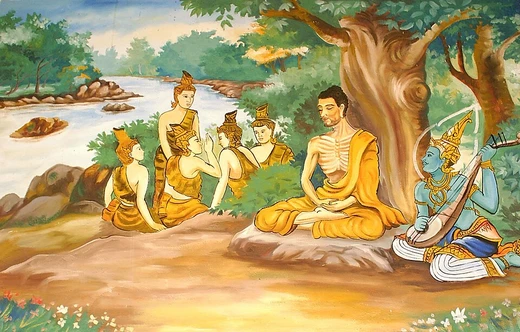
Bayon
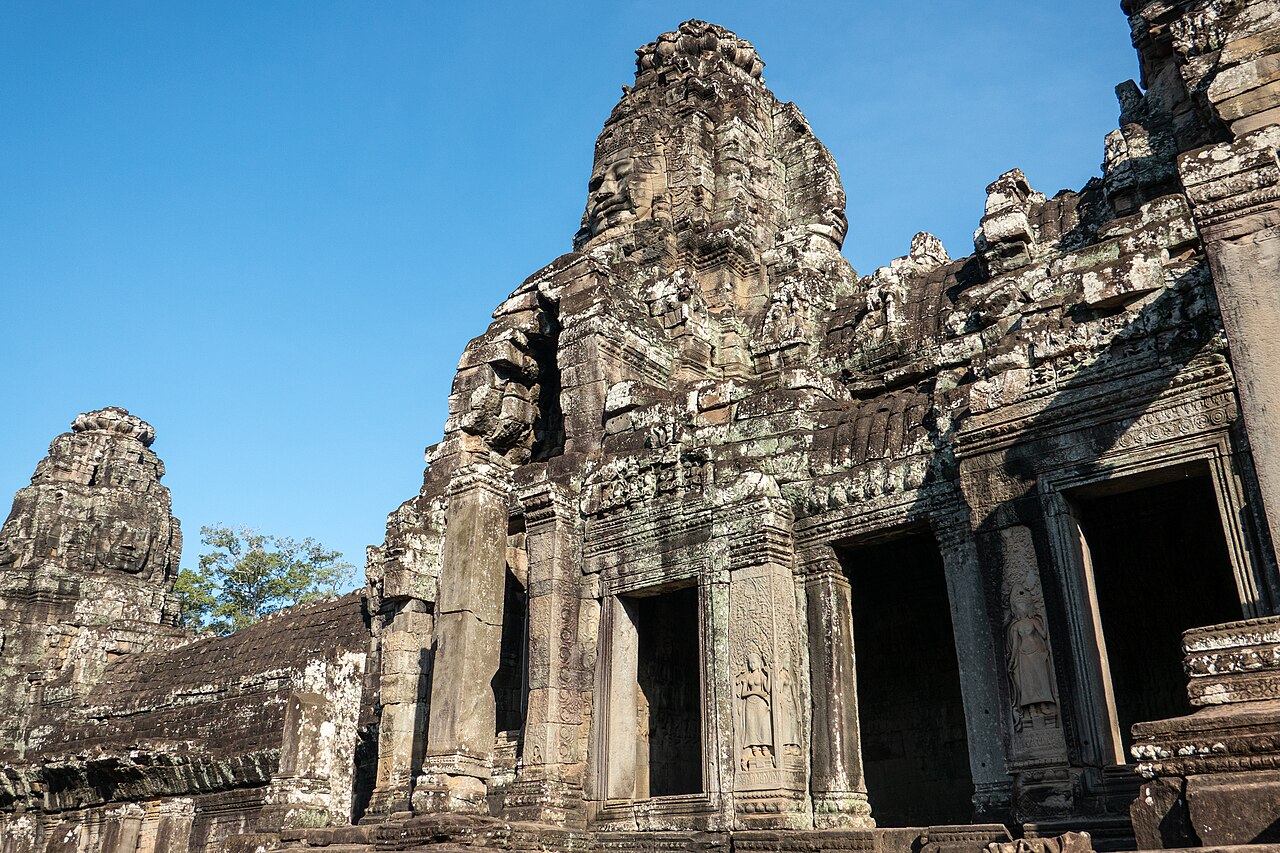
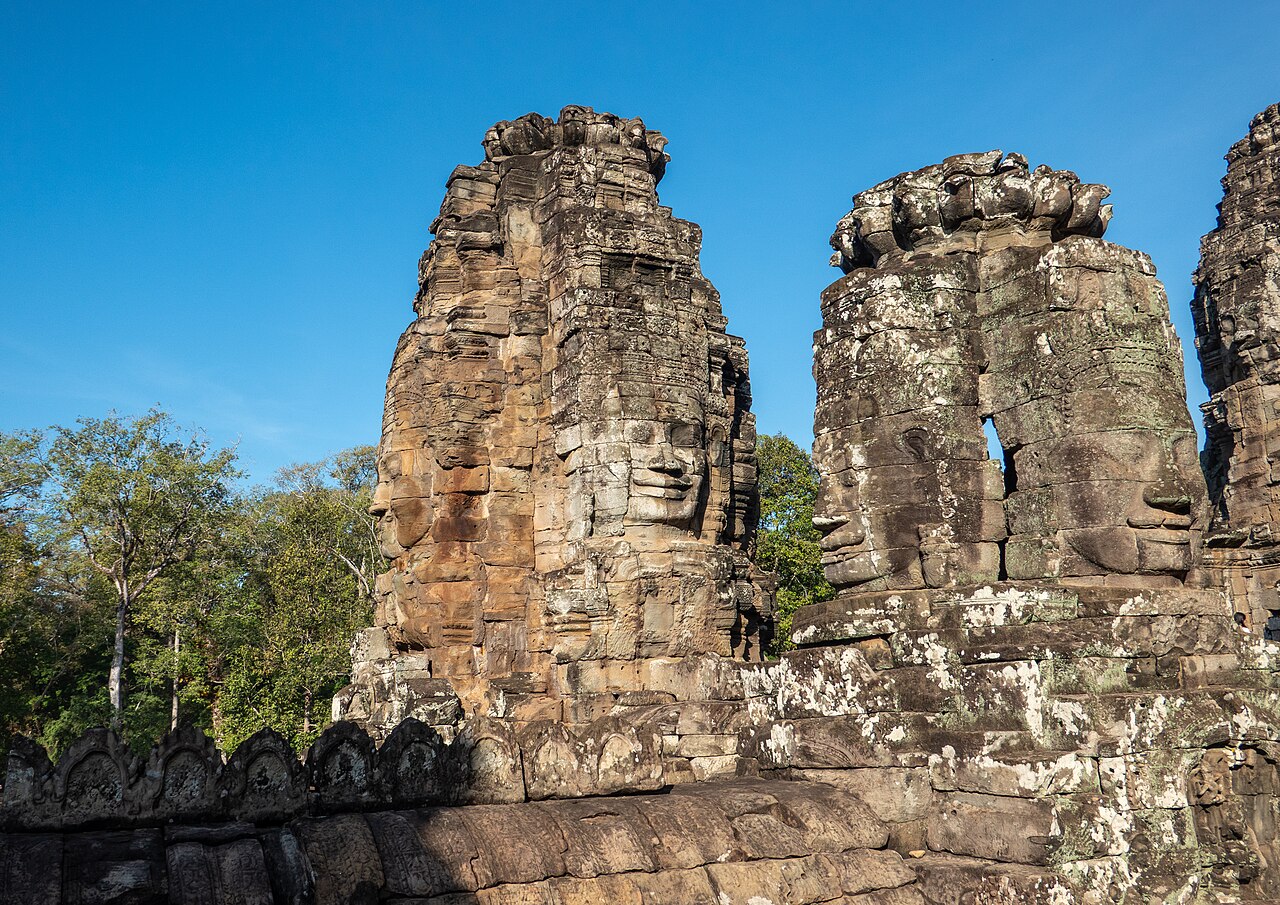
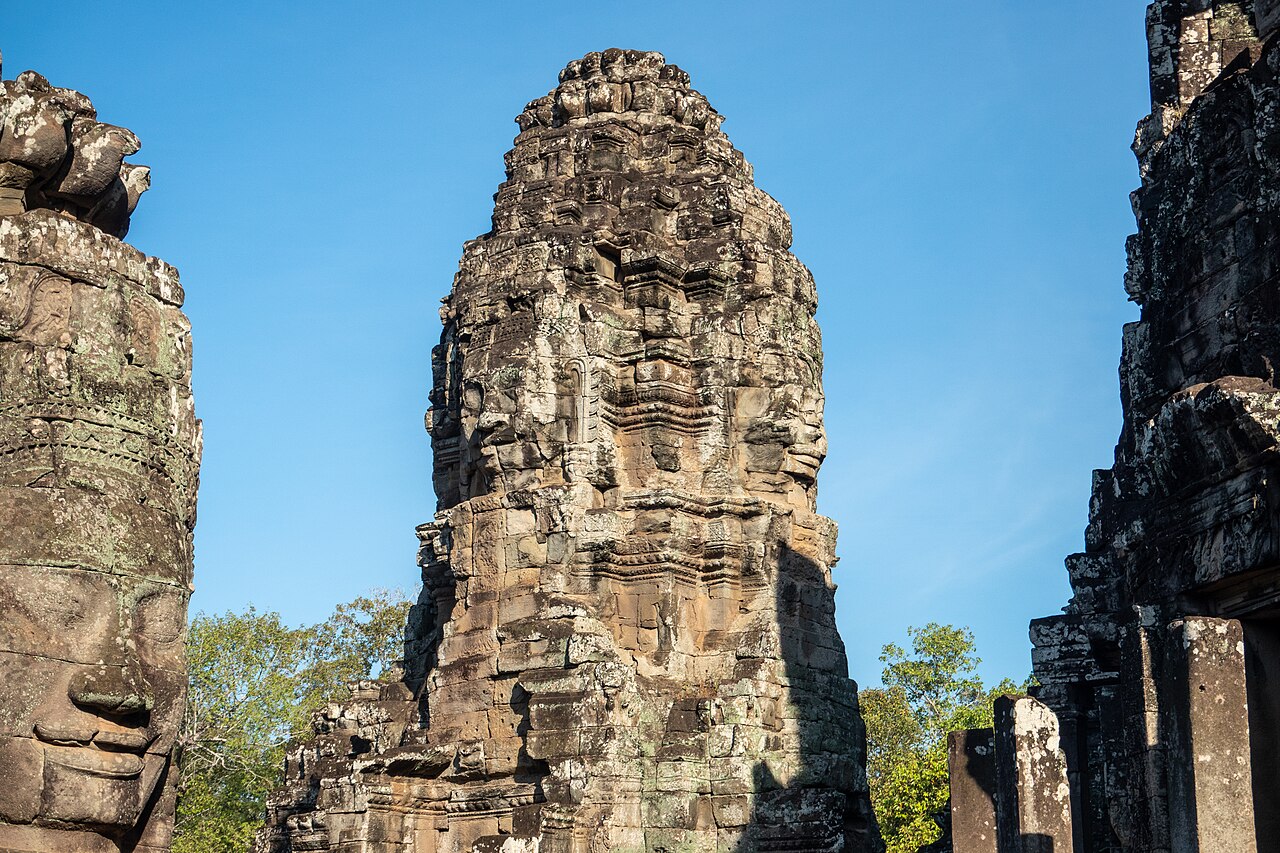
The Bayon: a richly decorated Theravada Buddhist temple at Angkor, known for its serene stone faces and extensive bas-reliefs.

No(0)GoodNamesLeft · CC BY-SA 4.0
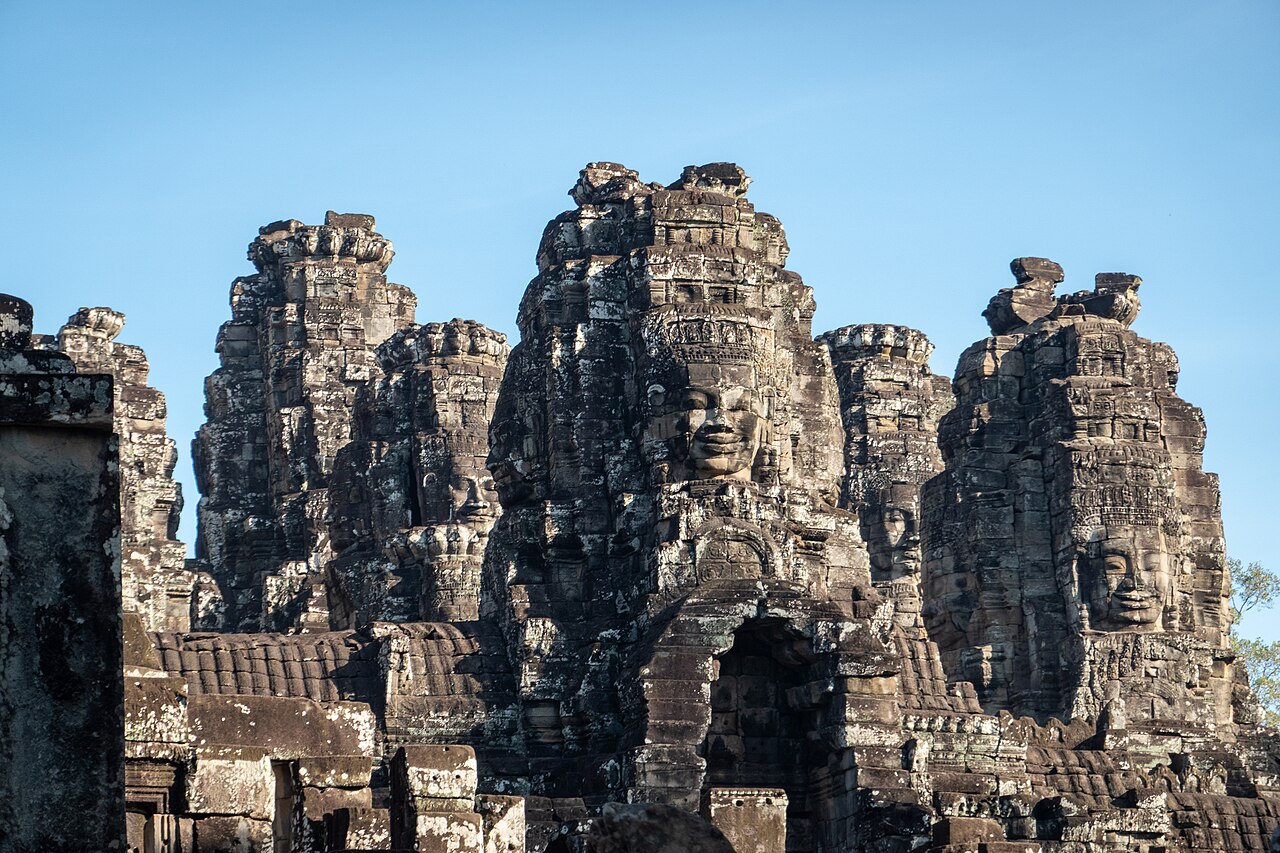
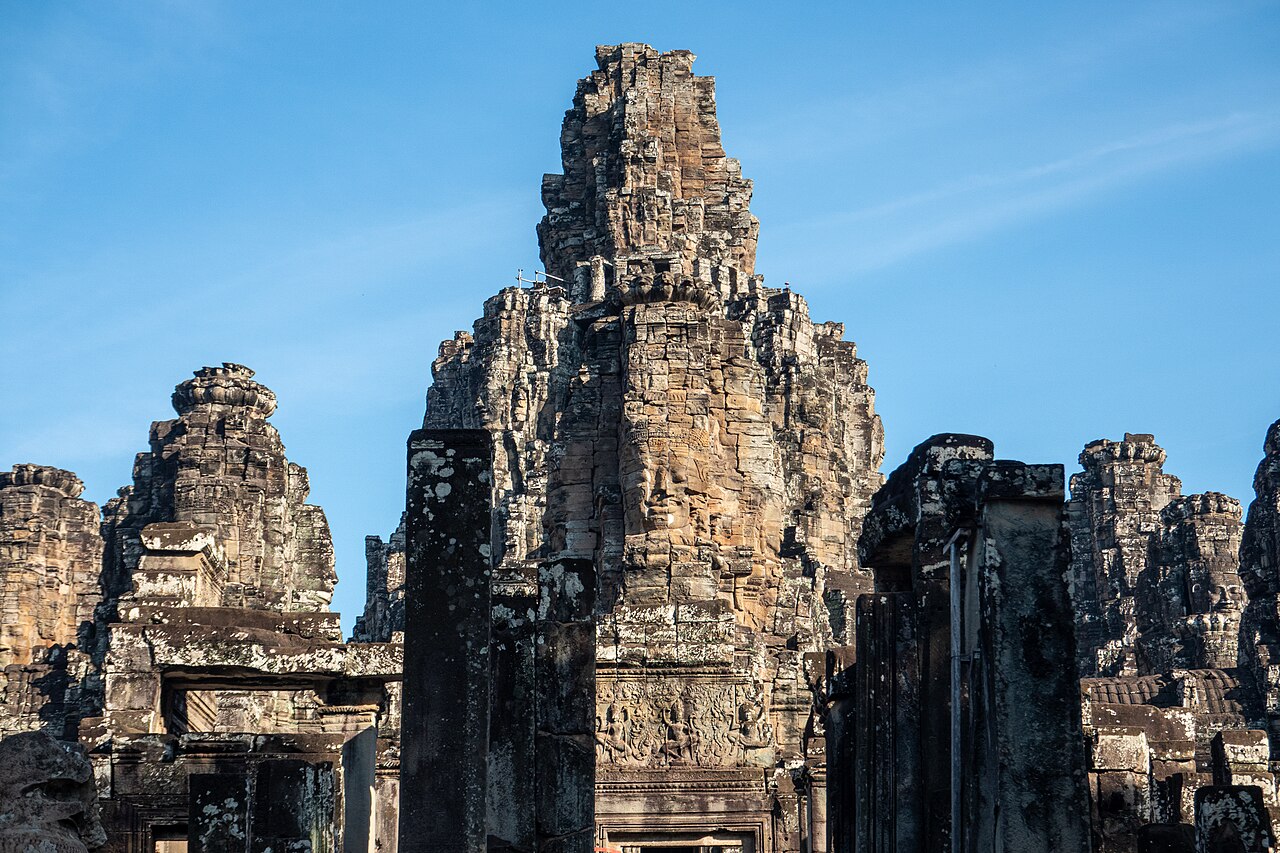
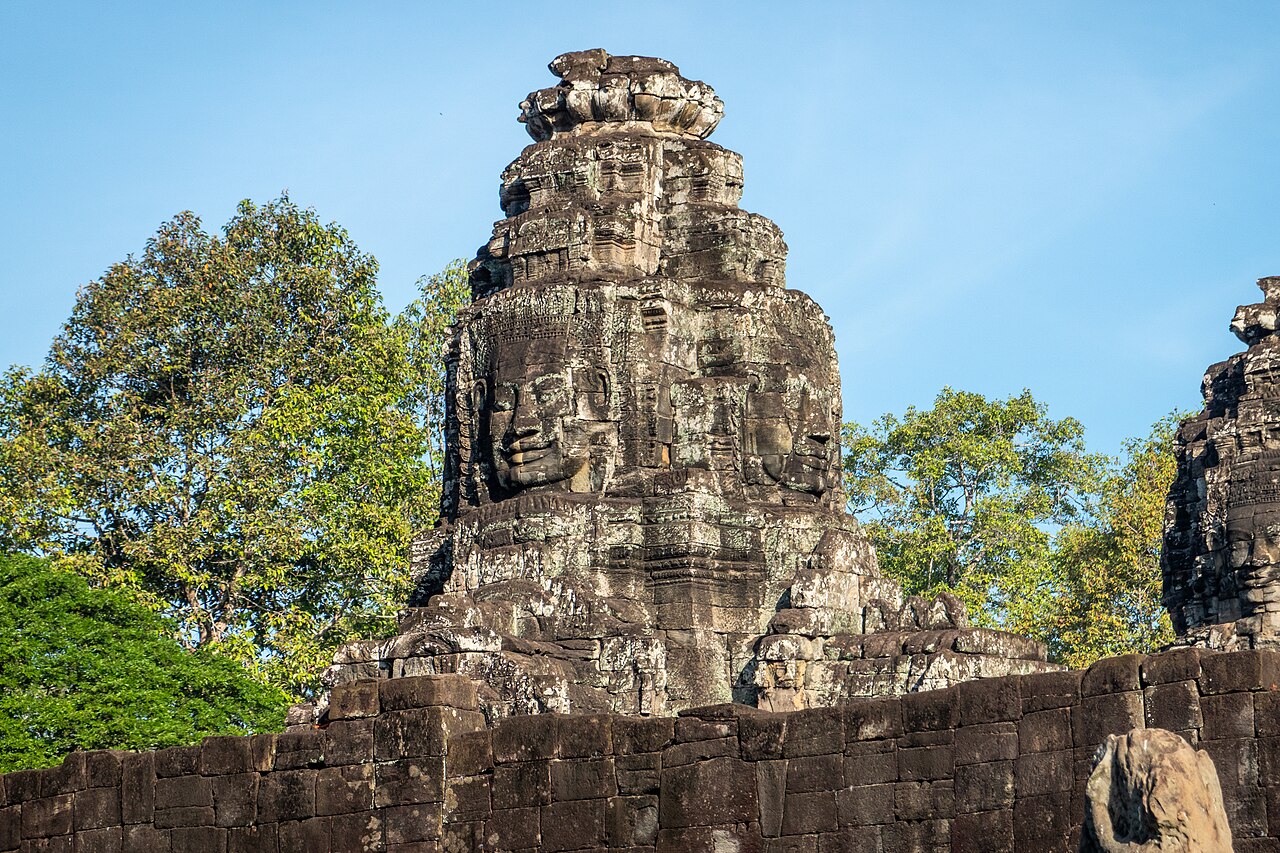
The Bayon, a Theravada Buddhist temple from the Khmer Empire, sits at the heart of Angkor Thom in Cambodia. King Jayavarman VII built it as his state temple in the late 12th or early 13th century. The temple was first a Mahayana Buddhist monument focused on the Bodhisattva of compassion, but later changed to reflect the rise of Theravada Buddhism in the region. Its layout, carvings, and themes of compassion and kingship show how Buddhism and royal power were linked at Angkor, and its ongoing use as a Buddhist site highlights Buddhism’s lasting impact there. The Bayon is famous for its many towers, each covered with calm, smiling stone faces on all sides. Most scholars think these faces represent King Jayavarman VII, symbolizing both compassion and royal authority. The temple also has large bas-reliefs that show historical events, religious stories, and everyday life in the Khmer Empire, making it a key source for understanding Angkorian society.
Quick Facts
- Native Name
- Jayagiri (Chey Kiri)
- Country
- Cambodia
- Location
- Angkor Thom
- Deity
- Avalokiteshvara, Hevajra (Jayagiri)
- Sect
- Theravada
- Architecture
- Bayon
- Completed
- End of the 12th century CE
- Creator
- Jayavarman VII
- Religious Affiliation
- Buddhism
Facts from the source article.
Lore & Background
The original name for the Bayon is Jayagiri (or 'Victory Mountain' or 'Mountain of Brahma'; 'Jaya' - another name of Brahma and 'giri' to mountain), with Sanskrit roots similar to Sīnhāgiri ('Lion Rock'). The name of Bayon was given by Etienne Aymonier in 1880. According to his report, Bayon was the Latin transliteration of what he had seen written in Khmer as 'Bayânt' which he presumed must have been a corrupted form of the Pali Vejayant or Sanskrit Vaijayant, the name of the celestial palace of Indra of which the Bayon was presumed to be the earthly reflection. The first syllable Ba as a Sanskritic prefix was similar to that found in other places such as Ba Phnom and could signify the presence of a protector or defensor. The similarity of the 216 gigantic faces on the temple's towers to other statues has led many scholars to the conclusion that the faces are representations of Jayavarman VII, himself. Scholars have theorized that the faces belong to Avalokitesvara, the bodhisattva of compassion. But some locals believe the temple was built for Brahma, since the faces have four sides, representing Brahma's four faces. Also, the faces have three eyes, which symbolizes Shiva in the Trimurti. Buddha's images seldom wear jewelry like necklaces, large earrings and a crown. The two hypotheses need not be regarded as mutually exclusive. Angkor scholar George Coedès has theorized that Jayavarman VII stood squarely in the tradition of the Khmer monarchs in thinking of himself as a devaraja (god-king), the difference being that while his predecessors were Hindus and associated themselves with Brahma and his symbol the chaturmukha (four faces), Jayavarman VII was a Buddhist. The outer wall of the outer gallery features a series of bas-reliefs depicting historical events and scenes from the everyday life of the Angkorian Khmer. Though highly detailed and informative in themselves, the bas-reliefs are not accompanied by any sort of epigraphic text, and for that reason considerable uncertainty remains as to which historical events are portrayed and how, if at all, the different reliefs are related.
Reader's Guide
The temple is oriented towards the east, and so its buildings are set back to the west inside enclosures elongated along the east-west axis. Because the temple sits at the exact centre of Angkor Thom, roads lead to it directly from the gates at each of the city's cardinal points. The temple itself has no wall or moats, these being replaced by those of the city itself: the city-temple arrangement, with an area of 9 square kilometres, is much larger than that of Angkor Wat to the south (2 km²). Within the temple itself, there are two galleried enclosures (the third and second enclosures) and an upper terrace (the first enclosure). All of these elements are crowded against each other with little space between. Unlike Angkor Wat, which impresses with the grand scale of its architecture and open spaces, the Bayon 'gives the impression of being compressed within a frame which is too tight for it.'
Did You Know?
- The Bayon was the last state temple to be built at Angkor, and the only Angkorian state temple to be built primarily to worship Buddhist deities.
- The Japanese Government Team for the Safeguarding of Angkor (JSA) has described the Bayon as 'the most striking expression of the baroque style' of Khmer architecture.
- Since the time of Jayavarman VII, the Bayon has undergone numerous Buddhist additions and alterations at the hands of subsequent monarchs.
Royal Theology and the Faces of Compassion
The Bayon stands as the sole Angkorian state temple constructed primarily for the worship of Buddhist deities, making it a singular monument in the empire's architectural history. Built in the late twelfth or early thirteenth century as the centerpiece of King Jayavarman VII's vast program of public works, the temple was originally conceived around the Mahayana cult of Avalokitesvara, the bodhisattva of compassion. The 216 enormous stone faces carved into the towers, visible on all four sides, have long been interpreted as portraits of Jayavarman VII himself, embodying both royal authority and Buddhist mercy. Scholar George Coedès argued that the king maintained the traditional Khmer devaraja concept of the god-king, but where his Hindu predecessors identified with Brahma's four faces, Jayavarman VII channeled that same symbolic power through a Buddhist lens. Some local traditions, however, see the four-sided faces and three eyes as references to Brahma and Shiva, suggesting the iconography may deliberately layer multiple theological readings. The temple's later adaptation to Theravada Buddhism further testifies to the enduring entanglement of faith and kingship at Angkor.
Compressed Grandeur and the Baroque Temple
Where Angkor Wat commands the landscape with its sweeping open courtyards and monumental scale, the Bayon achieves its power through density and compression. Oriented toward the east, the temple's enclosures are packed tightly together with minimal breathing room between them, creating what observers have described as a structure squeezed inside a frame too small for its contents. This crowding of galleried enclosures and the upper terrace produces an overwhelming visual effect that the Japanese Government Team for the Safeguarding of Angkor has characterized as the most striking expression of the baroque style in Khmer architecture, a deliberate contrast to the classical elegance of Angkor Wat. The temple sits at the precise geometric center of Angkor Thom, with roads converging from each of the city's four cardinal gates. Rather than possessing its own walls and moats, the Bayon borrows the defensive perimeter of the city itself, a nine-square-kilometer area dwarfing Angkor Wat's two. This city-temple integration means the sacred structure is inseparable from the urban fabric, a design philosophy unique among Angkorian state temples.
A Temple Rewritten by Successive Faiths
The Bayon's religious identity has never been static. Conceived under Jayavarman VII as a Mahayana Buddhist monument devoted to the bodhisattva of compassion, the temple was fundamentally altered when his successor Jayavarman VIII restored Hinduism as the state religion in the mid-thirteenth century, and the sanctuary was reoriented accordingly. Centuries later, the rise of Theravada Buddhism across Cambodia prompted yet another round of modifications, adding features such as the eastern terrace, the libraries, the squared corners of the inner gallery, and portions of the upper terrace—none of which belonged to the original architectural plan. After these successive religious reconfigurations, the temple was eventually surrendered to the jungle. The original name, Jayagiri, meaning Victory Mountain or Mountain of Brahma, already hints at a Hindu layer beneath the Buddhist surface. The name Bayon itself was not assigned until 1880, when Etienne Aymonier encountered the Khmer rendering Bayânt and linked it to the Pali or Sanskrit name of Indra's celestial palace, suggesting the temple was meant as an earthly mirror of a heavenly dwelling.
Stone Chronicles Without Words
The outer gallery of the Bayon carries an extensive program of bas-reliefs that depict historical events, religious narratives, and the rhythms of daily life in the Khmer Empire, making the temple one of the richest visual archives for understanding Angkorian society. Yet these carvings present a persistent scholarly challenge: they are accompanied by no epigraphic text, no inscriptions to identify the figures, date the scenes, or explain the sequence of events. This absence of written context leaves considerable uncertainty about which specific historical episodes are portrayed and how the individual reliefs relate to one another. The faces on the towers, meanwhile, wear jewelry—necklaces, large earrings, and crowns—that is atypical of standard Buddhist iconography, a detail that has fueled debate over whether they represent the king, the bodhisattva Avalokitesvara, or even Hindu deities. The temple's iconography, spatial logic, and emphasis on compassion intertwined with sovereign power together document the inseparability of religion and royal authority in the Angkorian world, preserving in stone a civilization's self-image across multiple centuries of shifting belief.
Gallery
Frequently Asked Questions
What is the Bayon?
The Bayon is a Mahayana Buddhist temple complex located at the very center of Angkor Thom in Cambodia. It was constructed in the late 12th or early 13th century as the official state temple of King Jayavarman VII.
What are the famous stone faces on the Bayon?
The temple's towers are encrusted with 216 enormous, gently smiling faces carved on every side. These are widely understood to be portraits of Jayavarman VII, fusing the image of a compassionate ruler with the authority of the throne.
Who built the Bayon and what was its original name?
King Jayavarman VII commissioned the structure as the spiritual heart of his capital. Its original name, Jayagiri, translates to 'Victory Mountain,' reflecting its role as a monument to his reign.
What is the Bayon's religious significance?
It was originally consecrated to the Bodhisattva of compassion within the Mahayana Buddhist framework. Over time, as Theravada Buddhism became the dominant tradition in Cambodia, the site was re-adapted to serve that school.
Why is the Bayon considered important in Buddhist and Khmer history?
It physically anchors the center of Angkor Thom and represents a rare fusion of Mahayana devotional art with Khmer royal ideology. Its serene, all-seeing faces have made it one of the most iconic symbols of Southeast Asian Buddhist statecraft.
More in Buddhist mythology 1-24
Spotted an error? Know more?
Reader corrections go straight into our review queue. Suggest an edit · How this site is sourced