Diyu
Chinese mythological realm of the dead for atonement and reincarnation.

周漢 · Public domain
Diyu (地獄, meaning "earth prison") is the Chinese mythological realm of the dead, often described as a kind of hell. Its concept blends the Buddhist idea of Naraka with traditional Chinese afterlife beliefs and later popular reinterpretations of both. In some ways, it resembles the Christian notion of purgatory.
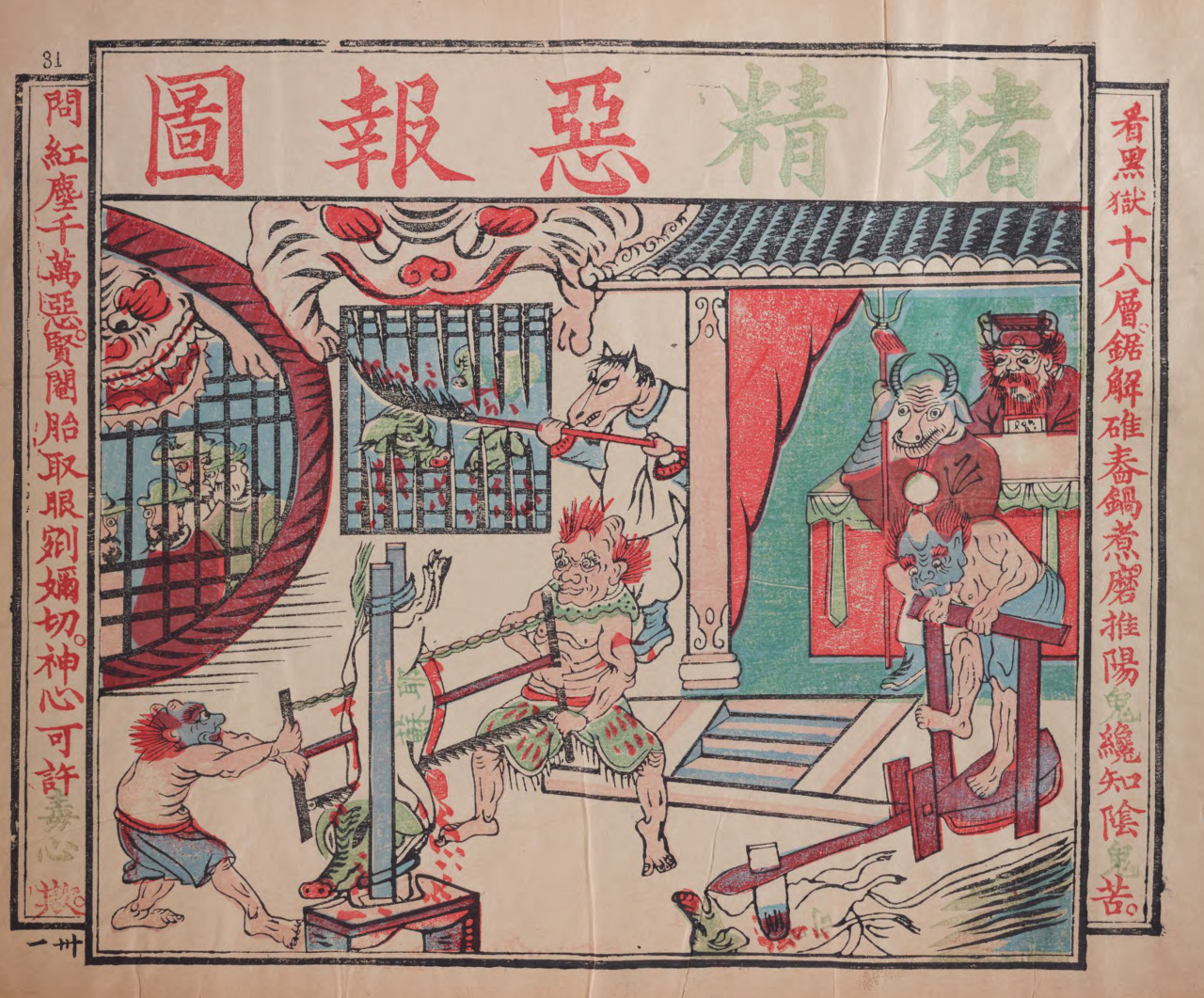
Typically, Diyu is imagined as an underground maze with many levels and chambers. After death, souls are brought here to atone for their earthly sins. The number of levels and the deities in charge vary between Buddhist and Taoist accounts. Some traditions describe three or four "courts," while others mention the "Ten Courts of Hell," each overseen by a judge known as a Yama King. Still other Chinese legends refer to the "Eighteen Levels of Hell." Each court handles a different type of atonement and punishment. Most stories say sinners endure horrific tortures until they "die" again, only to be restored to their original state and repeat the ordeal.
In Taoism, Buddhism, and folk religion, Diyu functions as a purgatory where spirits are punished and purified before reincarnation. Many deities are associated with it, though their names and roles are often conflicting. Early Chinese societies sometimes believed the dead went to places like Mount Tai, Jiuyuan, Jiuquan, or Fengdu. Today, Fengdu and temples on Mount Tai have been turned into tourist attractions with artistic depictions of hell. Some folk religion writings, such as the Taiwanese novel *Journeys to the Under-World*, describe new hells created as the world changes—for example, punishments for reckless driving or modernized versions of old tortures, like using heated iron rails instead of clothes irons in the "Hand-searing Hell." There is also a "Centre for Making-up of Recitations" for priests, monks, and Taoists who recited scriptures incorrectly for profit, and a "City of Innocent Deaths" for those who died with unresolved grievances, including suicides, accident victims, and abortion deaths. Sinners are sent to Diyu regardless of their religion, even Christians.
Quick Facts
- Title
- Diyu
- Romaji
- Jigoku
- Rr
- Jiok
- Mr
- Chiok
- Qn
- Địa ngục
- Wylie
- Dmyal Ba
- Monr
- Tam
- Mon
- Там / (Tam)
- My
- ငရဲ / Nga Yè
- Rtgs
- Nárók
- Msa
- Neraka
- Lao
- ນະຮົກ / Na Hok
Facts from the source article.
Lore & Background
Diyu is typically depicted as a subterranean maze with various levels and chambers, to which souls are taken after death to atone for the sins they committed when they were alive. The exact number of levels in Diyu and their associated deities differ between Buddhist and Taoist interpretations. Some speak of three to four 'courts'; others mention 'Ten Courts of Hell', each of which is ruled by a judge (collectively known as the Ten Yama Kings); other Chinese legends speak of the 'Eighteen Levels of Hell'. Each court deals with a different aspect of atonement and different punishments; most legends claim that sinners are subjected to gruesome tortures until their 'deaths', after which they are restored to their original state for the torture to be repeated.
Reader's Guide
Diyu serves as a purgatory in Chinese mythology, combining Buddhist, Taoist, and folk religious ideas to punish and renew spirits for reincarnation. Its significance lies in its role as a moral framework: the severity and duration of punishment depend on the sins committed, with grave sins such as unfilial acts, rape, and debauchery leading to eternal damnation in Avīci. The concept has evolved over time, with modern additions such as new hells for reckless driving or modernized punishments like searing hands on iron rails. Diyu also includes specific locations like the Naihe Bridge, where souls drink Mengpo soup to forget past lives, and the City of Innocent Deaths for those who died with grievances. The Ten Courts of Yanluo and the Eighteen Levels of Hell are the most common organizational structures, each with distinct judges and tortures. Diyu's legacy persists in Chinese folk religion, literature, and tourist attractions such as Fengdu and Mount Tai temples, which incorporate artistic depictions of hell and the afterlife.
Did You Know?
- Diyu is loosely based on a combination of the Buddhist concept of Naraka, traditional Chinese beliefs about the afterlife, and popular expansions of these traditions.
- Some Chinese folk religion planchette writings describe new hells with modernized punishments, such as the 'Hand-searing Hell' that initially used clothes irons but now uses iron rails tied with springs.
- The concept of the 'Ten Courts of Yanluo' began after Chinese folk religion was influenced by Buddhism.
Origins & Syncretic Foundations
Diyu is not a single tradition but a layered composite built over centuries. It weaves together the Buddhist Naraka concept, indigenous Chinese afterlife beliefs, and countless popular reinterpretations into one coherent purgatorial realm. The result functions much like purgatory in certain Christian denominations, serving to punish and renew spirits before they are prepared for reincarnation. Early Chinese societies imagined varied destinations for the dead—Mount Tai, Jiuyuan, Jiuquan, or Fengdu—before the more structured hell system crystallized. Taoist, Buddhist, and folk religious ideas all contribute to its character, and the exact number of levels and the deities governing them shift depending on which tradition one follows. Some accounts speak of three or four courts, others of ten, and still others of eighteen. This fluidity is itself a hallmark of the tradition, reflecting how Chinese mythology absorbs, reorganizes, and reimagines spiritual ideas across generations rather than fixing them in a single authoritative text.
The Architecture of Punishment
The physical structure of Diyu is typically imagined as a vast subterranean labyrinth of levels and chambers. In the Ten Courts of Yanluo system, which emerged after Buddhism deeply influenced Chinese folk religion, there are 12,800 hells beneath the earth—eight dark, eight cold, and 84,000 miscellaneous ones situated at the edge of the universe. Before any court proceedings begin, every soul stands before the Mirror Platform, where all sins committed during life are reflected back at them. Each of the ten courts, overseen by a Yanwang judge, addresses a distinct aspect of atonement. The Eighteen Levels of Hell, a concept originating in the Tang dynasty, were simplified from an earlier Buddhist text that listed 134 hell-worlds. Commonly cited tortures include steaming, frying in oil cauldrons, being sawed in half, crushed by boulders, or hung upside down by hooks. Crucially, sinners cannot die from these ordeals; their bodies are restored so the suffering can begin again. Grave transgressions such as unfilial acts or rape result in eternal confinement in Avīci rather than a finite sentence.
The Journey of the Soul
The path a soul traverses through Diyu is richly detailed in Chinese mythology. Before reincarnation, every spirit must cross the Naihe Bridge, the so-called Bridge of Helplessness, where they drink Mengpo soup to erase all memories of their current life. Along the way, souls pass the Wang Xiang Tai, the Home-Viewing Pavilion, from which they can look out at their families and loved ones still living in the mortal world—a final, bittersweet glimpse before the forgetting takes hold. The capital of Diyu itself is called Youdu, conceived as resembling a typical Chinese metropolis like Chang'an but perpetually shrouded in darkness. The duration of a soul's stay is not fixed; it depends on the severity of one's transgressions. After completing their sentence across the various courts, the soul is ultimately released for reincarnation. Notably, this system applies regardless of a person's religious affiliation—Christians and adherents of other faiths are equally subject to Diyu's judgments.
Evolution & Modern Adaptations
Diyu is not a static concept; it has continuously adapted to reflect the moral concerns of each era. Planchette writings and folk religious texts, such as the Taiwanese novel Journeys to the Under-World, describe new hells being created for modern sins—punishments for reckless driving, for instance, or the Hand-searing Hell, where the method of inflicting pain has been updated from clothes irons to iron rails tied with springs. A dedicated Centre for Making-up of Recitations exists to house clergy who recite scriptures incorrectly or skip passages. The City of Innocent Deaths shelters those who perished with unresolved grievances, including suicides, accidental deaths, and abortion deaths. Even the physical landscape has shifted: Fengdu and temples on Mount Tai, once sacred sites, have been rebuilt as tourist attractions featuring artistic depictions of hell. Meanwhile, the Ten Courts system has expanded its moral scope, sentencing those involved in producing pornographic materials to various hells before Avīci, until all such content ceases to exist.
Gallery
Frequently Asked Questions
What is Diyu?
Diyu, literally "earth prison," is the Chinese mythological underworld where deceased souls undergo punishment for their sins before being reborn. It fuses the Buddhist concept of Naraka with indigenous Chinese afterlife traditions into a single layered afterlife system.
How is Diyu structured?
Diyu is typically depicted as a vast underground labyrinth divided into multiple tiers or courts, each housing different forms of torment. The exact number of levels shifts across traditions—some texts describe three or four courts, others the famous Ten Courts, and still others eighteen distinct levels.
Who judges the dead in Diyu?
In the most widely known version, ten Yama Kings serve as judges, each presiding over one court and overseeing a specific category of sin and its corresponding punishment. Other Buddhist and Taoist accounts assign different numbers of deities or bureaucratic officials to these roles.
What is the purpose of Diyu?
Diyu functions as a corrective holding ground where spirits atone for their earthly misdeeds through various torments before they are released to reincarnate. Unlike a permanent damnation, it is designed as a transitional stage that purifies the soul for its next life.
How does Diyu differ from the original Buddhist Naraka?
While Naraka in early Buddhist texts is a realm of suffering tied directly to karma, Diyu layers in Chinese bureaucratic imagery—courts, judges, clerks, and paperwork—giving the afterlife a more administrative, earthly flavor. This hybrid also borrows structural echoes from concepts like Christian purgatory, blending multiple religious ideas into one framework.
More in Buddhist mythology 1-24
Spotted an error? Know more?
Reader corrections go straight into our review queue. Suggest an edit · How this site is sourced