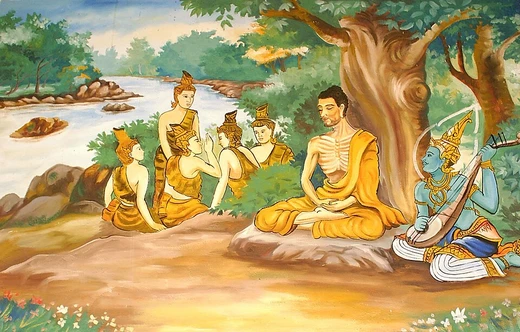
King Kalābu
Mythical Buddhist king who tested the perfection of tolerance.

King Kalābu (Sanskrit: Kalāburāja), also known as King Kalinga, King Kalabha or King Kali, is a mythical king in Buddhism. His name appears in both Southern Buddhism and Northern Buddhism, and in Chinese he is known as 歌利王 (Gēlì wáng), sometimes rendered 迦蓝浮王 (Jiālánfú wáng) or 卡拉補王 (Kǎlābǔ wáng). He is primarily known from the Kṣāntivādi Jātaka, where he serves as the antagonist who brutally tests the tolerance of an ascetic.
- Also known as
- King Kalinga, King Kalabha, King Kali
- Field
- Buddhist mythology
- Known for
- Antagonist in the Kṣāntivādi Jātaka; past birth of Devadatta
- Appears in
- Southern Buddhism, Northern Buddhism, Diamond Sutra
Lore & Background
King Kalābu appears in the Kṣāntivādi Jātaka (Sanskrit; Pali: Khantivādī Jātaka). The story recounts that he ruled the kingdom of Varanasi (modern Benares). One day, while on an outing with his harem, the king fell asleep. The women wandered off and encountered an ascetic meditating under a tree, who preached the Dhamma to them. When the king awoke and learned where they were, he flew into a rage and confronted the ascetic.
The ascetic declared he taught tolerance, defined as the ability to stay unmoved in the face of physical or verbal atrocities. The king ordered his executioner to whip the ascetic, then to cut off his bodily parts. The ascetic remained calm, stating that tolerance was in his heart, not his body. The king stomped on the ascetic's chest, yet the ascetic expressed no ill-will and wished the king a long life. The Pali version reveals that King Kalābu was a past birth of Devadatta, the enemy of the Buddha, and that the ascetic was the Bodhisatta (a future Buddha), not the already-enlightened Buddha.
Reader's Guide
King Kalābu's significance lies in his role as the foil in the Kṣāntivādi Jātaka, a foundational story illustrating the perfection of tolerance (kṣānti pāramitā) in Buddhism. The narrative demonstrates the ideal of remaining unmoved by harm, a virtue the Buddha claimed to have cultivated over many lifetimes. The story is referenced in the Diamond Sutra, where the Buddha recalls being cut apart by the Kalirāja (King Kalābu) and states that because he had no notions of self, person, being, or life, he felt no hatred or anger.
The tale also serves as a moral lesson in the Brahmajāla Sutta, where the Buddha advises his followers not to give way to resentment when others speak in dispraise of him, the Dhamma, or the Sangha. By linking King Kalābu to Devadatta, the story reinforces the Buddhist concept of karmic continuity across lives. The king's brutal actions and the ascetic's unwavering forbearance have made this Jātaka a key reference for discussions on patience, non-retaliation, and the transcendence of ego in Buddhist literature.
Did You Know?
- In Chinese, his name is rendered as 歌利王 (Gēlì wáng), 迦蓝浮王 (Jiālánfú wáng), or 卡拉補王 (Kǎlābǔ wáng).
- The Pali version of the Kṣāntivādi Jātaka identifies King Kalābu as a past birth of Devadatta, the Buddha's enemy.
- The Diamond Sutra references King Kalābu (as Kalirāja) cutting the Buddha's body apart in a past life.
Identity and Cross-Tradition Presence
King Kalābu, whose Sanskrit name is rendered Kalāburāja, occupies a distinctive place in Buddhist mythology as a figure whose story transcends the usual sectarian boundaries of the tradition. He is also referred to as King Kalinga, King Kalabha, or King Kali, and his name survives in both Southern and Northern Buddhist textual traditions, a rare occurrence that underscores the breadth of his narrative reach. In Chinese Buddhist literature the king appears under several transliterations: 歌利王 (Gēlì wáng), 迦蓝浮王 (Jiālánfú wáng), and 卡拉補王 (Kǎlābǔ wáng), each reflecting different phonetic strategies for rendering the original Sanskrit into Sinitic speech. This multiplicity of names across Pali, Sanskrit, and Chinese corpora signals that Kalābu was not a minor local character but a widely recognized archetype of royal tyranny and spiritual provocation. His presence in both the Southern Jātaka canon and Mahāyāna sūtras such as the Diamond Sutra and the Mahāvastu confirms that the figure served as a shared narrative resource for communities separated by geography and doctrinal emphasis.
The Torture Narrative in the Kṣāntivādi Jātaka
The central episode involving King Kalābu is preserved in the Kṣāntivādi Jātaka, a tale whose title translates roughly as the teaching of tolerance. The story is set in the kingdom of Varanasi, corresponding to modern Benares, where the king one day takes his harem out for recreation. After a period of play he dozes off on the lap of one of his concubines while the other women wander the garden. There they encounter an ascetic meditating beneath a tree, and his discourse on the Dhamma captivates them so completely that they forget their royal master. Upon waking, the king discovers his women absorbed in the sermon and erupts in fury. What follows is a sequence of escalating violence: he orders his executioner to whip the ascetic, then to sever his limbs, and finally he himself stamps on the man's chest until blood pours from his mouth. Through every stage the ascetic remains calm, declaring that tolerance resides in the heart, not in the flesh. A general who had originally invited the ascetic to the city rushes to the scene, applies ointment, and pleads that the man not curse the kingdom. The ascetic responds that he harbors no ill-will and instead wishes the king a long life. The Buddha, recounting this as a past life, identifies it as his own perfection of tolerance.
Doctrinal Identity and the No-Self Reading
The Pali version of the Jātaka assigns a specific past-life identity to both principal characters: King Kalābu is revealed to be a former birth of Devadatta, the Buddha's enemy, while the tortured ascetic is the Buddha himself in that existence. This identification transforms the tale from a generic moral anecdote into a statement about the deep structural opposition between the Buddha and his most personal adversary. The Mahāyāna tradition deepens the philosophical stakes further. In the Diamond Sutra, the Buddha tells Subhūti that when his body was cut apart by Kalirāja, there were no notions of a self, a person, a being, or a life. Had such notions been present, hatred and anger would have arisen. The sutra adds that the Ṛṣi of Forbearance endured this across five hundred lifetimes, throughout which no sense of individual identity ever arose. An alternate rendering of the episode also appears in the Mahāvastu, showing that the no-self interpretation of Kalābu's violence was not a single-school innovation but a broadly shared Mahāyāna reading of the same narrative core.
Tolerance as Living Practice in the Buddha's Later Teaching
The narrative of King Kalābu does not remain a closed historical parable; the Buddha explicitly connected it to his own living conduct as a teacher. When the ascetic Suppiya, operating outside the Buddhist Sangha, launched criticisms against the Buddha, his teaching, and his community, the Buddha's response echoed the very composure the ascetic displayed under Kalābu's blade. In the Brahmajāla Sutta, the Buddha instructs his monks that if others speak in dispraise of the Tathāgata, the Dhamma, or the Sangha, they must not allow resentment, displeasure, or animosity to take root in their hearts. He warns that anger in such circumstances creates an obstacle for the practitioner and, more critically, impairs the ability to discern whether the criticism is rightly or wrongly spoken. This passage frames the Kalābu episode not as a remote feat of endurance but as the foundational discipline behind every instance in which the Buddha chose measured response over retaliatory heat, binding past-life perfection to present-day ethical instruction.
Frequently Asked Questions
Who is King Kalābu?
King Kalābu (Sanskrit: Kalāburāja) is a mythical ruler in Buddhist tradition, also called King Kalinga, King Kalabha, or King Kali. He is recognized across both Southern and Northern Buddhist canons and appears in Chinese Buddhist texts under names such as Gēlì wáng or Jiālánfú wáng.
What is King Kalābu's role in Buddhist mythology?
He is best known as the antagonist in the Kṣāntivādi Jātaka, where he repeatedly and savagely dismembers an ascetic to see whether the practitioner can hold perfect equanimity under extreme suffering. His cruelty is designed to be the ultimate trial of the virtue of kṣānti (forbearance).
Why is King Kalābu significant in Buddhist teaching?
He dramatizes the perfection of tolerance by showing that even the most brutal provocation can be met with compassion rather than retaliation, making the abstract virtue of kṣānti viscerally real. His identification as a past birth of Devadatta, the Buddha's famous rival, adds a layer of karmic irony to his role as the one who tests the Bodhisattva's patience.
In which Buddhist texts does King Kalābu appear?
His primary appearance is in the Kṣāntivādi Jātaka, a story found in both the Southern and Northern Buddhist Jātaka collections. He is also referenced in the Diamond Sutra, where his name surfaces in a passage illustrating the impermanence of worldly power.
More in Buddhist mythology 1-24
Spotted an error? Know more?
Reader corrections go straight into our review queue. Suggest an edit · How this site is sourced