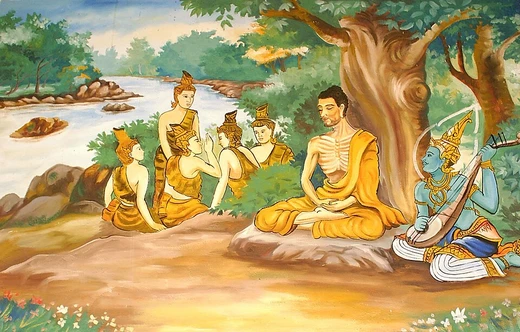
Shiva in Buddhism
A Buddhist deva associated with Shiva, varying across traditions.

Maheśvara (Sanskrit: महेश्वर; Pali: Mahissara; Chinese/Japanese: 大自在天) is a major heavenly being, or deva, in Buddhist mythology. He is closely linked to the Hindu god Shiva, but how he is understood and what role he plays shifts considerably from one Buddhist tradition to another.
The name Maheśvara comes from two Sanskrit words: "Mahā," meaning "great," and "Īśvara," meaning "lord." When combined through a grammatical rule called sandhi, they form "Maheśvara"—"the great lord."
In Theravāda Buddhism, this figure is usually called by his older epithet, Īsāna (or Mahissara in Pali). He is seen as a powerful celestial being who, like all beings, remains trapped in the cycle of birth and death (saṃsāra). Early Pali texts explicitly reject the idea that he is a supreme creator god—a view known as Issaranimmānavāda. In the Dhajagga Sutta, for instance, Īsāna is listed as one of several commander deities in the Tāvatiṃsa heaven, leading a heavenly army alongside Sakka (Indra), Pajāpati, and Varuṇa. This places him below Sakka in the cosmic hierarchy. Pali texts also use the term Mahissara, but almost always in the context of the Buddha’s refutation of the belief that a supreme god controls suffering, happiness, and the world order.
Despite these classical texts, Theravāda Buddhists in Southeast and South Asia have often incorporated reverence for Shiva through cultural and royal blending. In Thailand, he is called Phra Isuan, and his images—influenced by Khmer and Sukhothai court Brahmanism—are placed in temples as protector deities (dharmapāla) who bow to the Buddha’s teachings. In Sri Lanka, direct worship of Shiva is less common among Sinhalese Buddhists, but his power is channeled through his son Skanda, who was syncretized into the guardian deity Kataragama. This figure is one of the four guardian deities (hatara varam deviyo) protecting Buddhism in Sri Lanka.
In Mahāyāna and Vajrayāna Buddhism, Maheśvara takes on more varied roles. He can be a powerful worldly deity, an emanation of the bodhisattva Avalokiteśvara, or even a bodhisattva himself in certain esoteric texts. According to the Karandavyuha Sutra, Maheśvara was born from Avalokiteśvara’s brow. In his present life as a deva, he earned that rebirth by donating a cup of honey to Kassapa Buddha in a past life.
Quick Facts
- Sanskrit Name
- Maheśvara
- Pali Name
- ĪsānaMahissara
- Chinese Name
- 大自在天 · (Pinyin: Dàzìzàitiān)
- Japanese Name
- 大自在天 · (romaji: Daijizaiten)
- Tagalog Name
- Mahesbala
Facts from the source article.
Lore & Background
In the Theravāda tradition, Maheśvara is primarily known by his ancient epithet Īsāna or Mahissara. Early Pali texts, such as the Dhajagga Sutta (SN 11.3), mention Īsāna as one of the commander deities in the Tāvatiṃsa heaven, leading a heavenly army alongside Sakka (Indra), Pajāpati, and Varuṇa in a cosmic battle against the Asuras. His position in this hierarchy indicates subordination to Sakka. The term Mahissara appears in Pali literature in theological contexts concerning the Buddha's refutation of Issaranimmānavāda, the view that a supreme creator god governs suffering, happiness, and the world order.
In Mahāyāna and Vajrayāna Buddhism, Maheśvara's role expands. According to the Karandavyuha Sutra, he was born from the brow of Bodhisattva Avalokiteshvara. He is described as a bodhisattva of the Tenth Bhumi, one of the twenty-four protective deities of Chinese Buddhism, and one of the sixteen dharmapalas of Tibetan Buddhism. A popular story in scriptures like the Sarvatathāgatatattvasaṅgraha tells how Vajrapāni kills Maheśvara for his evil deeds, after which his life is transferred to another realm where he becomes a Buddha named Bhasmeśvaranirghoṣa, the 'Soundless Lord of Ashes.'
Reader's Guide
Maheśvara's significance in Buddhism lies in his transformation from a Hindu supreme deity into a subordinate celestial being or protective figure, reflecting Buddhism's rejection of a creator god and its incorporation of local deities. In Theravāda traditions, he remains a deva bound in saṃsāra, with texts explicitly refuting his role as Īśvara. Yet cultural syncretism persists: in Thailand, he is venerated as Phra Isuan, a protector of the Dhamma depicted in temples, while in Sri Lanka, his power is absorbed through his son Skanda, syncretized as the guardian deity Kataragama. In Mahāyāna and Vajrayāna, Maheśvara's status elevates to that of a bodhisattva or emanation of Avalokiteśvara, and he is included among protective deities in Chinese and Tibetan Buddhism. His mantra, preserved in Chinese and Japanese phonetic transcriptions, reflects his continued ritual role. The story of his subjugation by Vajrapāni illustrates the triumph of Buddhist teachings over deceptive doctrines. Overall, Maheśvara exemplifies how Buddhism adapts and recontextualizes external divine figures within its own cosmology, maintaining their relevance while subordinating them to Buddhist principles.
Did You Know?
- The Sanskrit name Maheśvara combines 'Mahā' (great) and 'Īśvara' (lord) via sandhi, meaning 'the great lord.'
- In the Dhajagga Sutta, Īsāna is described as a commander deity subordinate to Sakka in the Tāvatiṃsa heaven.
- In a popular story, Vajrapāni kills Maheśvara, who is then reborn as a Buddha named Bhasmeśvaranirghoṣa.
More in Buddhist mythology 1-24
Spotted an error? Know more?
Reader corrections go straight into our review queue. Suggest an edit · How this site is sourced