Phra Malai
Legendary monk who journeyed through hells and heavens.

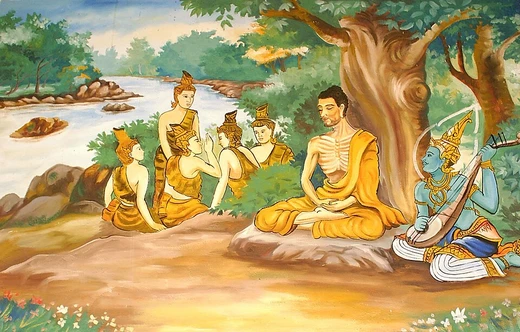
Phra Malai is a legendary Buddhist monk from Thai Theravada Buddhism, whose story is recorded in the royal version Phra Malai Kham Luang and the vernacular Phra Malai Klon Suat. The tale, centered on themes of reincarnation, merit, and Buddhist cosmology, was widely popular in 19th-century Thailand, particularly in funeral practices and illuminated manuscripts.
- Field
- Buddhist legend and literature
- Nationality
- Thai (story possibly originated in Sri Lanka)
- Known for
- Traveling to hells and heavens, meeting the future Buddha Maitreya, and teaching merit-making
- Earliest manuscript date
- C.S. 878 (CE 1516)
- Medium
- Palm-leaf manuscripts, folding books (samut khoi), artworks
Lore & Background
Phra Malai, according to various versions of the story, was a Buddhist monk who accumulated so much merit that he acquired great supernatural abilities. Using his powers, he traveled to the various hells, where he meets suffering denizens who implore him to have their living relatives make merit on their behalf. He later traveled to the heavenly realms of Trāyastriṃśa and Tushita, where he meets Indra and the future Buddha Maitreya, who is still a Bodhisattva, who instructs him further in merit-making. Beyond these basic elements, further embellishments and flourishes were often added during recitations to better entertain the audience.
Reader's Guide
The Phra Malai story holds significance as a popular part of Thai funeral practices in the 19th century, often read at wakes with monks adding dramatic twists. Starting during the reign of King Mongkut (Rama IV), these performances were seen as inappropriate, and monks were banned from reciting Phra Malai during funerals, though the ban was circumvented by using former monks dressed in monastic robes. The tale was also an extremely popular subject of illuminated manuscripts, written in folding samut khoi books using Khom Thai script, often in a highly colloquial and risqué style. These manuscripts typically included seven subjects, such as devas, scenes of hell, and Phra Malai with Indra at a heavenly stupa, and were used as chanting manuals or produced as lavishly decorated presentation volumes for the recently deceased, as it was considered very meritorious to produce or sponsor them.
Did You Know?
- The earliest known Phra Malai manuscript is dated C.S. 878 (CE 1516), written in Pali and vernacular Northern Thai.
- Most surviving manuscripts date from the late-18th and 19th centuries.
- The story was often read at funerals as part of the entertainment during the wake.
- After a ban by King Mongkut, former monks dressed in monastic robes performed the recitations.
More in Buddhist mythology 1-24
Spotted an error? Know more?
Reader corrections go straight into our review queue. Suggest an edit · How this site is sourced