Nimi (king)
First Videha king; cursed to lose his body; travels to heaven and hell.

Nimi (Sanskrit: निमि) is a king from the Solar dynasty in Hindu mythology. He is recognized as the first ruler of the Videha kingdom and the forefather of the Janaka line of Mithila. The son of Ikshvaku and a descendant of Manu, Nimi is said in the Vayu Purana to have founded a city called Jayantapura near the Gautam Ashram.
In one account, Nimi organized a yajña and asked Sage Vasishtha to serve as the chief priest. Vasishtha, already committed to officiate a yajña for Indra, said he would come afterward. Nimi left without answering, and Vasishtha assumed he had agreed to wait. After finishing Indra’s ceremony, the sage hurried to Nimi’s yajña only to find it already underway, led by Gautama. Angered, Vasishtha cursed Nimi to lose his physical form while asleep. Nimi’s bodyless spirit then went to heaven with Indra, where it remained for an unspecified period. Once the yajña was completed, the priests asked the gods to restore Nimi’s body, but he refused. This story appears in the Puranas, such as the Vishnu Purana, rather than in the Valmiki Ramayana.
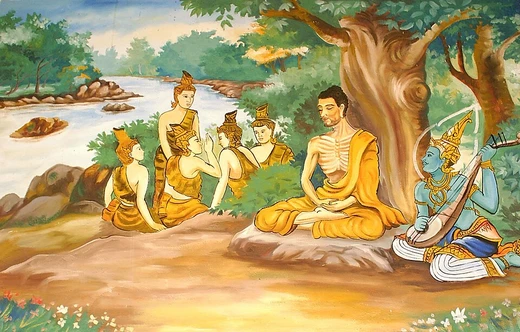
In Buddhist traditions, a righteous Videhan king named Nimi (or Nemi) is described. He travels to heaven and hell in a celestial chariot, a tale found in one Pāli Canon text and two post-canonical works. The name Nimi or Nemi is interpreted as “he brings the lineage full circle like the rim (nemi) of a carriage wheel.” The story begins with King Makhadeva, who instructs his barber to warn him when his first grey hair appears—a common memento mori motif tied to the ancient Indian concept of life stages. When the barber does so, the king becomes a hermit, entrusting his son to follow the same path. Later reborn in a heavenly realm, Makhadeva sees his descendants continuing this tradition and decides to be reborn as the next in line, taking the name King Nimi. This king then visits heaven and hell at the invitation of the god Sakka. In the end, Makhadeva (later Nimi) is identified as a previous birth of the Buddha, with the barber and charioteer as the disciple Ānanda.
This story appears in many early Buddhist texts, both canonical and post-canonical. Translator C. A. F. Rhys Davids compared it to Dante’s *Inferno*. The tale of King Nimi’s journey is iconic in traditional Thai art and widely recognized in Thailand.
Quick Facts
- Texts
- Ramayana
- Dynasty
- Suryavamsha (Janaka vamsha of Janakpur)
- Father
- Ikshvaku
- Children
- King Mithi
Facts from the source article.
Lore & Background
In Hindu tradition, Nimi once performed a yajña and invited Sage Vasishtha to be the main priest. However, Vasishtha had already committed to conduct a yajña for Indra and told Nimi he would officiate afterward. Nimi went away without replying, and Vasishtha assumed he had assented. When Vasishtha arrived after Indra's yajña, he found that Gautama was already conducting Nimi's yajña. Angered, Vasishtha cursed Nimi to cease living in corporal form while asleep. Nimi was left without his body and went to heaven with Indra, staying there for an unspecified duration. After the yajña succeeded, priests asked the gods to return Nimi to his body, but he refused. This account appears in the Puranas, such as the Vishnu Purana, and is not found in the Valmiki Ramayana.
Reader's Guide
Nimi is significant across Hindu, Buddhist, and Jain traditions as a paradigmatic king whose story illustrates themes of renunciation, karma, and the tension between worldly duty and spiritual life. In Hinduism, his refusal to return to his body after being cursed by Sage Vasishtha highlights the power of a king's resolve and the consequences of ritual miscommunication. The episode, recounted by Rama in the Ramayana, reinforces the importance of proper priestly conduct and the irreversible nature of certain curses. In Buddhism, the story of King Nimi traveling to heaven and hell in a celestial chariot serves as a moral lesson on the superiority of the spiritual life of renunciation over worldly life. The narrative, which identifies Nimi as a previous birth of the Buddha, connects the ideal of the solitary Buddha with the tradition of Videhan renouncing kings. Scholar Naomi Appleton argues for a link between these stories and the solitary Buddha ideal, while translator C. A. F. Rhys Davids compared the legend with Dante's Inferno. The story is iconic in traditional Thai art and easily recognizable to the average Thai person. In Jain texts, a similar motif of a king called Nami appears. Overall, Nimi's legacy spans multiple religious traditions, embodying the archetype of a righteous king who ultimately chooses spiritual transcendence over earthly power.
Did You Know?
- Nimi is considered the first king of the Videha kingdom and ancestor of the Janaka lineage of Mithila.
- According to the Vayu Purana, King Nimi established a city called Jayantapura near the Gautam Ashram.
- After being cursed by Sage Vasishtha, Nimi stayed in heaven with Indra for 9,000,000 years.
- In Buddhist tradition, King Nimi travels to heaven and hell in a celestial chariot at the invitation of the god Sakka.
Frequently Asked Questions
Who is Nimi (king)?
Nimi is a Solar-dynasty monarch recognized as the first sovereign of the Videha kingdom and the progenitor of the Janaka royal line of Mithila. He is identified as the son of Ikshvaku and a descendant of the primordial ancestor Manu, and he appears in both Hindu and Buddhist literary traditions.
What role does Nimi play in Buddhist texts?
In the Pāli Canon, Nimi features in narratives in which his disembodied consciousness journeys through the heavenly realms and the hells, making him a vehicle for illustrating karma and rebirth. His story is used didactically to show that even a great king remains bound to the cycle of existence.
What is the famous yajña curse involving Nimi?
Nimi arranged a sacrificial ritual and asked Sage Vasishtha to preside, but Vasishtha explained he was already pledged to officiate Indra's ceremony and would come afterward. When Nimi left without giving a clear reply, Vasishtha read his silence as consent to wait and pronounced a curse that stripped Nimi of his physical body.
Why is Nimi (king) significant across the broader mythological canon?
As the founding monarch of Videha and the ancestor of the Janaka dynasty, Nimi anchors a major royal lineage that recurs throughout the Puranas and Buddhist literature alike. His dual presence in Hindu and Buddhist canons makes him a key bridge figure for understanding how shared mythological material was adapted across traditions.
More in Buddhist mythology 1-24
Spotted an error? Know more?
Reader corrections go straight into our review queue. Suggest an edit · How this site is sourced