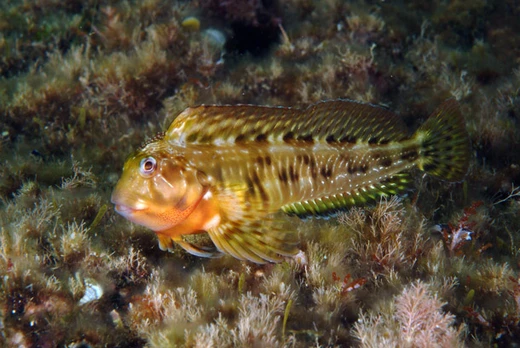
Xiphasia matsubarai
Eel-like blenny found from surface to nearly 5 km depth.

The Japanese snake blenny, *Xiphasia matsubarai*, is a combtooth blenny found across the western Pacific and Indian Oceans, with its range barely reaching the Atlantic Ocean at False Bay, South Africa. It lives from the surface down to depths of 4,960 meters (16,270 feet) and grows to 30 cm (12 inches) in standard length. Its diet consists mainly of bony fish, and it rises to the surface at night to feed. This species also appears in the aquarium trade.
The body of *X. matsubarai* is elongated and eel-like, with a dorsal fin running the entire length of the body. Gray-brown stripes extend from the head along the body. The head is small and rounded at the front, with slightly smaller eyes positioned near the sides. It lacks scales. The mouth has a single row of incisor teeth and large canines, with the lower canines being noticeably longer than the upper ones. Researchers used distinct morphological traits and sequence analysis to identify this species, and comparisons by Smith-Vanzi and Shen with *X. setifer*—focusing on fin length and color—helped confirm the initial discovery of the snake blenny.
The specific name honors Japanese ichthyologist Kiyomatsu Matsubara (1907–1968) of Kyoto University, a colleague of the two authors who named the species in his honor for the kindness he had shown them.
Quick Facts
- Taxon
- Xiphasia matsubarai
Facts from the source article.
Lore & Background
Xiphasia matsubarai has an elongated body that resembles an eel, with a dorsal fin covering the whole length of the body. Gray-brown stripes run from the head along the body. The head is small and rounded anteriorly, with eyes slightly smaller and located near the lateral sides of the head. It lacks scales and possesses a single row of incisor teeth and large canines; the bottom canines are significantly longer than those in the upper jaw. The species feeds primarily on bony fish, rising to the surface at night to feed. It can also be found in the aquarium trade. The article identified distinct morphological characteristics and sequence analysis that helped identify X. matsubarai. Smith-Vanzi and Shen made important comparisons between X. matsubarai and X. setifer, which included fin length and color, supporting the initial discovery of the snake blenny.
Reader's Guide
The significance of Xiphasia matsubarai lies in its remarkable depth range, from the surface to 4,960 m, making it one of the deepest-dwelling blennies. Its eel-like morphology and lack of scales distinguish it from many other combtooth blennies. The species was identified through distinct morphological characteristics and sequence analysis, with Smith-Vanzi and Shen providing important comparisons to X. setifer regarding fin length and color. The specific name honours Japanese ichthyologist Kiyomatsu Matsubara, a colleague of the two authors who named the species in his honour for the kindness he had shown them. Its presence in the aquarium trade indicates some interest among hobbyists, though its deep-water habits may limit captive availability. The species' feeding behavior—rising to the surface at night to prey on bony fish—highlights its role as a nocturnal predator in the water column.
Did You Know?
- Xiphasia matsubarai can be found at depths from the surface to 4,960 m (16,270 ft).
- It has an elongated, eel-like body with no scales.
- The bottom canines are significantly longer than the upper canines.
- The species is named after Japanese ichthyologist Kiyomatsu Matsubara.
More in Blennies, Part 2 1-24
Spotted an error? Know more?
Reader corrections go straight into our review queue. Suggest an edit · How this site is sourced