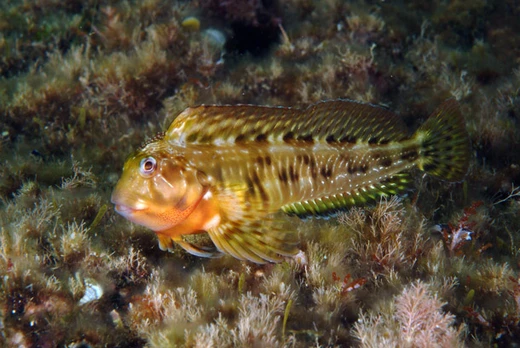
Northern clingfish
A small intertidal fish with a powerful suction disc.

Coughdrop12 · CC BY-SA 4.0
The northern clingfish (*Gobiesox maeandricus*) is a small ray-finned fish that lives in the rocky intertidal zone along the eastern Pacific coast. It belongs to the Gobiesocidae family, a group known for a specialized suction disc that lets them hold onto rocks and other surfaces in the shifting tides.
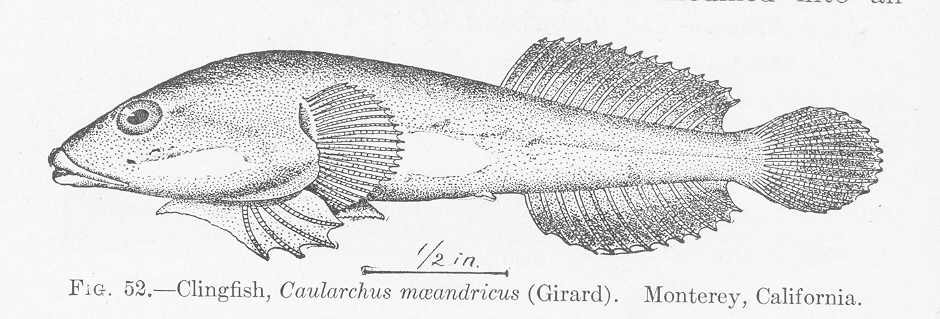
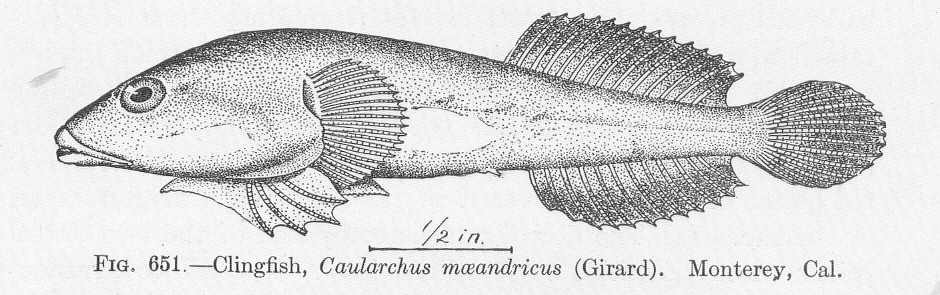
**Description** This fish has a flattened, elongated body and head, with smooth, scaleless, slimy skin. It has 12 to 14 anal soft rays and 13 to 16 dorsal soft rays, with no spined rays. Its caudal fin is rounded, and its pectoral fins are short and wide, which helps with suction and movement. Adults usually reach about 7.6 cm (3 inches) long, but can grow up to 17 cm (6.5 inches). Their color ranges from brown to reddish, and juveniles have distinct white bars along the back and the edge of the tail fin. They have a reduced swim bladder and no stomach.
The clingfish’s most distinctive feature is its powerful suction disc, located on the underside of the body. This disc is formed from fused pelvic and pectoral fins. It allows the fish to stick to rough surfaces and withstand strong waves. The disc is covered with tiny, hair-like filaments called epidermal papillae, which create friction. When the disc edges pull inward to attach, water tries to leak underneath, but these filaments block it. This mechanism lets the fish generate attachment forces 80 to 150 times its own body weight.
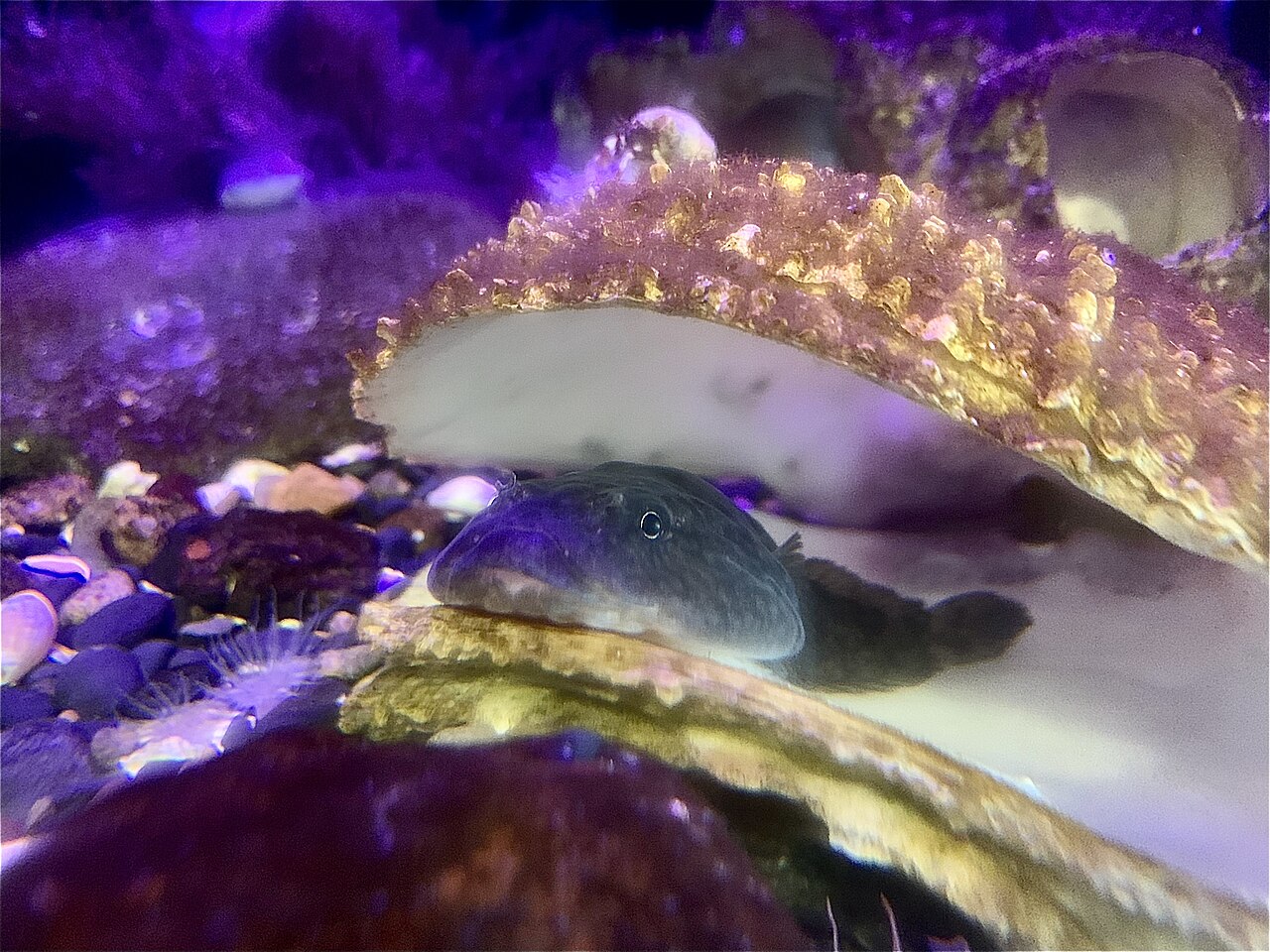
Most rocks in its habitat are covered with a biofilm of algae, bacteria, and small invertebrates. This layer actually helps the clingfish stick better, because the disc anchors to the biological film rather than bare rock. On clean, unfouled rocks, the disc may not hold well. The fish can attach to surfaces that are slippery or nonslippery, smooth or rough. Larger fish have more surface area for friction, so body size affects adhesive performance. Researchers study this suction ability to develop better adhesives.
**Geographic distribution** *G. maeandricus* lives in the rocky intertidal zone of the eastern Pacific Ocean. Its range stretches from southeastern Alaska, down the coasts of Canada and the United States, to southern California, and continues into Baja California, Mexico. Some individuals are also found around Revillagigedo Island. As an intertidal species, it constantly experiences changes from the tides. It is abundant throughout its native range.
Quick Facts
- Genus
- Gobiesox
- Species
- maeandricus
Facts from the source article.
Lore & Background
The northern clingfish has a flattened, elongated body and head with smooth, scaleless skin. Its coloration ranges from brown to reddish tones, and juveniles display distinctive white bars along the dorsal side and the edge of the caudal fin. It possesses a reduced swim bladder and lacks a stomach. The suction disc on its ventral side is formed by fused pelvic and pectoral fins, and features specialized epithelial microstructures called epidermal papillae—subdivided into tiny, hair-like filaments that prevent water from leaking under the disc during attachment. This allows the fish to adhere to a wide range of surfaces, from slippery to nonslippery and smooth to rough. Most rocks in its habitat are fouled with biofilms, which enhance adhesion; on unfouled rocks, the disc may fail to adhere effectively. Body size influences adhesive performance, as larger fish have greater surface area for friction.
Geographically, G. maeandricus ranges from southeastern Alaska down to southern California and into Baja California, Mexico, with some individuals around Revillagigedo Island. It is abundant throughout its native range. As a cryptobenthic fish, it spends most of its life hidden among rocks and vegetation in shallow coastal waters from 0–8 meters deep, occupying microhabitats such as rocky tide pools and upper regions of the kelp canopy. Its solitary lifestyle is characterized by a lack of long-distance migration, limited dispersal, and reduced territorial behaviors, though it can exhibit territorial behavior when provoked. During high tide, it actively explores and feeds on small crustaceans, mollusks, isopods, worms, and limpets, using its suction disc to pry prey from hard surfaces. During low tide, it shelters beneath rocks or in crevices to avoid predation and desiccation, and can respire in air for short periods.
Reproductively, G. maeandricus is oviparous, with spawning usually occurring in spring (April–June). Males construct nests in rocky crevices where females deposit adhesive eggs; males guard the eggs until they hatch. Larvae attach to kelp during early development before relocating into more dynamic intertidal regions. Predators such as gopher snakes have been documented feeding on these fish along the shores of the San Juan Islands.
Reader's Guide
The northern clingfish is significant for its remarkable suction disc, which generates attachment forces 80 to 150 times the fish's body weight, enabling it to thrive in the dynamic intertidal zone. This adhesive ability is studied by researchers to improve adhesive technologies. The species is also notable for its reliance on biofilms on rocks for effective adhesion, highlighting the ecological interdependence within its habitat. Its conservation status is Least Concern according to the 2024 IUCN Red List, due to a stable and widespread population. However, environmental disturbances from human activity—such as water pollution from oil spills, agricultural runoff, mining waste, heavy metals, and pesticides—as well as coastal urban development, trampling, foraging, and harvesting in tide pools threaten its habitat. Natural climate-related influences like the Pacific Decadal Oscillation, Northern Pacific Gyre Oscillation, and alternating El Niño and La Niña events also affect habitat stability and increase species vulnerability. Conservation efforts protecting rocky intertidal environments indirectly support and sustain populations of northern clingfish. The species' ability to adhere to various surfaces and its role as a cryptobenthic fish contribute to its ecological importance in the intertidal community.
Did You Know?
- Its suction disc is formed from modified pelvic and pectoral fins fused together.
- Gopher snakes have been documented feeding on northern clingfish along the shores of the San Juan Islands.
Taxonomic Framework of British Waters
The provided material organizes the fish of Great Britain into a hierarchical taxonomic structure that begins with jawless species and progresses through cartilaginous forms to bony fish. At the base sit the Agnatha, which include hagfish and lampreys, creatures lacking the paired fins and jaws that characterize most familiar fish. Above them, the Chondrichthyes encompass a remarkable array of cartilaginous species, from the ancient-looking frilled shark to the familiar basking shark, organized into orders such as Squaliformes, Lamniformes, and Rajiformes. The final and most species-rich division, Osteichthyes, groups the bony fish into orders like Clupeiformes (herrings), Cypriniformes (carps), and Anguilliformes (eels). A small bony fish such as the Northern clingfish would occupy a position within this Osteichthyes framework, sharing the fundamental skeletal architecture of the group while representing one of the more specialized and less conspicuous members of the broader British ichthyofauna documented in the list.
Habitat Breadth and Species Origin
The catalogue explicitly encompasses both freshwater and marine environments across Great Britain, noting that listed species inhabit lakes, rivers, streams, man-made pools, and salt water alike. This dual focus on habitat type underscores that the fish community of the British Isles is not a single uniform assemblage but a mosaic shaped by very different physical conditions. Equally important is the distinction the source draws between native species, those that have evolved in or naturally colonized British waters, and introduced species that have been brought from other countries. This native-versus-introduced framework is significant for understanding the ecological role of any given fish, including small bony species like the Northern clingfish, whose presence in a particular water body may reflect either long-standing natural distribution or more recent human-mediated movement. The breadth of the listing, spanning from deep-sea gulper sharks to freshwater eels, illustrates just how varied the aquatic environments are that support these organisms.
Evolutionary Range Captured in One Region
What strikes most about the assembled list is the sheer evolutionary span it captures within the waters surrounding one island nation. At one extreme are the hagfish and lampreys, jawless vertebrates that represent some of the most basal living fish lineages. At the other are the highly derived bony fish, including the familiar herring, pilchard, and sprat of the Clupeiformes, or the eel-like forms of the Anguilliformes. Between these poles lie the cartilaginous fish, whose orders, Squaliformes, Lamniformes, Rajiformes, and Torpediniformes, collectively showcase hundreds of millions of years of morphological experimentation, from the flat bodies of skates and rays to the open-ocean thresher shark. A small, specialized bony fish such as the Northern clingfish sits within this vast spectrum, a reminder that even the least conspicuous members of the list are part of a continuum of form and function stretching back to the earliest vertebrates.
Systematic Depth of the Catalogue
The source material reveals an extraordinarily granular approach to documenting British fish, moving from broad class-level divisions down through orders, families, and individual species with their full binomial names. Within the Squaliformes alone, the listing distinguishes true dogfish, bramble sharks, kitefin sharks, gulper sharks, lantern sharks, rough sharks, and sleeper sharks, each family with multiple named species. This level of taxonomic detail extends across every major group, from the two hagfish species in Myxinidae to the numerous skate and ray species catalogued under Rajidae. For a small, often-overlooked bony fish like the Northern clingfish, this systematic depth matters: it ensures the species is recorded not as an isolated curiosity but as one node in a rigorously organized web of relationships, each family and genus placed in its proper context alongside dozens of other British and introduced species documented in the same reference.
Gallery
Frequently Asked Questions
What is the Northern clingfish?
The Northern clingfish (Gobiesox maeandricus) is a small ray-finned fish in the Gobiesocidae family, native to the rocky shores of the eastern Pacific. It belongs to a group of fish collectively known for their specialized adhesive disc.
What makes the Northern clingfish special?
Its defining feature is a powerful suction disc that lets it grip rocks and other hard surfaces through crashing waves and shifting tides. This adaptation is what allows it to remain anchored in the intertidal zone where conditions change with every wave cycle.
How big does a Northern clingfish get?
Most individuals measure roughly 7.6 centimeters (about 3 inches) in total length. The species can reach a maximum of around 17 centimeters (6.5 inches), but that is the upper extreme rather than the norm.
Where does the Northern clingfish live?
It is found in the rocky intertidal zone along the eastern Pacific coastline, the band of habitat that is alternately submerged and exposed as the tide rises and falls. This is a harsh, wave-battered environment where its suction disc is essential for survival.
What does a Northern clingfish look like?
It has a flattened, elongated body and head covered in smooth, scaleless, slimy skin, with a rounded caudal fin and short, broad pectoral fins. Its fin structure includes 13 to 16 dorsal soft rays and 12 to 14 anal soft rays, with no spined rays present.
More in Blennies, Part 2 1-24
Spotted an error? Know more?
Reader corrections go straight into our review queue. Suggest an edit · How this site is sourced