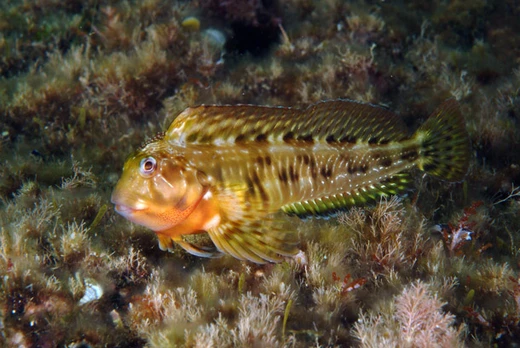
Gouania (fish)
Clingfishes endemic to Mediterranean gravel beaches.

Gouania are small, bottom-dwelling fish that belong to the clingfish family, Gobiesocidae. All five known species in this genus are found only in the Mediterranean Sea, where they are the sole vertebrates living on European intertidal gravel beaches. To endure the intense wave action, drying out between tides, and disturbance from tourism, they rely on a thoracic adhesive disc—a feature common to all clingfish—that grips both smooth and rough surfaces. This adaptation is key to surviving in such a demanding habitat.
For a long time, scientists thought Gouania contained just one species, the blunt-snouted clingfish. That changed with a 2020 study, which added three new species and revived an older name, *G. pigra*, from synonymy with *G. willdenowi*.
The genus is named after French botanist Antoine Gouan (1733–1821).
These fish live within the sediment of gravel beaches, a zone called the interstitial habitat. The environment is harsh: mechanical stress from waves, drying out from tidal exposure, and human activity from tourism. To cope with drying, they display passive amphibious emergence, a common trick among intertidal marine species. Their range stretches from the intertidal zone down to about 2 meters deep.
All five species are spread across the three main Mediterranean basins. Adults are stationary and benthic, so they cannot actively move to new areas. Instead, their pelagic larvae drift passively, but they tend to stay close to shore and rarely enter large currents that would carry them far. This limited dispersal gives each species a well-defined geographic range. *G. adriatica* lives in the Adriatic Sea and down into the northern Ionian Sea. *G. orientalis* is confined to the eastern Mediterranean, including the Gulf of Corinth, Aegean Sea, and the islands of Crete and Kythira. *G. hofrichteri* has the largest range, spreading across the eastern Mediterranean but mostly found in the northern and southern Ionian Sea. *G. pigra* is only in the Adriatic Sea, making it the only marine species endemic to that area.
Gouania fish are small, reaching up to 6 cm in length. Like many cryptobenthic species, they have an elongated body, small fins, and small eyes. All species look nearly identical, which is why the genus was once thought to be monotypic. Geometric morphometric analysis has been crucial for telling them apart.
Quick Facts
- Taxon
- Gouania (fish)
Facts from the source article.
Lore & Background
Formerly considered monotypic, containing only the blunt-snouted clingfish, a 2020 study described three new species and resurrected a synonym of G. willdenowi (G. pigra). All species of clingfish have a thoracic adhesive disc that allows them to hold onto smooth and rough surfaces, an adaptation that enables Gouania to survive the harsh conditions of gravel beaches. Gouania fish are small, growing up to 6 cm in length, with an elongated body, small fins, and small eyes. Geometric morphometric analyses have been important for species identification, as all species look almost identical. Two main morphotypes exist: slender-bodied and stout-bodied gouania, with eye size and number of vertebrae further distinguishing species. Gouania has the most vertebrae of any European clingfish, providing flexibility to inhabit gravel beaches with smaller particles.
Reader's Guide
Gouania's significance lies in its unique ecological niche as the only vertebrate adapted to European intertidal gravel beaches. This demanding environment includes mechanical stress from waves, desiccation from tides, and anthropogenic activity from tourism. The genus exhibits passive amphibious emergence behavior as a common adaptation to desiccation. Their distribution is limited by a stationary benthic adult lifestyle; only pelagic larvae can passively disperse, but they tend to stay close to shore and rarely enter larger circulation systems. This restricted dispersal has led to well-defined geographic distributions for each species across the three major Mediterranean Basins. G. adriatica occurs in the Adriatic Sea and northern Ionian Sea; G. orientalis is limited to the oriental Mediterranean basin including the Gulf of Corinth, Aegean Sea, Crete, and Kythira; G. hofrichteri has the largest range, mostly in the northern and southern Ionian Sea; G. pigra is found only in the Adriatic Sea and is the only marine species endemic to that area. The genus was named for French botanist Antoine Gouan.
Did You Know?
- Gouania are the only vertebrates to inhabit European intertidal gravel beaches.
- G. pigra is the only marine species endemic to the Adriatic Sea.
Frequently Asked Questions
Who is Gouania (fish)?
Gouania is a small genus of Mediterranean clingfish (family Gobiesocidae) comprising five recognized species. Every one of them is restricted to European intertidal gravel beaches, where they serve as the only vertebrate residents of that shore type.
What are Gouania (fish)'s powers or key adaptations?
Their standout trait is a broad pectoral adhesive disc that lets them lock onto both smooth and rough rock, holding fast against crashing surf, air-drying between tides, and heavy foot traffic. This grip is the single feature that makes life on an exposed gravel beach possible for them.
Why is Gouania (fish) important to fans and to science?
Ecologically, they occupy a niche no other vertebrate fills on European intertidal gravel. Taxonomically they are also notable for carrying the greatest number of vertebrae of any European clingfish, a detail that has kept ichthyologists revisiting their skeletal anatomy.
Who is the genus Gouania named after, and how big do they get?
The name honors the French naturalist Antoine Gouan (1733–1821), a key figure in 18th-century zoological classification. The fish themselves are tiny, topping out at roughly 6 cm, and they range from the splash zone down to about 2 meters depth.
More in Blennies, Part 2 1-24
Spotted an error? Know more?
Reader corrections go straight into our review queue. Suggest an edit · How this site is sourced