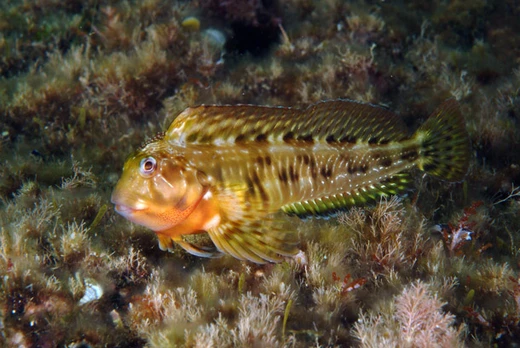
Weedsucker
A clingfish that secures itself with a pelvic sucker.

Georgina Jones · CC BY-SA 4.0
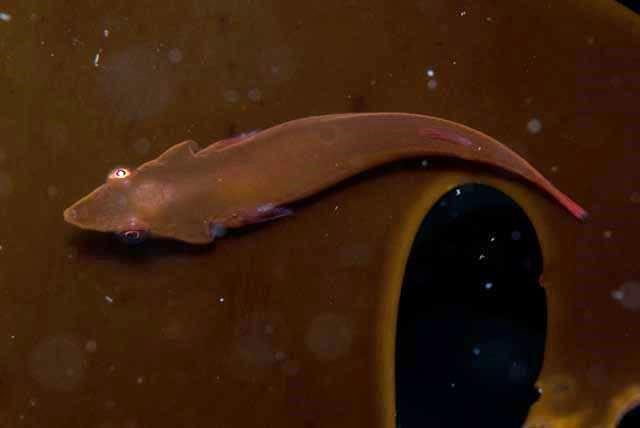
The weedsucker (Eckloniaichthys scylliorhiniceps) is a clingfish native to the coasts of Namibia and South Africa, ranging from Lüderitz to the Kei River mouth. Reaching a maximum total length of 3.5 centimeters, it is the sole species in its genus, first described by James L.B. Smith in 1943 from a specimen collected 16 kilometers west of East London, near Igoda, South Africa. Like other clingfishes, its most noticeable feature is a sucker formed from modified pelvic fins, which it uses to attach to the seafloor. Its diet consists entirely of small benthic crustaceans. Fertilization is internal, and females lay 120 to 150 eggs on kelp fronds, likely spawning year-round. Predators include diving birds like Cape cormorants and fish such as *Poroderma africanum*. The weedsucker is considered a key part of the kelp forest ecosystem below the low water mark, linking small benthic crustacean prey to larger predators. Its genus name combines *Ecklonia* (a type of kelp where it lives) with the Greek *ichthys* for "fish." The species name blends *skyllion* (Greek for dogfish), *rhinus* ("snout"), and *ceps* ("head"), referencing its pointed snout.
Quick Facts
- Taxon
- Eckloniaichthys scylliorhiniceps
Facts from the source article.
Lore & Background
The weedsucker was described by James L.B. Smith in 1943, with the type locality given as 10 miles (16 km) west of East London, east of Igoda, South Africa. It is the only species in its genus, Eckloniaichthys, a name derived from Ecklonia (a genus of sea bamboo or kelp) and ichthys (Greek for 'fish'). The specific name scylliorhiniceps combines skyllion (Greek for dogfish), rhinus ('snout'), and ceps ('head'), referencing its pointed snout.
This species is common in waters off southern Africa. Its most obvious trait is a disc-like sucker made from modified pelvic fins, which it uses to secure itself to the substrate. Its diet consists wholly of small benthic crustaceans. The weedsucker is thought to spawn throughout the year, with females laying 120 to 150 eggs on kelp fronds after internal fertilization.
The weedsucker is regarded as an important component of the kelp forest ecosystem found below the low water mark, as it forms a link in the food web between its prey of small benthic crustaceans and larger predators. It is thought to be preyed on by diving birds such as Cape cormorants and by fish such as Poroderma africanum.
Reader's Guide
The weedsucker is significant as the only known member of its genus, Eckloniaichthys, and as a key component of the kelp forest ecosystem along the coasts of Namibia and South Africa. According to the source article, it is regarded as an important link in the food web, connecting its prey of small benthic crustaceans to larger predators such as Cape cormorants and the fish Poroderma africanum. Its diet consists wholly of small benthic crustaceans, and it spawns throughout the year, with females laying 120 to 150 eggs on kelp fronds. The species was described by James L.B. Smith in 1943, with a type locality near East London, South Africa. Its common name and scientific name reflect its habitat in kelp (Ecklonia) and its pointed snout (scylliorhiniceps). The weedsucker's ability to secure itself with a pelvic sucker is a defining trait shared with other clingfishes. Its presence in the kelp forest below the low water mark underscores its ecological role in this habitat.
Did You Know?
- It secures itself to the substrate using a disc-like sucker made from modified pelvic fins.
- Females lay 120 to 150 eggs on kelp fronds, and spawning is thought to occur throughout the year.
- Its specific name, scylliorhiniceps, refers to its pointed snout, combining Greek words for dogfish, snout, and head.
Gallery
Frequently Asked Questions
Who is Weedsucker?
Weedsucker is a tiny clingfish species (Eckloniaichthys scylliorhiniceps) found along the southern African coast. It stands alone in its genus, making it the only member of that particular group.
What are Weedsucker's powers or role?
Its signature trait is a suction disc formed from modified pelvic fins, which lets it anchor itself firmly to the ocean floor. It feeds exclusively on tiny crustaceans living on the seabed.
Why is Weedsucker important?
As the sole species in the genus Eckloniaichthys, it represents a unique evolutionary lineage within the clingfish family. Its small size and specialized benthic feeding niche make it a distinct part of the coastal ecosystem.
Where does Weedsucker live?
Its range stretches along the coasts of Namibia and South Africa, from Lüderitz down to the mouth of the Kei River. The original specimen was collected about 16 kilometers west of East London, near Igoda.
More in Blennies, Part 2 1-24
Spotted an error? Know more?
Reader corrections go straight into our review queue. Suggest an edit · How this site is sourced