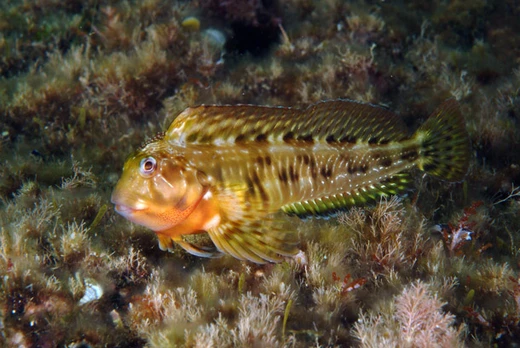
Diademichthys lineatus
A small reef fish with a toxic mucus and a sex-linked snout.

The long-snout clingfish, also called the urchin clingfish, is a small marine fish from the Gobiesocidae family. It reaches up to 5 centimeters in length and has an elongated body with a long, flattened snout. Males and females differ in snout shape—females have a longer, finer snout—which reflects their different diets. Body color ranges from dark brown to red-brown, with three yellowish stripes running along the top and sides. A yellow spot sits in the center of the tail fin, and the snout may also show some yellow. This fish releases a grammistin-like toxic mucus from its skin.
The species is widespread across the tropical Indo-West Pacific, from the Gulf of Oman to Papua New Guinea. It lives in reef environments and is often found with long-spined sea urchins, especially those in the genus *Diadema*. Its diet includes burrowing bivalves in corals, the tube feet of its host urchin, and the eggs of a commensal shrimp. The sexual dimorphism in snout length results from dietary differences: adult females eat more small bivalves and shrimp eggs, while adult males eat tube feet more frequently.
Quick Facts
- Taxon
- Diademichthys lineatus
Facts from the source article.
Lore & Background
The long-snout clingfish has an elongated body and a stretched, spatulate snout. The snout is a criterion for recognizing the sex of the fish, since females have a longer and finer snout than males. This sexual dimorphism reflects a different diet between the two sexes: adult females eat small bivalves and shrimp's eggs more often than adult males, who eat tube feet more frequently.
The body's background color varies from dark brown to red-brown, and the body has three yellowish longitudinal lines that run along it—one on the top of the body and the two others on the median axis of the sides. The caudal fin is marked by a yellow spot in its center, and the snout can also have some yellow coloration. The longsnouted clingfish has been found to release a grammistin-like toxic mucus on its skin.
Long-snout clingfish are widespread throughout the tropical waters of the Indo-West Pacific region, inhabiting the region from the Gulf of Oman to Papua New Guinea. They are found in reef environments often associated with long-spined sea urchins particularly of the genus Diadema.
Reader's Guide
Diademichthys lineatus is significant as a small marine fish in the family Gobiesocidae, known for its specialized association with long-spined sea urchins of the genus Diadema. Its notable feature is the release of a grammistin-like toxic mucus on its skin, which may serve as a defense mechanism. The species exhibits clear sexual dimorphism in snout length, linked to dietary differences: females, with longer snouts, consume more small bivalves and shrimp eggs, while males eat more tube feet from their urchin hosts. This dietary divergence is a key aspect of its biology. The fish's distribution across the Indo-West Pacific, from the Gulf of Oman to Papua New Guinea, highlights its adaptability to tropical reef environments. Its legacy lies in illustrating how morphology and diet can co-vary between sexes in a reef-dwelling species, and its toxic mucus adds to the diversity of chemical defenses among marine fishes.
Frequently Asked Questions
What is Diademichthys lineatus?
It's a tiny clingfish (family Gobiesocidae) that tops out around 5 cm and is best known for its elongated, flattened snout. You'll find it clinging to long-spined sea urchins (Diadema) on Indo-West Pacific reefs.
How do male and female Diademichthys lineatus look different?
The most visible sex difference is in the snout: females grow a noticeably longer and finer one than males. Beyond that, both sexes share the same dark-brown-to-red-brown body with three pale yellowish stripes and a yellow dot on the tail.
What does Diademichthys lineatus actually eat?
It specializes in burrowing bivalves tucked inside coral, the tube feet of its host urchin, and the eggs of commensal shrimp. The different snout shapes between the sexes are thought to reflect how each gender targets these slightly different food sources.
Where in the ocean can you find Diademichthys lineatus?
Its range stretches across the Indo-West Pacific, from the Gulf of Oman all the way to Papua New Guinea. Within that range it stays close to reef structures where long-spined Diadema urchins are present.
Why is Diademichthys lineatus's toxic mucus a big deal?
The fish secretes a grammistin-like toxin from its skin, which acts as a chemical defense against predators that might try to grab it off the urchin. For a fish only 5 cm long, that mucus is essentially its main bodyguard.
More in Blennies, Part 2 1-24
Spotted an error? Know more?
Reader corrections go straight into our review queue. Suggest an edit · How this site is sourced