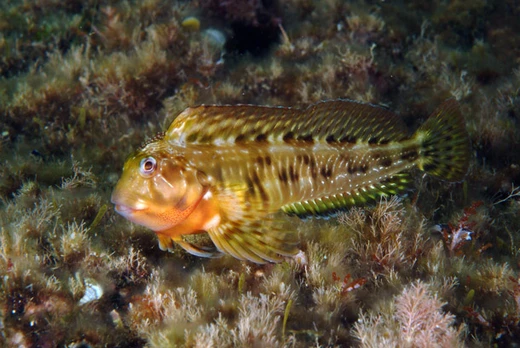
Chorisochismus
Monotypic genus of giant clingfish found off southern Africa.

Wikimedia Commons · Public domain
Chorisochismus is a genus of clingfish known only from a single species, Chorisochismus dentex, commonly called the rocksucker or giant clingfish. It is notable for being one of the largest clingfish species, reaching up to 30 cm in total length, and for its specialized feeding on limpets.
Quick Facts
- Taxon
- Chorisochismus dentex
Facts from the source article.
Lore & Background
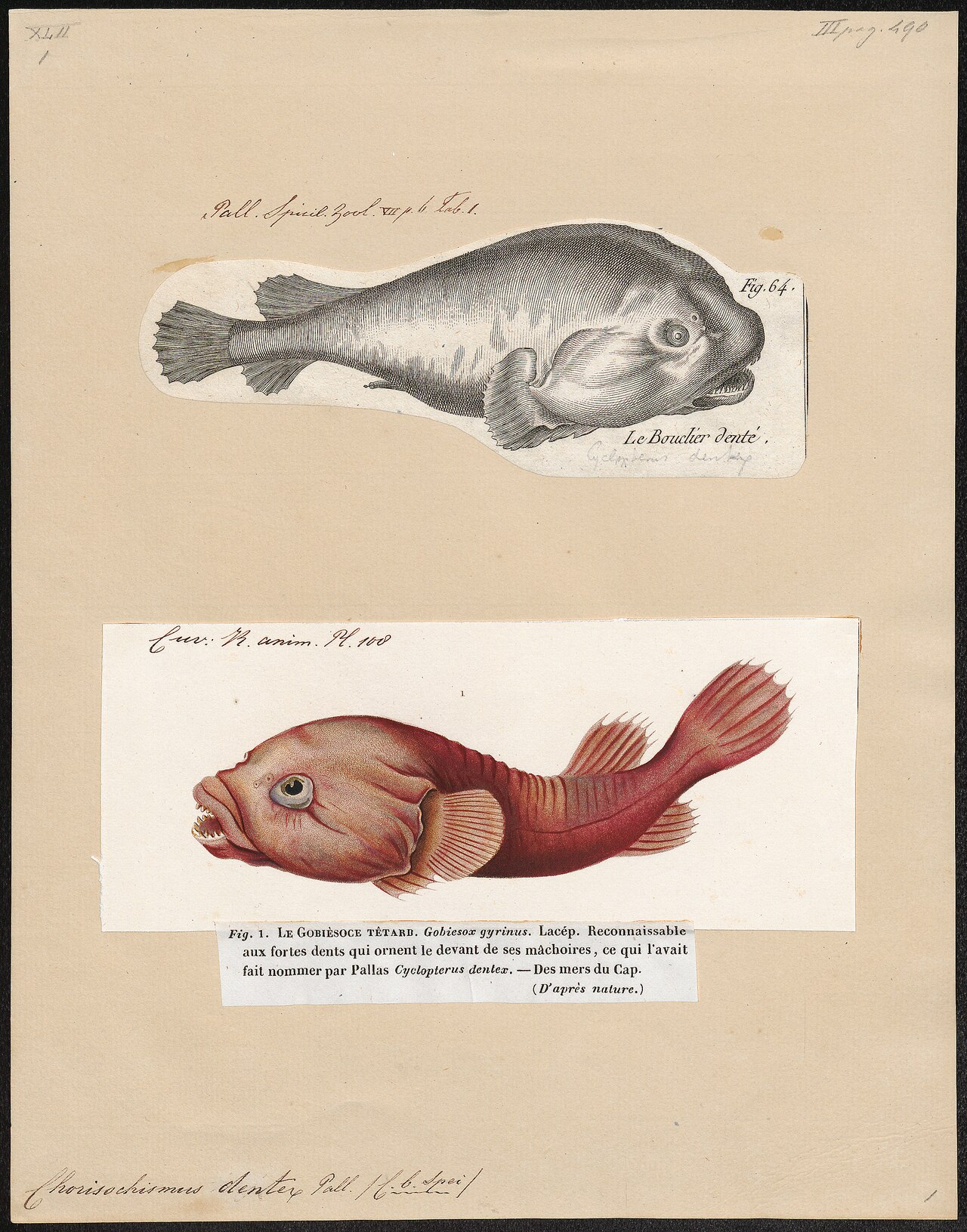
Chorisochismus dentex has a broad head that tapers to a narrow tail and large eyes. Its colour is typically mottled greenish or reddish. Dead and dried specimens are occasionally found by beachcombers, and their often red colour combined with their strange shape and proportionally large teeth have caused some to describe them as 'sea monsters'.
This species inhabits intertidal and subtidal zones in shallow reefs and rock pools, most commonly in areas with flat boulders, but also in kelp beds or crevices in caves. It is found from intertidal rock pools down to a depth of at least 15 m.
Feeding varies with age: juveniles mostly feed on small crustaceans, while adults are specialized feeders of patellid limpets. The fish perches next to its prey, lunges forward and up, dives down with its mouth open, inserts its large upper front teeth below the limpet's edge, and flips it. The limpet is swallowed whole in about one second, and the shell is later regurgitated after digestion.
Reader's Guide
Chorisochismus is significant as the only known member of its genus, and its sole species, Chorisochismus dentex, is one of the largest clingfish in the world, matching the South American Sicyases sanguineus in size. Its specialized feeding behavior on patellid limpets is notable: the fish uses a rapid lunge-and-flip technique to dislodge limpets that are strongly attached to rocks, swallowing them whole in about one second. The prey can be quite large relative to the fish—a 12.2 cm-long specimen contained a 3.1 cm limpet. The species' appearance, particularly in dead and dried specimens, has led to folk descriptions as 'sea monsters' due to its red colour, strange shape, and large teeth. Its distribution is limited to the coast of southern Africa from Namibia to northern Natal, South Africa, where it occupies intertidal and subtidal zones down to 15 m depth. The genus is thus a distinctive component of the region's shallow reef and rock pool ecosystems.
Did You Know?
- Chorisochismus dentex is the only known member of its genus.
- It is one of the largest clingfish species, reaching 30 cm in total length.
- Adults feed almost 75% on patellid limpets, flipping them off rocks in about one second.
- Dead and dried specimens have been described as 'sea monsters' due to their red colour and large teeth.
Gallery
Frequently Asked Questions
What is Chorisochismus?
Chorisochismus is a monotypic genus of giant clingfish whose sole member, Chorisochismus dentex, is commonly called the rocksucker. It inhabits the waters off southern Africa.
How big does Chorisochismus dentex get?
Individuals can grow to roughly 30 cm (12 in) in total length, placing it among the largest clingfish species known, tied with Sicyases sanguineus.
What does Chorisochismus dentex feed on?
Limpets of the family Patellidae form the bulk of its diet at around 75 percent, supplemented by other sea snails, sea urchins, and trace amounts of chitons.
Where does Chorisochismus live?
It occurs from the intertidal zone to depths of at least 15 m along the southern African coastline, spanning from Namibia as far north as Natal, South Africa.
Why is Chorisochismus notable among clingfish?
Its combination of large body size and a feeding strategy heavily specialized on limpets sets it apart from most other members of the clingfish family.
More in Blennies, Part 2 1-24
Spotted an error? Know more?
Reader corrections go straight into our review queue. Suggest an edit · How this site is sourced