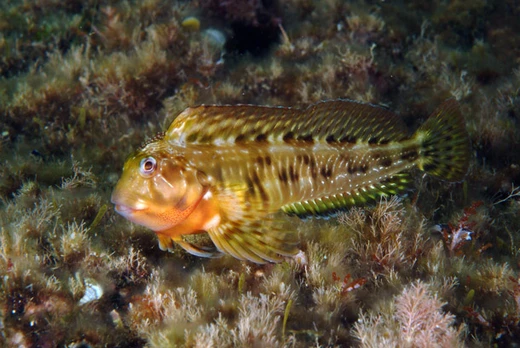
Gobiesocidae
Small, cryptic fishes that cling with a powerful sucking disc.

Clingfishes are small, ray-finned fish that make up the family Gobiesocidae—the sole family in the suborder Gobiesocoidei, within the order Blenniiformes. They range from fairly small to very small and are found across tropical and temperate regions worldwide, mostly near coastlines, though a handful of species live in deeper waters or freshwater. Most clingfish stick to shallow reefs or seagrass beds, using a suction disc on their chest to hold onto rocks, algae, and seagrass leaves. They’re generally too small to matter much for fisheries, but the relatively large *Sicyases sanguineus* is regularly caught for food, and a few other species sometimes show up in the marine aquarium trade.
Clingfish live mainly near shore in the Atlantic, Indian, and Pacific Oceans, including marginal seas like the Mediterranean, Gulf of Mexico, Caribbean, and Gulf of California. The highest number of species occurs in tropical and warm temperate areas, but some extend into colder waters—for example, *Diplecogaster bimaculata* reaches Norway; *Apletodon dentatus*, *Lepadogaster candolii*, and *L. purpurea* reach Scotland; *Gobiesox maeandricus* reaches Alaska; *Gobiesox marmoratus* and *Sicyases sanguineus* reach southernmost South America; and *Gastrocymba quadriradiata* lives around New Zealand’s subantarctic islands. Their typical habitats are shallow rocky reefs and shores, coral reefs, seagrass meadows, and algae beds. They often live in places with strong currents and wave action, and some are amphibious. The most amphibious, intertidal species can survive on land for three to four days if kept moist by splashing waves, getting oxygen through their gills, skin, and possibly their mouths. At least a few can tolerate significant water loss while out of water.
A smaller number of clingfish shelter among sea urchins or crinoids. Whether this relationship is obligate (always with a host) or facultative (sometimes with a host) depends on the species. In some, only the young are obligate and gradually leave as they grow. Three species—the Australian *Cochleoceps bicolor* and *C. orientalis*, and the warm East Atlantic *Diplecogaster tonstricula*—are cleaner fish that cling onto larger fish to clean them.
Quick Facts
- Taxon
- Gobiesocidae
- Type Species
- Gobiesox cephalus
- Type Species Authority
- Lacépède, 1800
Facts from the source article.
Lore & Background
Clingfishes are primarily found near the shore in the Atlantic, Indian and Pacific Oceans, including marginal seas such as the Mediterranean, Gulf of Mexico, Caribbean and Gulf of California. The greatest species richness is in tropical and warm temperate regions, but the range of a few extends into colder waters, like Diplecogaster bimaculata (north to Norway), Apletodon dentatus, Lepadogaster candolii and L. purpurea (all three north to Scotland), Gobiesox maeandricus (north to Alaska), Gobiesox marmoratus and Sicyases sanguineus (both to southernmost South America), and Gastrocymba quadriradiata (from New Zealand's subantarctic islands). Clingfishes mainly inhabit shallow rocky reefs and shores, coral reefs, seagrass meadows and algae beds. They often live in places exposed to strong currents and wave action, and some are amphibious. As long as the strongly amphibious, intertidal-living species are kept moist by splashing waves, they can survive for up to three–four days on land, gaining oxygen from the air by the branchial surfaces (gills), skin and perhaps the mouth. At least a few species even tolerate a relatively high degree of water loss when on land. A relatively small number of species shelter in sea urchins or crinoids. Whether this relationship is obligate or facultative varies with species. In some, only young clingfish are obligate and gradually move away as they become adult. Three clingfish species, the Australian Cochleoceps bicolor and C. orientalis, and the warm East Atlantic Diplecogaster tonstricula, are cleaner fish that will cling onto the bodies of larger fish. Although several species can occur in brackish water, only seven Gobiesox species from warmer parts of the Americas are freshwater fish that live in fast-flowing rivers and streams. Most known clingfish species are from relatively shallow coastal waters, but several inhabit the mesophotic zone and a few even deeper, with Alabes bathys, Gobiesox lanceolatus, Gymnoscyphus ascitus, Kopua kuiteri, K. nuimata and Protogobiesox asymmetricus reported from depths of 300–560 m. Because of their small size and typical habitat, it is however suspected that still-undiscovered deep-water species remain. Even in shallow coastal waters many clingfish are highly cryptic and easily overlooked, mostly staying under cover, although there are species that are active and will swim in the open. As a consequence their abundance is often not well known. Several species are only known from a single or a few specimens. Species that appear uncommon or rare based on standard methods can actually be common if using methods that are more suitable for detecting them. Studies of better-known species have shown that they can be locally abundant. As many as 23 individuals of Lepadogaster lepadogaster have been documented from a single square metre. As of 2018, the IUCN has evaluated the conservation status of 84 clingfish species. The majority of these are considered least concern, 17 are considered data deficient, 8 considered vulnerable and a single endangered. The vulnerable and endangered species all have small distributions, restricted to islands or a single bay. Three Gobiesox species that are restricted to fresh water in Mexico have not been rated by the IUCN, but are considered threatened by Mexican authorities.
Reader's Guide
Clingfishes are notable for their remarkable sucking disc, which is located on the underside at the chest and is formed primarily by modified pelvic fins and adjacent tissue. In some species it is divided in two, resulting in a larger front and a smaller rear sucking disc. The sucking disc is covered in tiny hexagons and each of these consists of many microscopic hair-like structures (setae), similar to the structures that allow geckos to cling to walls. The sucking disc can be remarkably strong, in some species able to lift as much as 300 times the weight of the clingfish. Gobies can have a similar sucking disc, but unlike that family the single dorsal fin in clingfish is not spiny. In a few clingfish species the disc is reduced or even absent, notably Alabes, which are quite eel-like in their shape and aptly named shore-eels. The sucking disc is also reduced in some deep-water clingfish species. Most clingfish species have a cryptic colouration, often brown, grey, whitish, black, reddish or green shades, and in some cases they can rapidly change colour to match their background. Species of deep water are often orange-red. Diademichthys lineatus, Discotrema species, Lepadichthys caritus and L. lineatus are strongly banded, which may function as a disruptive pattern when among sea urchin spines or crinoid arms, but may also be warning colours, as some members of these genera have poisonous skin and mucus. The skin of clingfishes is smooth and scaleless, with a thick layer of protective mucus. In at least Diademichthys lineatus and Lepadichthys frenatus, the mucus production increases if the fish is disturbed. The taste of their mucus is highly bitter to humans and it can kill other fish, due to a grammistin-like toxin. Another defense appears to be present in a couple of Acyrtus and Arcos species, which have a spine at their gill cover that appears to be connected to a venom gland, strongly suggesting that the world's smallest venomous fish is Acyrtus artius, which is less than 3 cm long. Feeding varies depending on exact clingfish species. Most primarily feed on tiny crustaceans or gastropods. Other small animals recorded in their diet include chitons, bivalves, medium-small crustaceans like crabs and barnacles, sea urchins, worms, insect larvae, fish and fish eggs. In some species, cannibalism where a large clingfish eats a smaller clingfish is not uncommon. Limpets and other shelled invertebrates are well-protected and often strongly attached to the rock surface. Clingfish species that feed extensively on them have developed specialized teeth and techniques to dislodge them, including rapidly inserting their relatively large, fang-like front teeth under the edge of the prey to flip it, or jamming the teeth on or under the shell's edge to make a small break.
Did You Know?
- The sucking disc of some clingfish species can lift as much as 300 times the weight of the fish.
- The world's smallest venomous fish is likely Acyrtus artius, a clingfish less than 3 cm long.
- Three clingfish species are cleaner fish that cling onto the bodies of larger fish.
Frequently Asked Questions
Who is Gobiesocidae?
Gobiesocidae is the family of clingfishes, the sole family in the suborder Gobiesocoidei and a member of the order Blenniiformes. These small, ray-finned fishes are best known for their cryptic body shapes and their talent for gripping surfaces in coastal waters.
What is Gobiesocidae's signature ability?
Every species in the family carries a muscular suction disc on its underside that lets it clamp onto rocks, algae, and seagrass blades. This grip is powerful enough to keep them anchored against currents in shallow reefs and seagrass beds.
Where can you find Gobiesocidae?
Clingfishes occur along tropical and temperate coastlines around the globe, with the bulk of species staying in shallow, structured habitats. A handful of species push into deeper water, recorded at 300–560 m, and a few have even adapted to freshwater.
What is the size range within Gobiesocidae?
The family stretches from Acyrtus artius, which measures under 3 cm, up to Chorisochismus dentex and Sicyases sanguineus, both reaching roughly 30 cm. Most members, however, remain well below that upper bound and are quite small.
Why does Gobiesocidae matter to people?
Because the majority of clingfishes are too tiny to be of commercial interest, they barely register in fisheries. Their real significance is ecological: as small, cryptic predators and prey, they help structure coastal reef and seagrass food webs.
More in Blennies, Part 2 1-24
Spotted an error? Know more?
Reader corrections go straight into our review queue. Suggest an edit · How this site is sourced