Lipogramma trilineata
A deep-reef basslet with blue lines, threatened by invasive lionfish.

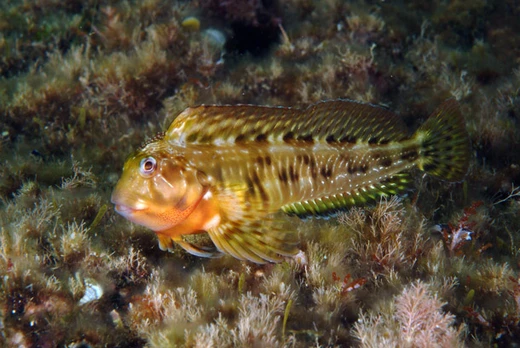
The three-lined basslet, *Lipogramma trilineata*, is a ray-finned fish belonging to the family Grammatidae. Its body is elongated and compressed, with a large eye, a short snout, and a forward-facing mouth equipped with teeth on the jaws, vomer, and palatine bone. The upper head, back, and dorsal fin are yellow to reddish orange, while the rest of the body is bluish grey—though the yellow can extend over the entire body. Three black-edged blue lines mark the fish: one runs along the center of the snout through the forehead and nape, and one on each side runs from the eye to beneath the front of the dorsal fin. A blue line also edges the dorsal fin, and the other fins are translucent blue.
This species is found in the western Atlantic, from waters off southeastern Florida through the Bahamas, into the Gulf of Mexico and the Caribbean Sea, and along the coasts from Quintana Roo, Mexico, to Nicaragua, as well as near Cartagena and off Venezuela at Curaçao and Bonaire. It lives under rocky and coral ledges, on deep reefs, and on outer walls at depths between 22 and 69 metres (72–226 feet). Its range has been invaded by lionfish, an invasive species that preys on fish smaller than 15 centimetres (5.9 inches), making both adult and juvenile *L. trilineata* likely prey. In the Bahamas, a nearly two-thirds decline in the biomass of lionfish prey fish has been recorded over two years, and other basslet species have been confirmed as lionfish prey.
Quick Facts
- Taxon
- Lipogramma trilineata
Facts from the source article.
Lore & Background
Lipogramma trilineata is found underneath rocky and coral ledges, as well as on deep reefs and outer walls, at depths from 22 to 69 metres. Its range extends from southeastern Florida through the Bahamas, into the Gulf of Mexico and Caribbean Sea, and along the coasts of Central and South America from Quintana Roo, Mexico to Nicaragua, and off Cartagena and Venezuela at Curaçao and Bonaire. The species has an elongated, compressed body with a large eye and short snout, and its mouth sits at the front of the head, with teeth on its jaws, vomer, and palatine bone. The upper part of the head, back, and dorsal fin are yellow to reddish orange, while the rest of the body is bluish grey; the yellow colouration can cover the whole body. Three black-edged blue lines run along the centre of the snout through the forehead and nape, and one on each side from the eye to beneath the front of the dorsal fin. A blue line runs along the margin of the dorsal fin, and the other fins are translucent blue.
Reader's Guide
The significance of Lipogramma trilineata lies in its role within the western Atlantic reef ecosystem and its vulnerability to the invasive lionfish. The source article notes that lionfish prey on a variety of fish species smaller than 15 centimetres, which includes both adult and juvenile L. trilineata. In the Bahamas, a near two-thirds decline in the biomass of fish preyed upon by lionfish was recorded over a period of two years, and other basslet species have been confirmed as lionfish prey. This suggests that L. trilineata populations may be impacted by lionfish predation, contributing to broader ecological changes in its habitat. The species' specific depth range and habitat preferences—under ledges and on deep reefs—may offer some refuge, but the documented declines in prey biomass highlight the pressure from invasive species. As a member of the Grammatidae family, its distinctive coloration and three blue lines make it a recognizable component of the deep-reef fish community, and its presence across a wide geographic range underscores its ecological importance in the western Atlantic.
Did You Know?
- Lipogramma trilineata is found at depths from 22 to 69 metres.
- It has three black-edged blue lines on its head and body.
- Lionfish prey on fish smaller than 15 centimetres, including both adult and juvenile L. trilineata.
Frequently Asked Questions
What is Lipogramma trilineata?
Lipogramma trilineata, commonly known as the three-lined basslet, is a small ray-finned fish in the family Grammatidae. It is a deep-reef dweller with an elongated, laterally compressed body and three striking black-edged blue lines that give it its common name.
Where does Lipogramma trilineata live and at what depth?
This species is found throughout the western Atlantic, spanning southeastern Florida, the Bahamas, the Gulf of Mexico, the Caribbean Sea, and south to Nicaragua, Cartagena, Curaçao, and Bonaire. It typically ranges between 22 and 69 metres (about 72 to 226 feet) on deep reef structures.
What does Lipogramma trilineata look like?
The upper head, back, and dorsal fin are yellow to reddish orange while the lower body is bluish grey, though in some individuals the yellow washes over the entire body. Three black-edged blue lines stand out: one runs along the midline of the snout, forehead, and nape, and the remaining two trace from each eye toward the front of the operculum. The fish also has a notably large eye, a short snout, and a forward-facing mouth with teeth on the jaws, vomer, and palatine bone.
What is threatening Lipogramma trilineata populations?
Invasive lionfish are the primary threat to this deep-reef basslet, exerting heavy predation pressure on its numbers. In the Bahamas, local biomass of the species fell by nearly two-thirds over a two-year window, a collapse fans and researchers largely attribute to lionfish encroachment.
What does Lipogramma trilineata eat?
The three-lined basslet is a small-predator species, with a prey-size threshold around 15 centimetres (5.9 inches) in body length marking the upper range of what it typically targets. Its forward-facing, toothed mouth—armed across the jaws, vomer, and palatine bone—is adapted for snatching small reef invertebrates in the dim light of its deep habitat.
More in Blennies, Part 2 1-24
Spotted an error? Know more?
Reader corrections go straight into our review queue. Suggest an edit · How this site is sourced