Tripterygiidae
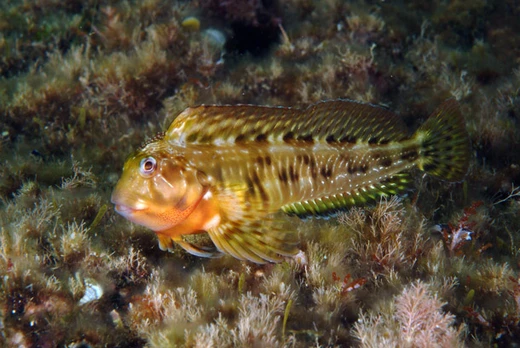
Threefin blennies have a dorsal fin split into three parts.

Tripterygiidae, commonly known as threefin or triplefin blennies, are small percomorph marine fish of the order Blenniiformes. They are notable for their dorsal fin divided into three distinct parts, which gives them their common name and distinguishes them from other blennies.
- Family name origin
- Greek tripteros meaning 'with three wings'
- Number of species
- about 150
- Number of genera
- 30
- Largest species
- Notoclinus fenestratus (New Zealand topknot) at 20 cm total length
- Typical size range
- most species do not exceed 6 cm
- Diet
- small invertebrates
- Habitat
- shallow, clear waters with sun exposure, such as lagoons and seaward reefs
Lore & Background
Threefin blennies are demersal fish that spend most of their time on or near the bottom on coral and rocks. They are typically found in shallow, clear waters with sun exposure, such as lagoons and seaward reefs. These nervous fish retreat to rock crevices at any perceived threat.
Many threefin blennies are brightly coloured, often for reasons of camouflage, and are popular in the aquarium hobby. They are diurnal and territorial, with many species exhibiting sexual dichromatism: females are drab compared to males. In some species, the second dorsal fin is extended in males.
The family name derives from the Greek tripteros meaning 'with three wings'. The body is elongated with a typical blenny form. The dorsal fin is separated into three parts, the first two of which are spinous. The pelvic fins are small, slender, located underneath the throat, and possess a single spine. The anal fin is large and may have one or two spines. The pectoral fins are greatly enlarged, and the tail fin is rounded.
Reader's Guide
Threefin blennies of the family Tripterygiidae are significant as a diverse group of small marine fish found in tropical and temperate waters of the Atlantic, Pacific, and Indian Oceans. With about 150 species in 30 genera, they occupy a distinct ecological niche as demersal fish on coral and rocky bottoms in shallow, sunlit waters. Their bright coloration, often serving as camouflage, makes them popular in the aquarium hobby. The family's defining characteristic—the dorsal fin divided into three parts—sets them apart from other blennies. Their behavior includes diurnal activity, territoriality, and sexual dichromatism, where males are more brightly colored than females. The largest species, the New Zealand topknot (Notoclinus fenestratus), reaches 20 cm, while most others are under 6 cm. Their diet consists of small invertebrates. The family is classified into two subfamilies: Notoclininae and Tripterygiinae, with genera such as Enneanectes, Helcogramma, and Tripterygion. Their nervous nature and reliance on rock crevices for shelter highlight their adaptation to reef environments.
Did You Know?
- The family name Tripterygiidae comes from the Greek tripteros meaning 'with three wings'.
- Threefin blennies have a dorsal fin separated into three parts, with the first two being spinous.
- The largest species is the New Zealand topknot, Notoclinus fenestratus, at 20 cm total length.
- Many threefin blennies are brightly coloured for camouflage and are popular in the aquarium hobby.
More in Blennies, Part 2 1-24
Spotted an error? Know more?
Reader corrections go straight into our review queue. Suggest an edit · How this site is sourced