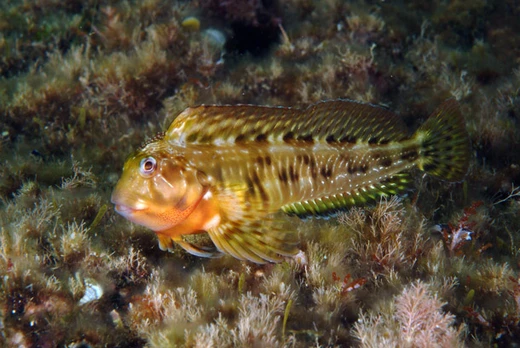
Pseudochrominae
Small reef fish with divided lateral line and guarded egg masses.

Pseudochrominae is a subfamily of ray-finned fishes, one of four subfamilies that make up the family Pseudochromidae. The species within the subfamily are commonly called dottybacks. They are small reef-associated marine fish which have an Indo-Pacific distribution.
Quick Facts
- Taxon
- Pseudochrominae
Facts from the source article.
Lore & Background
The subfamily Pseudochrominae is characterized by a pelvic fin with a single spine and five branched rays, a head covered in scales, teeth on the palatine bone, and 16–20 rays in the pectoral fin. The lateral line is divided into two: a longer part running from the head to the posterior part of the dorsal fin just below it, and a shorter part on the rear of the flanks. They grow to a maximum length of 19 cm.
Pseudochrominae has a widespread distribution in the Indian Ocean and western Pacific Ocean, mainly in tropical areas. Their distribution extends from the eastern coast of Africa, east across the Indo-Pacific region to American Samoa, with southern limits at Durban in South Africa and Elizabeth Reef in the northern Tasman Sea, and north as far as southern Japan.
Species in the Pseudochrominae are mainly associated with reefs, with several found among branching corals and some living within large sponges. They occur from the intertidal shallows down to depths of 100 m. Most are fiercely territorial, defending small home ranges and living solitarily, as pairs, or in very small groups of a male and a few females. They are predators of small invertebrates such as crustaceans, small bivalves and gastropods, polychaetes, and some small fish. Many species are hermaphroditic—some simultaneously hermaphroditic, others protogynous or protandrous—and adopt the coloring and pattern of the different sex as they transform. Many species produce a fluffy, round egg mass that the male often guards in a small cave or burrow; the mass is formed by interlinking filaments covering half the surface of each egg opposite the micropyle, attached by a small loaf-like structure diagnostic of the pseudochromines. Males guard the eggs until they hatch, which varies from 3–7 days after hatching the pelagic larvae disperse.
Reader's Guide
The subfamily Pseudochrominae is notable for its distinctive reproductive biology and territorial behavior. The loaf-like structures that attach egg filaments are diagnostic of the group, providing a key identification feature. Their hermaphroditic strategies—including simultaneous, protogynous, and protandrous forms—demonstrate a range of sexual systems within a single subfamily. The male's guarding of the fluffy egg mass in a cave or burrow until hatching (3–7 days) is a consistent parental care pattern. Ecologically, dottybacks are small reef predators that occupy specific microhabitats such as branching corals and large sponges, and their distribution spans the entire Indo-Pacific from eastern Africa to American Samoa and from southern Japan to Durban and the Tasman Sea. Their territoriality, often solitary or in small groups, contrasts with a few social species. The subfamily's significance lies in its contribution to understanding reef fish diversity, reproductive adaptation, and biogeography, as described in the source article.
Did You Know?
- The lateral line of Pseudochrominae is divided into two parts: a longer one below the dorsal fin and a shorter one on the rear flanks.
- Many species are hermaphroditic, including simultaneous, protogynous, and protandrous forms.
- The egg mass is fluffy and round, formed by filaments attached to each egg via a small loaf-like structure diagnostic of the subfamily.
- Males guard the eggs in a small cave or burrow until they hatch, which takes 3–7 days.
More in Blennies, Part 2 1-24
Spotted an error? Know more?
Reader corrections go straight into our review queue. Suggest an edit · How this site is sourced