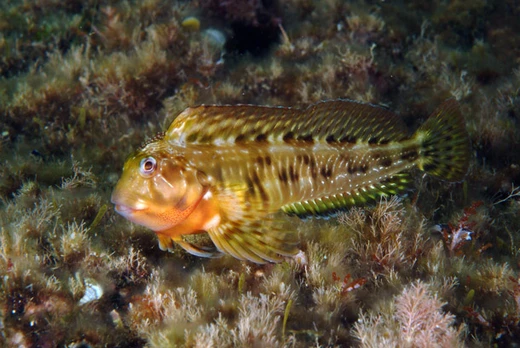
Plagiotremus goslinei
A venomous blenny that bites larger fish for food.

Plagiotremus goslinei, a combtooth blenny, goes by many common names, including biting blenny, Gosline's fangblenny, scale-eating blenny, Ewa fang blenny, blue-stripe blenny, and scale-eating fang blenny. Its scientific name honors American ichthyologist William A. Gosline of the University of Hawaiʻi.
This fish grows to a maximum length of 6.3 cm (2.5 in). It is also called the striped blenny because of the bright blue stripes running along its body. On its lower jaw, it has two large canine teeth. These sharp fangs can help the fish avoid being swallowed by larger predators by gripping the predator's esophagus. The fangs also deliver a venomous, opioid-like poison.
The biting blenny lives in coral reefs around Hawaii and across the eastern central Pacific Ocean. Its diet is varied, including mucus, scales, and skin tissue from larger fish, as well as shrimp, small crustaceans, worms, zooplankton, and fish eggs. It approaches larger fish from behind and takes bites from their backs and sides.
The population of this species is stable and abundant in the warm waters near the Hawaiian Islands, and it is considered a least concern species.
Quick Facts
- Taxon
- Plagiotremus goslinei
Facts from the source article.
Lore & Background
The biting blenny reaches a length of 6.3 cm (2.5 in) SL and is also called the striped blenny for the bright blue stripes running down its body. It has two large canines on its bottom jaw. These sharp fangs can, when the fish is eaten by a larger fish, hold on to the esophagus to prevent itself from being swallowed. The fangs can also be poisonous, delivering an opioid poison to the receiver.
The species epithet honors the American ichthyologist William A. Gosline (1915-2002) of the University of Hawaiʻi. The biting blenny is found in coral reefs in Hawaii and in the eastern central Pacific Ocean. Its diet is diverse, consisting of mucus, scales, and skin tissue of larger fish, shrimp, small crustaceans, worms, zooplankton, and fish eggs. It sneaks up behind larger fish and takes bites out of their backs and sides.
Reader's Guide
The biting blenny's significance lies in its unique feeding strategy and defensive adaptations. It is a scale-eating and mucus-feeding species that approaches larger fish from behind to take bites of their backs and sides. Its two large canines are not only used for feeding but also serve as a defense mechanism: if swallowed by a larger fish, the fangs can anchor into the esophagus, preventing the blenny from being consumed. Additionally, these fangs deliver an opioid poison, adding a chemical deterrent. The species is named after William A. Gosline, an American ichthyologist at the University of Hawaiʻi. Its population is currently stable and abundant around the warm waters of the Hawaiian Islands, and it is considered a least concerned population. The biting blenny's combination of stealthy predation, physical anchoring, and venomous bite makes it a notable example of adaptation among reef fishes.
Did You Know?
- The biting blenny has two large canines on its bottom jaw that can deliver an opioid poison.
- If eaten by a larger fish, its fangs can hold on to the esophagus to prevent being swallowed.
More in Blennies, Part 2 1-24
Spotted an error? Know more?
Reader corrections go straight into our review queue. Suggest an edit · How this site is sourced