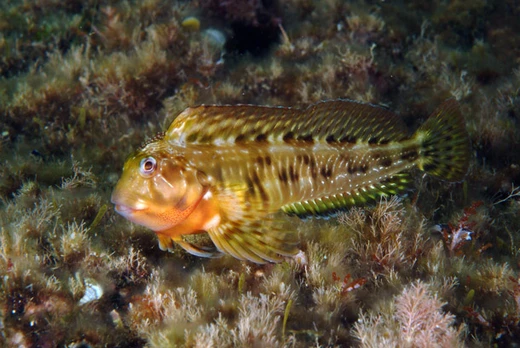
Plagiotremus ewaensis
Endemic Hawaiian reef fish with sharp fangs and blue stripes.

Plagiotremus ewaensis, also called the Ewa blenny, Ewa fangblenny, or blue-stripe blenny, is a combtooth blenny from the family Blenniidae. It is a reef fish found only in the Hawaiian Islands.
This fish is orange or reddish-brown, with blue and black stripes running the length of its body. It reaches about 4 inches (100 mm) in length. Its name comes from its sharp fangs, which it uses to bite flesh from prey and to defend itself. If swallowed, the fangblenny bites the inside of its predator’s mouth until it is released. A carnivore, it wanders the reef feeding on scales, skin, and mucus from larger fish. As a secondary consumer, it also feeds on predators such as sharks.
The Ewa fangblenny lives in Hawaiian reefs at depths of 4 to 55 meters, in water temperatures between 76.82°F and 80.24°F (24.9°C to 26.8°C). It uses empty worm snail holes in the reef for shelter when predators attack.
Quick Facts
- Taxon
- Plagiotremus ewaensis
Facts from the source article.
Lore & Background
The Ewa fangblenny is orange or reddish-brown in color, with blue and black stripes along the length of its body. It can grow up to about 4 inches (100 mm). The species gets its name from its sharp fangs, which it uses to bite off flesh from food sources and to defend itself from predators. If eaten, the fang blenny will bite the inside of the predator's mouth until the predator allows it to escape. This species is a carnivore that wanders the reef to feed on scales, skin, and mucus from bigger fish. As a secondary consumer, it also feeds on predators like sharks. The Ewa fang blenny resides in the reef at sea depths of 4 to 55 meters and temperatures ranging from 76.82 °F to 80.24 °F (24.9°C to 26.8°C). It makes use of empty worm snail holes in the reef as protection when predators attack.
Reader's Guide
Plagiotremus ewaensis is significant as an endemic species to the Hawaiian Islands, meaning it is found nowhere else in the world. Its unique defensive behavior—biting the inside of a predator's mouth to escape—highlights its specialized adaptation for survival. As a secondary consumer, it plays a role in the reef ecosystem by feeding on scales, skin, and mucus from larger fish, and even on predators like sharks. The species' reliance on empty worm snail holes for shelter underscores its dependence on specific microhabitats within the reef. Its striking coloration of orange or reddish-brown with blue and black stripes makes it visually distinctive among reef fishes. The Ewa fangblenny's carnivorous diet and fang-based feeding and defense mechanisms contribute to its ecological niche. The species' presence in Hawaiian waters at depths of 4 to 55 meters and within a narrow temperature range reflects its specific habitat requirements. Its legacy is tied to the biodiversity of Hawaiian coral reefs and the evolutionary adaptations of blennies.
More in Blennies, Part 2 1-24
Spotted an error? Know more?
Reader corrections go straight into our review queue. Suggest an edit · How this site is sourced