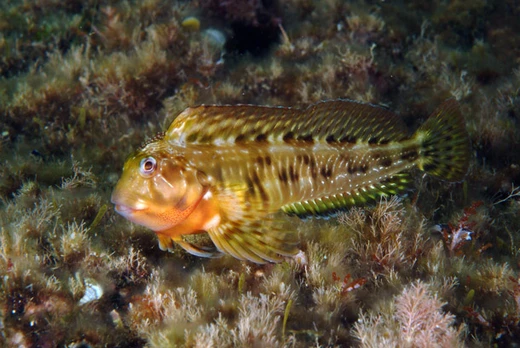
Ophioblennius trinitatis
A combtooth blenny endemic to southwest Atlantic reefs.

Ophioblennius trinitatis, a combtooth blenny, lives only in the southwest Atlantic Ocean. This subtropical marine fish is most often seen in Brazilian reefs, where locals call combtooth blennies "peixes-macacos" (monkey-fish). Adults grow to 5.6 cm (2.2 in) in standard length.
These fish have scaleless bodies and a row of comb-like teeth on the lower jaw and upper jaw, but not on the palate. Many combtooth blennies also have curved, fang-like teeth at the back of each lower jaw. *O. trinitatis* has a blunt head and large eyes set high on the head, each bordered by blue. A dark-brown spot about the size of the pupil sits just behind the eye. It differs from other *Ophioblennius* species by having 22 segmented rays in the dorsal fin and 23 in the anal fin. Adults are uniformly brown with pale yellow fins; under stress, they shift to irregular dark-and-light bands. Juveniles are bicolored—olive green on the front half, yellow on the rear.
The fish live in intertidal zones and tropical coral reefs of Brazil, down to 53 meters deep. Adults stay in shallow water among rocks and corals, while larvae occur in deeper water. They prefer structurally complex substrates with plenty of hiding spots.
As primary consumers, they eat detritus, turf algae, filamentous algae, red calcareous algae, ascidians, and various invertebrates. They coexist with other species by feeding more in the morning than in the afternoon—a resource-partitioning strategy. Juveniles feed more often than adults because of higher energy needs for growth. Larger individuals feed less because they spend more time patrolling feeding and breeding territories.
*O. trinitatis* is diurnal, territorial, and herbivorous. It acts aggressively toward other fish competing for resources, and its response depends on the intruder species. It uses agonistic displays against other highly territorial species with similar habitat and diet. Intraspecific aggression is rare; instead, individuals share territories symbiotically to improve defense and reduce energy costs. Larger fish are more aggressive because they defend bigger territories that attract more intruders. Agonistic interactions also increase when competing for refuge crevices.
Reproduction is oviparous and occurs year-round, with spawning and settlement following seasonal and lunar cycles. Males maintain nests within their territories.
Quick Facts
- Taxon
- Ophioblennius trinitatis
Facts from the source article.
Lore & Background
Ophioblennius trinitatis has a blunt head and large eyes positioned high on the head, with a blue coloration bordering each eye and a dark-brown spot after the eyeball. Adults have a homogenous brown color pattern with pale yellow fins, but in stressful situations the color changes to irregular alternating dark and light bands. Juveniles are bicolored, with an olive green anterior half and a yellow posterior half.
This species differs from other Ophioblennius in having 22 segmented dorsal-fin rays and 23 segmented anal-fin rays. It is commonly found in intertidal habitats and tropical coral reefs of Brazil at depths up to 53 meters, preferring areas with high structural complexity and ample hiding places. Adults are restricted to shallow waters among rocks and corals, while larvae can be found in deep waters.
Ophioblennius trinitatis are diurnal, territorial herbivores that are aggressive towards other fish when fighting for resources. They employ agonistic displays when interacting with other highly territorial species sharing similar habitat and food preferences. Intraspecific interactions are rare; instead, they demonstrate symbiotic sharing of territories to improve defense and minimize energy costs.
Reader's Guide
Ophioblennius trinitatis is notable as a primary consumer in Brazilian reef ecosystems, feeding on detritus, turf algae, filamentous algae, red calcareous algae, ascidians, and a variety of invertebrates. Its feeding behavior exemplifies resource partitioning: it feeds more often in the morning than in the afternoon, allowing coexistence with other species. Juveniles feed more frequently than adults due to higher energy demands of development, while larger individuals have lower feeding rates because they spend more time patrolling territories.
The species exhibits complex territorial behavior. Larger individuals defend larger territories and are more aggressive due to more frequent intruders. Agonistic interactions also increase when competing over refuge places such as crevices. Reproduction is oviparous with a year-long period, and spawning follows lunar periodicity: as the full moon approaches, females seek male nests for mating. Males guard the nest after spawning, and eggs are demersal, attached to substrate with an adhesive pad. This combination of behavioral and reproductive strategies highlights the species' adaptation to its shallow reef habitat.
Did You Know?
- Ophioblennius trinitatis reaches a maximum length of 5.6 cm (2.2 in) SL.
- Adults have a homogenous brown color pattern that changes to irregular bands under stress.
- Juveniles are bicolored: olive green anteriorly and yellow posteriorly.
- Spawning follows lunar periodicity, with females seeking male nests near the full moon.
More in Blennies, Part 2 1-24
Spotted an error? Know more?
Reader corrections go straight into our review queue. Suggest an edit · How this site is sourced