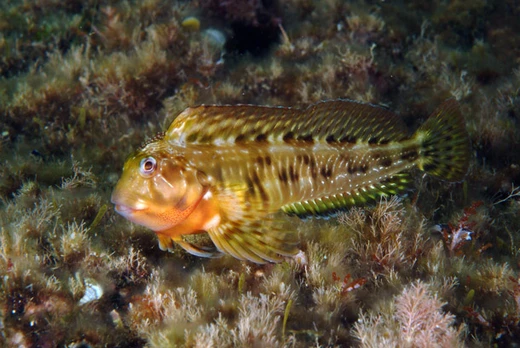
Ophioblennius steindachneri
A combtooth blenny of the eastern Pacific coral reefs.

Ophioblennius steindachneri, commonly called the large-banded blenny or Panamic fanged blenny, is a combtooth blenny that inhabits coral reefs in the eastern Pacific. It grows up to 18 cm (7.1 in) in standard length.
Juveniles are dark in color, while adults become brownish to olive with lighter markings. A dark spot sits behind the eye, and several broad bands run from the head, fading behind the pectoral fins.
This species ranges from the Gulf of California to Peru, including the Revillagigedo Islands, Cocos Island, Malpelo Island, and the Galápagos Islands.
Adults live mainly in the surge zone of exposed, steep rocky headlands, wedging into crevices in shallow water near shore. They are territorial, darting out to defend their space. By day, they graze on algae and sessile invertebrates, using comb-shaped incisor teeth to scrape food off rocks. Like all blennies, they are oviparous, laying demersal eggs attached to the substrate by a filamentous adhesive pad. Their planktonic larvae are often found in shallow coastal waters.
The specific name honors Austrian ichthyologist Franz Steindachner (1834–1919), who reported this species as *Blennophis webbii* in 1879.
Quick Facts
- Taxon
- Ophioblennius steindachneri
Facts from the source article.
Lore & Background
The large-banded blenny exhibits dark coloration as a juvenile, but develops brownish to olive coloration with lighter markings, as well as a dark spot behind the eye and several broad bands from the head and fading behind the pectoral fins. Adults are mainly found in the surge zone of exposed rocky headlands which have steep slopes where they wedge themselves into crevices near the shore in shallow water. They are territorial and will dart out of their hiding place to defend their territory. They feed during the day when they graze on algae and prey on sessile invertebrates by using incisor teeth, similar in shape to combs, to scrape food off the rock. Like all blennies they are oviparous, laying demersal eggs which are adhered to the substrate by a filamentous, adhesive pad or pedestal, and their larvae are planktonic, frequently recorded from shallow waters near the coast.
Reader's Guide
The significance of Ophioblennius steindachneri lies in its distinctive morphology and behavior within the eastern Pacific reef ecosystem. As a combtooth blenny, it uses comb-shaped incisor teeth to scrape algae and sessile invertebrates from rock surfaces, playing a role in controlling algal growth. Its territorial nature and habit of wedging into crevices in the surge zone of exposed rocky headlands highlight its adaptation to high-energy shallow environments. The species' range from the Gulf of California to Peru, including remote islands such as the Revillagigedo, Cocos, Malpelo, and Galápagos, underscores its presence across a broad biogeographic region. Its reproductive strategy—oviparous with demersal eggs attached by a filamentous pad and planktonic larvae—is typical of blennies and contributes to its dispersal. The specific name honors Austrian ichthyologist Franz Steindachner, who reported this species as Blennophis webbii in 1879, linking it to the history of ichthyological exploration in the region.
Did You Know?
- The large-banded blenny reaches a length of 18 centimetres (7.1 in) SL.
- It is found in the eastern Pacific from the Gulf of California to Peru, including the Galápagos Islands.
More in Blennies, Part 2 1-24
Spotted an error? Know more?
Reader corrections go straight into our review queue. Suggest an edit · How this site is sourced