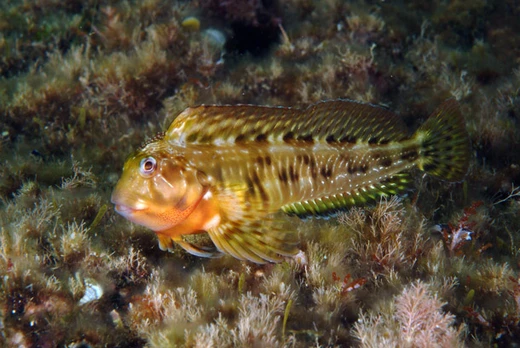
Ophioblennius atlanticus
A territorial blenny with large reddish lips and sharp canine teeth.

Ophioblennius atlanticus, commonly known as the redlip blenny or horseface blenny, is a species of combtooth blenny in the family Blenniidae. It is notable for its highly territorial behavior, large reddish lips, and the use of two long, sharp canine teeth to attack intruders.
Quick Facts
- Taxon
- Ophioblennius atlanticus
Facts from the source article.
Lore & Background
The species was originally described by French zoologist Achille Valenciennes in 1836. The genus name Ophis is Greek for 'serpent', and blennios is Greek for 'mucus'; the species name atlanticus refers to its location of capture. The common name 'redlip' comes from the reddish color of its lips.
Adult redlip blennies are chocolate brown with some yellow markings, possess blunt heads with four branching horns, and have large reddish lips. A paler variation exists with a shell-white body and reddish brown head. They are found in the western central Atlantic, as well as the eastern Atlantic from Senegal to Angola, and in the northeastern Atlantic in the Macaronesian archipelagos. They inhabit shallow, clear waters with coral reefs and rock bottoms at depths of 10 to 20 meters.
Redlip blennies are highly territorial, especially toward conspecifics, and will attack intruders with two long, sharp canine teeth. They lack a swimbladder, which does not affect adults. Their eggs are benthic, and males provide paternal care, including blowing air onto the eggs and rubbing their anal-urogenital region over the nest to apply antimicrobial substances.
Reader's Guide
Ophioblennius atlanticus is significant as a well-studied example of territorial and reproductive behavior in combtooth blennies. Its aggressive defense of resources, including shelter and spawning sites, is most severe toward conspecifics due to direct resource competition. The species exhibits complex mate choice: females select males based on both genetic quality (body size, which correlates with better protection and larger antimicrobial organs) and non-genetic quality (such as allopaternal care, where males care for foreign eggs, demonstrating trustworthiness). Males prepare multiple nests and reduce feeding during spawning seasons. The species reproduces year-round around the full moon, with eggs deposited in a single layer and guarded by the male until hatching. In aquaculture, they require a minimum 30-gallon tank with a lid due to their jumping ability, and are generally peaceful in community tanks except with similarly shaped fish. Their two razor-sharp canine teeth have earned them the nickname 'devil fish' in some countries.
Did You Know?
- The redlip blenny attacks intruders with two long, sharp canine teeth.
- Males rub their anal-urogenital region over the nest to protect eggs from microbial infections.
- Females choose mates based on body size, which indicates better genetic quality and antimicrobial protection.
- The species has been reported twice in the central Mediterranean Sea.
More in Blennies, Part 2 1-24
Spotted an error? Know more?
Reader corrections go straight into our review queue. Suggest an edit · How this site is sourced