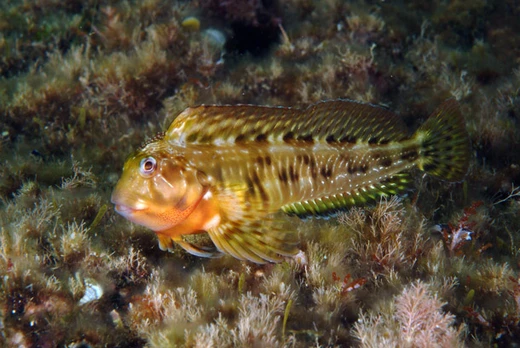
Meiacanthus grammistes
A venomous blenny whose venom targets opioid receptors.

Meiacanthus grammistes, known as the striped blenny, striped fang blenny, grammistes blenny, line-spot harptail blenny, or striped poison-fang blenny, is a species of combtooth blenny from the western Pacific Ocean. It is notable for its venom, which is being investigated as a potential new painkiller for human use.
Quick Facts
- Taxon
- Meiacanthus grammistes
Facts from the source article.
Lore & Background
The striped blenny is stout and deep-bodied, with a pointed snout and a long continuous dorsal fin. Its body is brown with tan wavy bands stretching the length of the body, and it has a small blue spot on the dorsal fin near the head. The fish has relatively large fangs (canine teeth) that protrude from the lower jaw. This species grows to 11 cm (4.3 in) total length. It stays in the open ocean but travels into shallow saltwater and brackish estuaries. This venomous species occasionally makes its way into the aquarium trade.
Reader's Guide
The venom of Meiacanthus grammistes is unusual because it targets the body's opioid receptors, and is being investigated as a potential new painkiller for human use. The venom consists of a neuropeptide also seen in cone snail venom, a lipase similar to one used by certain species of scorpions, and an opioid peptide. Blennies use it to stun predators; the venom reduces the predator's blood pressure, relaxing its jaws so the blenny can escape. Administration of the venom was found not to cause pain in mice, which is atypical as most fish venoms are painful. Administration of the venom also did not result in a drop in heart rate in rats. This species occasionally enters the aquarium trade, adding to its significance as a venomous fish with potential biomedical applications.
Did You Know?
- The venom contains a neuropeptide also found in cone snail venom.
- The venom reduces the blood pressure of predators, relaxing their jaws.
- Administration of the venom did not cause pain in mice, unlike most fish venoms.
- The fish has a small blue spot on its dorsal fin near the head.
More in Blennies, Part 2 1-24
Spotted an error? Know more?
Reader corrections go straight into our review queue. Suggest an edit · How this site is sourced