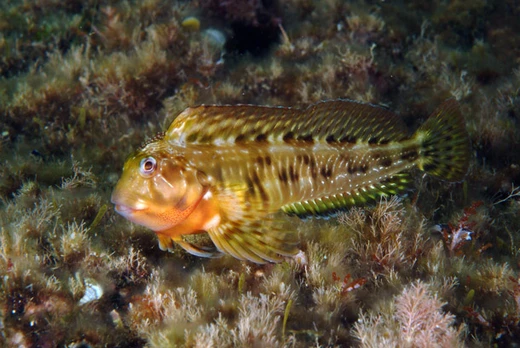
False cleanerfish
A combtooth blenny that mimics cleaner wrasses to avoid predation.

The false cleanerfish (Aspidontus taeniatus) is a species of combtooth blenny native to coral reef habitats in the Indo-Pacific. It is notable for its mimicry of the bluestreak cleaner wrasse (Labroides dimidiatus), copying both its appearance and dance, primarily to avoid predation and occasionally to bite the fins of client fish.
Quick Facts
- Taxon
- Aspidontus taeniatus
Facts from the source article.
Lore & Background
The false cleanerfish primarily lives among the cleaning stations of the bluestreak cleaner wrasse, with its territory overlapping that of its model. It mimics both the characteristic black stripe and blue body of L. dimidiatus, as well as its general body shape. Juveniles match the coloration of juvenile cleaner wrasses, and individuals may also mimic other reef fish or atypically colored cleaner wrasses in the same territory. A key difference is the false cleanerfish's underslung mouth, compared to the terminal mouth of the cleaner wrasse, and it possesses enormous canines in its lower jaw that fit into sockets on the roof of its mouth.
The false cleanerfish mimics the cleaner wrasse's dance by spreading its caudal fin and oscillating its posterior end up and down, eliciting posing behavior from client fish. However, instead of feeding on ectoparasites, it occasionally attacks and tears portions of fin from client fish, most successfully on juveniles. Adult fish that have been attacked may avoid or even attack A. taeniatus, suggesting they remember the experience. Stomach content analysis shows the false cleanerfish's diet consists primarily of demersal fish eggs and tube worm tentacles, with only a small portion of fish fins or ectoparasites.
Reader's Guide
The false cleanerfish is significant as a case study in mimicry, particularly aggressive mimicry, though its cheating behavior is less frequent than initially reported. The primary evolutionary driver for its mimicry appears to be predator avoidance: groupers raised in captivity do not attack L. dimidiatus but consume other non-cleanerfish, suggesting that mimicking the cleaner wrasse protects A. taeniatus from predation. The fact that adult client fish can distinguish between the mimic and its model and avoid the false cleanerfish supports the idea that it is not primarily an aggressive mimic. When cheating does occur, it imposes a cost on cleaning stations by making client fish more aggressive or avoidant. Geographical variation exists: in the Red Sea and Great Barrier Reef, foraging on tube worms or substrate is more common than attacks, while in French Polynesia and Indonesia, juveniles more often feed on client fish tissue. The evolution of this mimicry has been used as evidence for strong selection against client fish that attack their cleaners, and the largely nonaggressive mimicry supports the hypothesis of reciprocally altruistic behavior evolving.
Did You Know?
- The false cleanerfish has an underslung mouth, unlike the terminal mouth of its model, the bluestreak cleaner wrasse.
- Stomach contents of A. taeniatus consist primarily of demersal fish eggs and tube worm tentacles, not fish fins.
- In French Polynesia and Indonesia, juvenile false cleanerfish feed on client fish tissue more commonly than other food sources.
More in Blennies, Part 2 1-24
Spotted an error? Know more?
Reader corrections go straight into our review queue. Suggest an edit · How this site is sourced