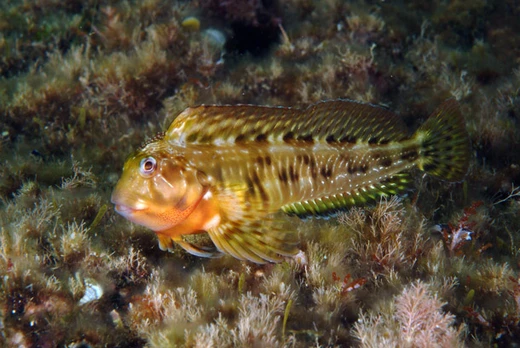
Dottyback
Brightly colored coral-reef fishes, often seen in the aquarium trade.

The dottybacks, scientifically known as the family Pseudochromidae, are a group of fish once placed in the order Perciformes or considered uncertain percomorphs, but are now classified as basal blenniiforms. This family includes about 152 species. They inhabit tropical and subtropical waters of the Indo-Pacific, with most living on coral reefs. Many dottybacks are brightly colored and often exhibit striking differences between males and females. They are generally small, typically under 10 cm (4 in) in length, with some species measuring less than 2 cm (0.8 in). The largest species, *Congrogadus subducens*, can reach up to 45 cm (1 ft 6 in). Dottybacks are set apart from other fish families by having three or fewer spines in the dorsal fin and an incomplete lateral line organ. Several of the more colorful species are popular in the marine aquarium trade, though some are aggressively territorial.
Quick Facts
- Taxon
- Pseudochromidae
Facts from the source article.
Lore & Background
Many species of dottybacks are brightly coloured fish, often showing striking sexual dimorphism. They are generally small, mostly less than 10 cm (4 in) in length, and some less than 2 cm (0.8 in). The largest by far, at up to 45 cm (1 ft 6 in), is Congrogadus subducens. Dottybacks are distinguished from other families by the presence of three or less spines in the dorsal fin and an incomplete lateral line organ.
Several of the brightly coloured members of the family are often seen in the marine aquarium trade, although some species are aggressively territorial. The family includes four subfamilies: Anisochrominae, Congrogadinae (eel blennies), Pseudochrominae, and Pseudoplesiopinae, each containing multiple genera.
Reader's Guide
The dottybacks, as a family of basal blenniiforms, represent a reclassification from their former placement in Perciformes or as incertae sedis percomorphs. Their significance lies in their diversity, with around 152 species distributed across the tropical and subtropical Indo-Pacific, primarily inhabiting coral reefs. The family is notable for its bright coloration and sexual dimorphism, which contribute to their popularity in the marine aquarium trade, though their aggressive territoriality can be a consideration for aquarists. The largest species, Congrogadus subducens, reaches up to 45 cm, contrasting with the typical small size of most dottybacks. Their distinguishing features—three or fewer dorsal fin spines and an incomplete lateral line—set them apart from other fish families. The family's taxonomic structure includes four subfamilies and numerous genera, reflecting a broad evolutionary radiation within coral reef ecosystems.
Did You Know?
- Dottybacks are now considered basal blenniiforms, formerly classified in Perciformes or as incertae sedis percomorphs.
- The largest dottyback species is Congrogadus subducens, reaching up to 45 cm (1 ft 6 in).
- Some dottyback species are aggressively territorial, despite being popular in the aquarium trade.
More in Blennies, Part 2 1-24
Spotted an error? Know more?
Reader corrections go straight into our review queue. Suggest an edit · How this site is sourced