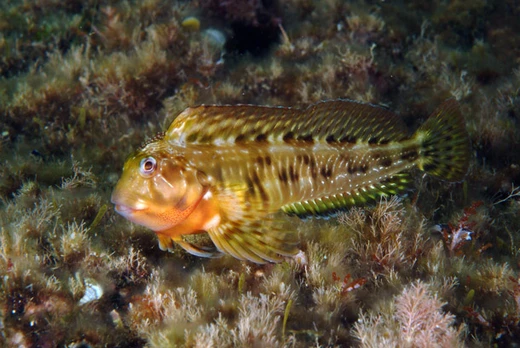
Comet (fish)
Nocturnal reef fish with a moray eel mimicry defense.

The comet, also known as the marine betta (Calloplesiops altivelis), is a tropical saltwater fish from the longfin family Plesiopidae. It lives near reefs in the Indo-Pacific Ocean, typically at depths between 3 and 50 meters, and grows up to 20 centimeters long.
Adults stay close to reefs, often hiding in caves and crevices along drop-offs. Nocturnal by nature, they spend the day under ledges or in holes. At night, they emerge to hunt along the reef. A distinctive eye-like marking on the dorsal fin helps them survive: when threatened, the fish tucks its head into a hole and presents its tail, which resembles the head of a moray eel.
Comets are predators that eat crustaceans and small fish. They hunt by swimming sideways toward their prey, then waiting. When the prey tries to flee to the side, it often moves directly toward the fish’s mouth.
In aquariums, comets are notoriously hard to feed because they typically only accept live food and need time to stalk it. If kept with faster predatory fish like lionfish or groupers, they may starve, as they cannot compete for food. However, they have been bred successfully in captivity.
Quick Facts
- Taxon
- Calloplesiops altivelis
Facts from the source article.
Lore & Background
Adults are usually found near reefs, and in caves and crevices along drop-offs. The comet is nocturnal by nature, and will hide under ledges and in holes by day. During night time, it leaves its hiding place and swims along the reef searching for food. They possess an eye-like shape which is actually the dorsal fin. When in danger, this fish will poke its head into a hole and expose its tail end, which mimics the head of the moray eel.
Comets are predators, feeding on crustaceans and small fish. They catch their prey by approaching it swimming sideways and then waiting for the prey to try to escape. As the prey tries to escape on the side of the fish, it will escape towards the fish's mouth half the time.
In the aquarium, comets are known to be difficult to feed in captivity, as they will generally only accept live foods. Moreover, they require time to stalk their prey. Therefore, if they are in an aquarium with other predatory fish (e.g. lionfish and groupers), they might starve, as they are not fast enough to get a good share of the food. Comets have been successfully bred in captivity.
Reader's Guide
The comet is notable for its distinctive defensive behavior: when threatened, it hides its head in a crevice and presents its tail, which bears an eye-like spot on the dorsal fin, mimicking the head of a moray eel. This adaptation likely deters predators. As a nocturnal predator, it feeds on crustaceans and small fish, using a sideways approach that exploits prey escape behavior. In captivity, the comet is challenging to maintain because it requires live food and time to stalk, and it may compete poorly with faster predatory tankmates. However, successful captive breeding has been achieved, offering potential for sustainable aquarium trade. Its natural depth range of 3 to 50 m and reef-associated habitat make it a common sight for divers in the Indo-Pacific.
Did You Know?
- The comet's eye-like shape on its tail is actually part of its dorsal fin.
- When threatened, it pokes its head into a hole and exposes its tail to mimic a moray eel.
- It catches prey by swimming sideways and waiting for the prey to escape toward its mouth.
More in Blennies, Part 2 1-24
Spotted an error? Know more?
Reader corrections go straight into our review queue. Suggest an edit · How this site is sourced