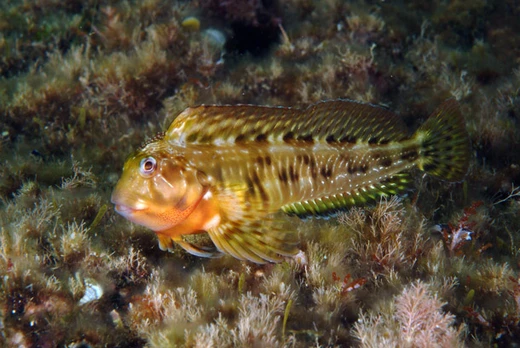
Butterfly blenny
A small blenny with a large eyespot on its dorsal fin.

The butterfly blenny (Blennius ocellaris) is a small fish belonging to the blenniid family, inhabiting marine waters from Northern and Western Europe through the Mediterranean and Black Seas to Morocco. It typically lives at depths between 10 and 400 metres, favoring rocky seabeds. Its body is deep in front and tapers quickly toward the tail, reaching up to 20 centimetres in length. The dorsal fin has 11 to 12 spines and 14 to 16 soft rays, while the anal fin has 2 spines and 15 to 16 soft rays. Tentacles appear on the nasal opening, above the eye, and on the nape near the first dorsal ray. The lateral line is broken, and the front part of the dorsal fin is much taller than the rest. The anal fin is long, extending half the body length, and the pelvic fins are set forward and split in two. The fish is mottled brownish-grey with five to seven dark vertical bars, and a large bluish-black eyespot ringed in white sits on the sixth and seventh dorsal rays. Its range stretches from the Mediterranean up the coasts of Spain, Portugal, and France to the English Channel and Irish Sea, over rocky, seaweed-covered substrates. This habitat makes it rarely caught in trawls, so it may be more common than records suggest. It lives in the subtidal zone down to about 100 metres. Spawning occurs in late spring, as late as June in the English Channel, with eggs hidden under an abandoned shell; the male guards them. One individual near Plymouth was found nesting inside the cavity of a large thigh bone.
Quick Facts
- Genus
- Blennius
- Species
- ocellaris
Facts from the source article.
Lore & Background
The butterfly blenny has a deep body at the front, tapering quickly to the caudal peduncle. It has tentacles on the nasal opening, above the eye, and on the nape near the first dorsal fin ray. The lateral line is discontinuous. The front part of the dorsal fin is much higher than the remainder, and the anal fin runs half the body length. The pelvic fins are set well forward and divided in two. Its coloration is mottled brownish-grey with five to seven dark vertical bars, and a large bluish-black eyespot surrounded by a white ring on the 6th and 7th rays of the dorsal fin.
It is found over rocky substrates covered with seaweed in the subtidal zone, down to about 100 m (330 ft). This habitat means it is seldom caught in trawls and may be more common than it seems. It spawns in late spring, hiding the eggs under an abandoned shell, with the male guarding them. An individual near Plymouth was found nesting inside the cavity of a large thigh bone.
Reader's Guide
The butterfly blenny is a small marine fish of Northern and Western Europe, the Mediterranean Sea, the Black Sea, and Morocco. It inhabits rocky floors with seaweed in the subtidal zone, down to about 100 m (330 ft), though its depth range extends to 400 m (1,312 ft). Its reliance on rocky, seaweed-covered substrates makes it seldom caught in trawls, suggesting it may be more common than records indicate. The species is distinguished by a large bluish-black eyespot ringed in white on the dorsal fin, and by tentacles on the nasal opening, above the eye, and on the nape. It spawns in late spring, with the male guarding eggs hidden under an abandoned shell; one individual near Plymouth was found nesting inside a large thigh bone. These details highlight its cryptic habits and specialized reproductive behavior.
Did You Know?
- It hides its eggs under an abandoned shell, and the male guards them.
- It is seldom caught in trawls because it lives over rocky substrates covered with seaweed.
More in Blennies, Part 2 1-24
Spotted an error? Know more?
Reader corrections go straight into our review queue. Suggest an edit · How this site is sourced