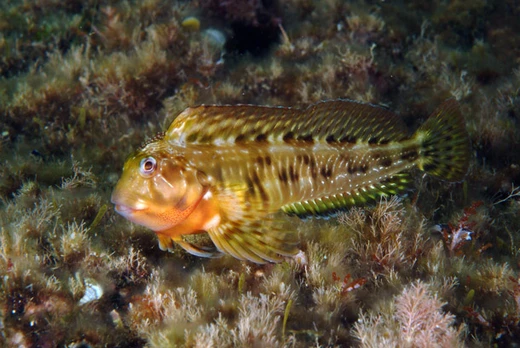
Bluestriped fangblenny
A fangblenny that mimics cleaner wrasse to bite fish.

The bluestriped fangblenny (Plagiotremus rhinorhynchos) is a species of combtooth blenny found in coral reefs in the Pacific and Indian Ocean. It is notable for being a specialized aggressive mimic of the juvenile bluestreak cleaner wrasse, using this resemblance to bite host fish rather than clean them.
Quick Facts
- Taxon
- Plagiotremus rhinorhynchos
Facts from the source article.
Lore & Background
The bluestriped fangblenny hides in deserted worm tubes or other small holes. Unlike most blennies, it is free swimming. Adults inhabit clear, coral-rich areas of lagoon and seaward reefs, and it is fairly common on both coral and rocky reefs, usually occurring singly or in pairs. They are known for being aggressive and feed on skin, mucus and sometimes other fish scales. They bite divers when alarmed.
From before birth, their eggs are demersal and adhesive and attach to substrates via a filamentous adhesive pad or pedestal. Two distinct color phases are present: blue with a black stripe from snout to tail, or orange with two narrow blue lines from snout to tail.
The bluestriped fangblenny is a specialized mimic of juvenile bluestreak cleaner wrasse (Labroides dimidiatus). Those fish serve as cleaners to larger host fish, which attend to have ectoparasites removed. The fangblenny does no cleaning, but bites the host fish and leaves.
Reader's Guide
The bluestriped fangblenny is significant as an example of aggressive mimicry in coral reef ecosystems. It mimics the juvenile bluestreak cleaner wrasse to enable it to loiter at cleaner stations and dupe clients waiting to be cleaned. Its success in this aggressive mimicry is, like Batesian mimicry, frequency-dependent: it works best when the mimic is rare compared to the genuinely symbiotic cleaner fish. This species reaches a length of 12 centimetres SL and is found in the Pacific and Indian Oceans. It is known for being aggressive, feeding on skin, mucus, and sometimes other fish scales, and it bites divers when alarmed. The bluestriped fangblenny hides in deserted worm tubes or other small holes and is free swimming, unlike most blennies. Its two distinct color phases—blue with a black stripe or orange with two narrow blue lines—aid in its mimicry. The species is fairly common on both coral and rocky reefs, usually occurring singly or in pairs.
Did You Know?
- Its success in aggressive mimicry is frequency-dependent, working best when the mimic is rare.
- It can attain around 90 mm in length and has two distinct color phases.
More in Blennies, Part 2 1-24
Spotted an error? Know more?
Reader corrections go straight into our review queue. Suggest an edit · How this site is sourced