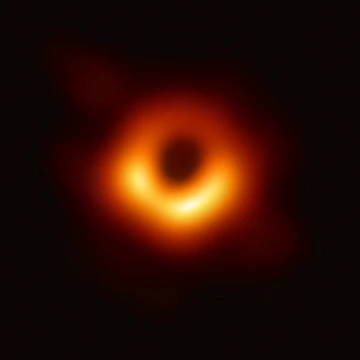
Supermassive black hole
Supermassive black holes anchor the centers of most large galaxies.

Event Horizon Telescope · via Wikipedia: Supermassive black hole · CC BY 4.0
A supermassive black hole is the heaviest kind of black hole, with a mass ranging from hundreds of thousands to billions of times that of the Sun. Black holes form when matter collapses under gravity, creating a spherical region from which nothing, not even light, can escape. Observations show that nearly every large galaxy hosts a supermassive black hole at its core. For instance, the Milky Way’s central black hole corresponds to the radio source Sagittarius A*. When interstellar gas falls onto these black holes, it powers active galactic nuclei and quasars. Two supermassive black holes have been directly imaged by the Event Horizon Telescope: Sagittarius A* and the one at the center of the giant elliptical galaxy Messier 87.
Supermassive black holes are typically defined as those with masses above 100,000 solar masses, and some reach several billion solar masses. Their physical properties set them apart from smaller black holes. For one, the tidal forces near the event horizon are much weaker. A person at the event horizon of a 10-million-solar-mass black hole would feel about the same tidal stretch between head and feet as on Earth’s surface. Unlike with stellar-mass black holes, significant tidal forces only occur deep inside the event horizon. Another counterintuitive feature is that the average density of a supermassive black hole—mass divided by the volume within its Schwarzschild radius—can be less than water’s density. This happens because the Schwarzschild radius scales directly with mass, while volume scales with the cube of the radius, so density drops as the square of mass. The Schwarzschild radius of a non-rotating, uncharged black hole of about 1 billion solar masses is roughly 19 astronomical units, similar to Uranus’s orbital distance. Some astronomers call black holes above 5 billion solar masses “ultramassive,” though the term is not widely used. Possible examples include the cores of TON 618, NGC 6166, ESO 444-46, and NGC 4889, among the most massive known. Studies suggest that the maximum natural mass for a luminous black hole with an accretion disk is around 50 billion solar masses, but a 2020 study proposed that even larger ones, dubbed “stupendously large black holes” with masses over 100 billion solar masses, could exist based on models; some place the black hole at the core of Phoenix A in this category.
- Mass range
- 100,000 to billions of solar masses
- Schwarzschild radius
- Directly proportional to mass; for 1 billion M☉, comparable to 19 AU
- Density
- Inversely proportional to the square of mass; can be less than water
- Known examples
- Sagittarius A*, Messier 87, TON 618, NGC 6166, ESO 444-46, NGC 4889, Phoenix A
- First direct image
- Messier 87 black hole, April 10, 2019, by Event Horizon Telescope
Lore & Background
The story of how supermassive black holes were found began with the investigation by Maarten Schmidt of the radio source 3C 273 in 1963. Initially thought to be a star, its spectrum proved puzzling and was determined to be hydrogen emission lines that had been redshifted, indicating the object was moving away from Earth. Hubble's law showed the object was located several billion light-years away, emitting the energy equivalent of hundreds of galaxies. The rate of light variations suggested the emitting region had a diameter of one parsec or less. In 1963, Fred Hoyle and W. A. Fowler proposed the existence of hydrogen-burning supermassive stars as an explanation, but Richard Feynman noted stars above a certain critical mass are dynamically unstable and would collapse into a black hole. Edwin E. Salpeter and Yakov Zeldovich proposed in 1964 that matter falling onto a massive compact object would explain the properties of quasars, requiring a mass of around 10^8 M☉.
Reader's Guide
Supermassive black holes are significant because they are now understood to be a common component of large galaxies, with observational evidence indicating almost every large galaxy has one at its center. Their discovery transformed the understanding of active galactic nuclei and quasars, which are powered by accretion of interstellar gas onto these black holes. The first direct image of a supermassive black hole, released by the Event Horizon Telescope in 2019, confirmed the existence of the event horizon and provided visual proof of these objects. The tidal forces near the event horizon of a supermassive black hole are much weaker than for stellar-mass black holes, and their average density can be less than water. The maximum natural mass for a luminous accreting black hole is typically around 50 billion M☉, though some studies suggest even larger 'stupendously large black holes' could exist. The legacy of supermassive black hole research includes the 2020 Nobel Prize in Physics awarded for the discovery of a supermassive compact object at the center of the Milky Way.
Did You Know?
- The tidal force on a person at the event horizon of a 10 million M☉ black hole is about the same as the tidal force between their head and feet on Earth.
- The Schwarzschild radius of a nonrotating supermassive black hole of around 1 billion M☉ is comparable to the semi-major axis of the orbit of Uranus.
- Some astronomers refer to black holes of greater than 5 billion M☉ as ultramassive black holes, though the term is not broadly used.
- The first horizon-scale image of a black hole, released in 2019, was of the supermassive black hole in the center of Messier 87.
More in Black holes 1-24
Spotted an error? Know more?
Reader corrections go straight into our review queue. Suggest an edit · How this site is sourced