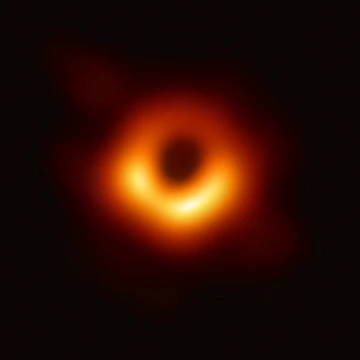
Stellar black hole
Black hole formed by gravitational collapse of a star.

ESO/L. Calçada/M.Kornmesser · via Wikipedia: Stellar black hole · CC BY 4.0
A stellar black hole, also known as a stellar-mass black hole, forms when a star collapses under its own gravity. These objects typically have masses between about five and several tens of times that of the Sun. While they often result from supernova explosions, other processes may also create them.
According to the no-hair theorem, a black hole is defined by only three properties: mass, electric charge, and angular momentum. For a stellar black hole, its spin comes from the conservation of angular momentum of the original star or the material that formed it.
A massive star inevitably collapses at the end of its life once its internal energy sources are exhausted. If the collapsing core’s mass is below the Chandrasekhar limit, a white dwarf forms. If it is higher but still below the Tolman–Oppenheimer–Volkoff (TOV) limit for neutron-degenerate matter, the result is a neutron star. If the collapsing mass exceeds the TOV limit, the collapse continues until a black hole is created. These limits are approximate and can shift depending on the star’s composition and rotation.
The exact maximum mass a neutron star can have before collapsing into a black hole remains uncertain. In 1939, the TOV limit was estimated at 0.7 solar masses. By 1996, a different estimate placed it between 1.5 and 3 solar masses. The most massive neutron star observed, PSR J0740+6620, has a mass of about 2.14 solar masses.
General relativity allows black holes of any mass, but lower masses require higher densities to form. No known stellar process produces black holes with masses less than a few times the Sun’s mass; if such small black holes exist, they are likely primordial. Until 2016, the largest known stellar black hole had a mass of 15.65 ± 1.45 solar masses. In September 2015, gravitational waves revealed a rotating black hole of 62 ± 4 solar masses formed from the merger of two smaller black holes. As of June 2020, the smallest known stellar black hole, in the binary system 2MASS J05215658+4359220, has a mass of 3.3 solar masses and a diameter of just 19.5 kilometers.
Observational evidence also points to two other, much more massive types of black holes: intermediate-mass black holes in globular clusters and supermassive black holes at the centers of galaxies like the Milky Way.
- Mass range
- ~5 to several tens of solar masses
- Smallest known mass
- 3.3 solar masses (as of June 2020)
- Largest known mass until 2016
- 15.65±1.45 solar masses
- Largest known mass 2015 merger
- 62±4 solar masses
- Diameter of smallest known
- 19.5 kilometers
- Fundamental properties
- mass, electric charge, angular momentum
Lore & Background
Stellar black holes form when a massive star exhausts its nuclear fuel and undergoes gravitational collapse. If the collapsing core's mass exceeds the Tolman–Oppenheimer–Volkoff limit, collapse continues until a black hole forms. The maximum mass a neutron star can have before collapsing into a black hole is not fully understood; estimates have ranged from 0.7 solar masses (1939) to 1.5–3 solar masses (1996). The maximum observed neutron star mass is about 2.14 solar masses for PSR J0740+6620 (discovered September 2019).
In close binary systems, stellar black holes are detected when they pull matter from a companion star, heating it to hundreds of millions of degrees and producing X-rays. The derived masses come from combining X-ray and optical data. All identified neutron stars have masses below 3.0 solar masses, while compact systems above that mass are considered black holes, though this proof relies partly on theory. A direct proof would require observing a particle or gas cloud falling into the black hole.
Some binaries are found far above the galactic plane due to black hole natal kicks. The velocity distribution of these kicks appears similar to that of neutron star kicks, contrary to expectations that higher mass would yield lower velocity. This may be due to fall-back of asymmetrically expelled matter increasing the black hole's momentum.
Reader's Guide
Stellar black holes are significant as the most common type of black hole formed from stellar evolution, bridging the gap between neutron stars and supermassive black holes. Their study provides crucial tests of general relativity and stellar astrophysics. The no-hair theorem limits their properties to mass, electric charge, and angular momentum. Observational evidence comes primarily from X-ray binary systems, where mass measurements above 3 solar masses strongly suggest black holes rather than neutron stars. The discovery of gravitational waves from merging stellar black holes (e.g., a 62±4 solar mass rotating black hole in September 2015) opened a new window for studying them. Mass gaps—ranges where black holes are not expected to form directly from stellar collapse—are predicted by models but challenged by observations, such as the 3.3 solar mass black hole candidate in 2MASS J05215658+4359220 and gravitational wave events in the lower mass gap. These gaps remain uncertain and may be populated by mergers. Stellar black holes also inform our understanding of supernova mechanisms, binary evolution, and the demographics of compact objects in the Milky Way and beyond.
Did You Know?
- The smallest known stellar black hole, as of June 2020, has a mass of 3.3 solar masses and a diameter of only 19.5 kilometers.
- In September 2015, a rotating black hole of 62±4 solar masses was discovered via gravitational waves from a merger of two smaller black holes.
- The maximum observed mass of a neutron star is about 2.14 solar masses for PSR J0740+6620, discovered in September 2019.
- A lower mass gap of roughly 2 to 5 solar masses is suspected, but its existence and theoretical basis are uncertain.
More in Black holes 1-24
Spotted an error? Know more?
Reader corrections go straight into our review queue. Suggest an edit · How this site is sourced