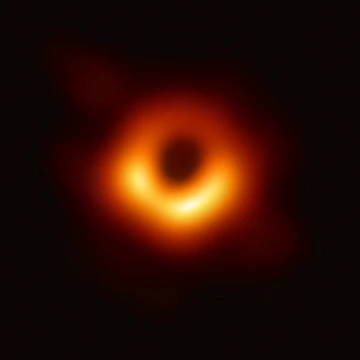
Primordial black hole
Hypothetical black holes formed moments after the Big Bang.
Primordial black holes (PBHs) are hypothetical black holes that formed soon after the Big Bang, during the inflationary era or early radiation-dominated universe, when extremely dense pockets of subatomic matter underwent gravitational collapse. Unlike stellar black holes, they do not require supernova compression and are not limited to a narrow mass range, potentially spanning from minuscule masses to thousands of solar masses. Their existence remains hypothetical but they are considered plausible candidates for dark matter and for seeding supermassive black holes.
- Field
- Cosmology, astrophysics
- Known for
- Hypothetical black holes formed in the early universe, proposed as dark matter candidates and possible seeds for supermassive black holes
Lore & Background
The concept of primordial black holes was first proposed in 1966 by Yakov Zeldovich and Igor Novikov, with the first in-depth study conducted by Stephen Hawking in 1971. They are thought to have formed less than one second after the Big Bang, before nucleosynthesis, making them naturally collisionless, stable (if sufficiently massive), and non-relativistic—properties that align with dark matter candidates. Many PBHs may have the mass of an asteroid but the size of a hydrogen atom, traveling at enormous speeds, with one likely within the Solar System at any given time; most would pass through stars without effect, but slow-moving ones could be captured, and Hawking proposed the Sun might harbor such a black hole.
Interest in PBHs revived strongly after the 2016 LIGO/Virgo detection of gravitational waves from merging 30-solar-mass black holes, with three groups independently proposing a primordial origin. Subsequent research has explored PBHs as dark matter across various mass ranges, including asteroid-mass PBHs (3.5 × 10⁻¹⁷ to 4 × 10⁻¹² solar masses) that could constitute all dark matter, and Earth-mass PBHs (5–15 M🜨) proposed in 2019 to explain orbital anomalies in the extended Kuiper Belt. In September 2022, PBHs were proposed to explain the unexpectedly large early galaxies ("little red dots") observed by the James Webb Space Telescope.
In November 2025, the LIGO/Virgo/KAGRA collaboration reported an unusual gravitational wave from a black hole merger with sub-solar masses, suggesting evidence for a primordial black hole population. Later in 2025, JWST observations of high-redshift little red dots provided constraints favoring massive black hole seeds from PBHs over standard stellar remnant models. A direct dynamical mass measurement of a black hole in a strongly lensed LRD at redshift 7.04 found a central mass of about 50 million solar masses, outweighing its galaxy's stars, and the most distant black hole identified to date—at redshift 12.34, less than 400 million years after the Big Bang—further challenged standard accretion limits.
Reader's Guide
Primordial black holes hold significance as a potential solution to multiple cosmological puzzles. They are leading candidates for dark matter, with recent analyses suggesting a broad mass distribution with a mode around one solar mass, consistent with observations from LIGO/Virgo and JWST. Their early formation before nucleosynthesis makes them naturally suited to explain the missing mass in the universe, and they may also serve as seeds for supermassive black holes at the centers of galaxies, including intermediate-mass black holes. The detection of gravitational waves from sub-solar-mass mergers in 2025 provided the strongest direct evidence yet for a primordial black hole population, while JWST observations of overmassive black holes in very early galaxies—such as a 50-million-solar-mass black hole at redshift 7.04 and a 10⁸-solar-mass black hole at redshift 8.6—support the idea that PBHs formed via direct collapse rather than from stellar remnants. Despite ongoing debates about abundance constraints from microlensing, cosmic microwave background anisotropies, and dwarf galaxy sizes, the convergence of gravitational-wave and JWST data has strengthened the case that PBHs may constitute a significant fraction—or even all—of dark matter, reshaping our understanding of the early universe and structure formation.
More in Black holes 1-24
Spotted an error? Know more?
Reader corrections go straight into our review queue. Suggest an edit · How this site is sourced