Oppenheimer–Snyder model
Model of stellar collapse into a black hole.
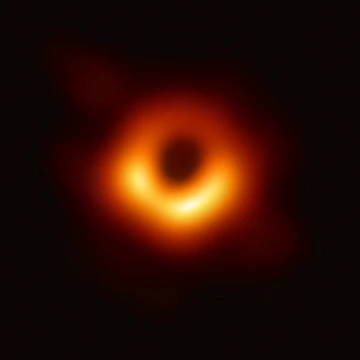
In general relativity, the Oppenheimer–Snyder model offers a way to understand how an extremely massive object can collapse into a black hole. It is a specific solution to the Einstein field equations, built upon the Schwarzschild metric, and takes its name from the physicists J. Robert Oppenheimer and Hartland Snyder, who introduced it in 1939. As a star collapses into a black hole, the geometry outside the collapsing sphere matches the Schwarzschild geometry, while the geometry inside the sphere is the same Robertson-Walker geometry found in the rest of the observable universe.
Albert Einstein developed his theory of general relativity in 1915. Although the Schwarzschild metric—the first nontrivial exact solution to Einstein's field equations, found by Karl Schwarzschild in 1916—implied the existence of black holes, Einstein initially denied they could be real. In 1939, he published a paper in the *Annals of Mathematics* arguing that these "Schwarzschild singularities" do not exist in physical reality. Just months later, Oppenheimer and his student Hartland Snyder published "On Continued Gravitational Contraction," which reached the opposite conclusion. They demonstrated that when a sufficiently massive star exhausts its thermonuclear fuel, it undergoes continued gravitational contraction and becomes isolated from the rest of the universe by an event horizon, a boundary from which even light cannot escape. This work predicted what are now called black holes, though the term itself was coined decades later, in the fall of 1967, by John Archibald Wheeler at a conference at the Goddard Institute for Space Studies, appearing in print the following year. Oppenheimer and Snyder used Einstein's own theory of gravity to show for the first time in contemporary physics how black holes could form, without referencing Einstein's 1939 article. They did, however, refer to an earlier paper by Oppenheimer and Robert Serber on neutron stars, which improved upon work by Lev Davidovich Landau and was essentially an exercise in nuclear physics and gravitation.
This line of investigation caught the attention of Richard Chace Tolman, who had previously found an exact solution to the Einstein field equations describing a static ideal fluid sphere.
- Field
- General relativity, astrophysics
- Known for
- Oppenheimer–Snyder model of gravitational collapse into a black hole
- Publication year
- 1939
- Key concept
- Continued gravitational contraction leading to an event horizon
Lore & Background
Albert Einstein, who developed general relativity in 1915, initially denied the possibility of black holes, despite the Schwarzschild metric obtained by Karl Schwarzschild in 1916. In 1939, Einstein published a paper claiming that 'Schwarzschild singularities' do not exist in physical reality. Months later, J. Robert Oppenheimer and his student Hartland Snyder published 'On Continued Gravitational Contraction,' arguing the opposite: a sufficiently massive star, after running out of thermonuclear fuel, will undergo continued gravitational contraction and become separated from the rest of the universe by an event horizon. This paper predicted the existence of what are now called black holes, though the term 'black hole' was coined decades later, in 1967, by John Archibald Wheeler.
Reader's Guide
The Oppenheimer–Snyder model was a landmark in general relativity, providing the first proof using Einstein's own theory that black holes could develop. The model describes the line element for continued gravitational collapse, with coordinates (τ, R, θ, φ) and parameters including the boundary of the matter region (R_b > 0) and mass (M > 0). The expression is valid both inside and outside the matter region, transitioning continuously. Initially, physicists were skeptical, viewing the model as 'truly strange' because the mathematical implications were so different from existing mental pictures. The work built on earlier studies by Oppenheimer and Robert Serber on neutron stars, and was influenced by Richard Chace Tolman's exact solution for a static ideal fluid sphere. Together with the Tolman-Oppenheimer-Volkoff limit, these papers established the foundation for the general-relativistic theory of stellar structure. Oppenheimer did not revisit the topic in future publications.
Did You Know?
- The Oppenheimer–Snyder model uses the same Robertson-Walker geometry inside the collapsing sphere as in the rest of the observable universe.
- The term 'black hole' was coined by John Archibald Wheeler in 1967, decades after Oppenheimer and Snyder's 1939 paper.
- Oppenheimer and Snyder's paper did not reference Einstein's 1939 article denying black holes, but did refer to an earlier paper by Oppenheimer and Robert Serber on neutron stars.
- The model's line element includes a function A(η) = (1 + cos η)/2, where η is defined implicitly by a relation involving τ and R.
More in Black holes 1-24
Spotted an error? Know more?
Reader corrections go straight into our review queue. Suggest an edit · How this site is sourced