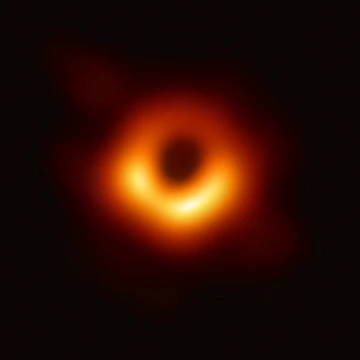
Kerr metric
Exact solution for rotating uncharged black holes.

Yukterez (Simon Tyran, Vienna) · via Wikipedia: Kerr metric · CC BY-SA 4.0
The Kerr metric describes the shape of empty spacetime around a rotating, uncharged black hole that is symmetric along its axis of rotation and has a nearly spherical event horizon. It is an exact solution to the Einstein field equations of general relativity, a set of highly non-linear equations for which exact solutions are rare. Roy Kerr found this solution in 1963, extending Karl Schwarzschild's 1915 metric—which described spacetime around a non-rotating, uncharged, spherical body—to account for rotation. (The charged, non-rotating case, the Reissner–Nordström metric, had been solved between 1916 and 1918, and the charged, rotating case, the Kerr–Newman metric, followed shortly after in 1965.)
A key prediction of the Kerr metric is frame-dragging, also called Lense–Thirring precession. This effect, first measured in 2011 by the Gravity Probe B experiment, means that objects near a rotating mass are pulled along with its rotation, not by any force or torque, but because the curvature of spacetime itself swirls around the rotating body. For a rotating black hole, at close enough distances, everything—including light—must rotate with it; this region is the ergosphere. Light from distant sources can loop around the event horizon multiple times if it passes close enough, producing several images of the same object. To a distant observer, the apparent perpendicular distance between these images shrinks by a factor of about 535 (e²π), though this distance is smaller for fast-spinning black holes.
The metric appears to have singularities at certain surfaces, whose size and shape depend on the black hole's mass and angular momentum. The outer surface, which encloses the ergosphere, is shaped like a flattened sphere. The inner surface is the event horizon: anything crossing it can never communicate with the outside universe. Neither surface is a true singularity, because a different choice of coordinates removes the apparent problem—similar to how the Schwarzschild metric's apparent singularity at its Schwarzschild radius can be eliminated by a coordinate transformation, connecting the external and internal patches. Objects between these two surfaces must co-rotate with the black hole, a feature that could, in principle, be used to extract energy from the black hole, up to its total mass-energy (Mc²).
- Field
- General relativity, black hole physics
- Known for
- Kerr metric (rotating black hole solution)
- Type
- Exact solution to Einstein field equations
Lore & Background
The Kerr metric was discovered in 1963 by Roy Kerr, filling a gap left by the Schwarzschild metric (1915) for non-rotating bodies and the Reissner–Nordström metric (1916–1918) for charged, non-rotating bodies. The natural extension to a charged, rotating black hole, the Kerr–Newman metric, was discovered shortly thereafter in 1965. The metric is commonly expressed in Boyer–Lindquist or Kerr–Schild forms, and can be derived from the Schwarzschild metric using the Newman–Janis algorithm or other methods.
A key feature of the Kerr metric is frame-dragging (Lense–Thirring precession), a prediction of general relativity first measured in 2011 by the Gravity Probe B experiment. This effect causes objects near a rotating mass to be entrained in its rotation due to the swirling curvature of spacetime. For rotating black holes, the region where all objects, including light, must co-rotate is called the ergosphere.
The metric has surfaces with apparent singularities: an outer surface enclosing the ergosphere (flattened sphere shape) and an inner surface marking the event horizon. Neither is a true singularity, as they can be eliminated by a different coordinate system. Objects between these surfaces must co-rotate with the black hole, a feature that can be used to extract energy up to the black hole's invariant mass energy.
Reader's Guide
The Kerr metric is significant as the exact solution for rotating uncharged black holes, a class of objects now known to exist through gravitational wave observations. The LIGO experiment, which first detected gravitational waves in 2016, provided the first direct observation of a pair of Kerr black holes. The metric predicts frame-dragging, confirmed by Gravity Probe B in 2011, and the ergosphere where co-rotation is mandatory. Light from distant sources can travel around the event horizon multiple times, creating multiple images whose apparent perpendicular distance decreases by a factor of e2π (about 535), though fast-spinning black holes reduce this distance. The metric's legacy includes enabling the study of energy extraction via the Penrose process and its role as a gravitational soliton in the Belinski–Zakharov transform. It remains a fundamental tool for understanding black hole astrophysics and testing general relativity.
Did You Know?
- Frame-dragging, predicted by the Kerr metric, was first measured in 2011 by the Gravity Probe B experiment.
- The LIGO experiment's 2016 detection of gravitational waves provided the first direct observation of a pair of Kerr black holes.
More in Black holes 1-24
Spotted an error? Know more?
Reader corrections go straight into our review queue. Suggest an edit · How this site is sourced