Holographic principle
The universe may be a hologram encoded on a distant surface.
The holographic principle is a property of string theories and a supposed property of quantum gravity. It states that the description of a volume of space can be thought of as encoded on a lower-dimensional boundary to the region, such as a light-like boundary like a gravitational horizon.
- First proposed by
- Gerard 't Hooft
- Year first proposed
- 1993
- String theoretic interpretation by
- Leonard Susskind
- Prime example
- AdS/CFT correspondence
- Inspired by
- Bekenstein bound of black hole thermodynamics
Lore & Background
The holographic principle was first proposed by Gerard 't Hooft in 1993. It was given a precise string theoretic interpretation by Leonard Susskind, who combined his ideas with previous ones of 't Hooft and Charles Thorn. Susskind stated that the three-dimensional world of ordinary experience is a hologram, an image of reality coded on a distant two-dimensional surface. As pointed out by Raphael Bousso, Thorn observed in 1978 that string theory admits a lower-dimensional description from which gravity emerges in what would now be called a holographic way. The prime example of holography is the AdS/CFT correspondence.
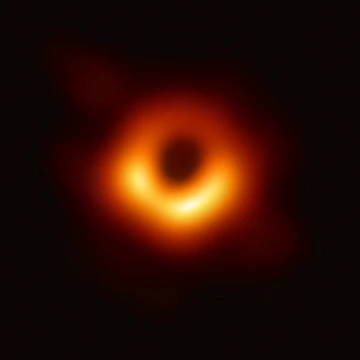
The holographic principle was inspired by the Bekenstein bound of black hole thermodynamics, which conjectures that the maximum entropy in any region scales with the radius squared, rather than cubed as might be expected. In the case of a black hole, the insight was that the information content of all the objects that have fallen into the hole might be entirely contained in surface fluctuations of the event horizon. The holographic principle resolves the black hole information paradox within the framework of string theory.
However, there exist classical solutions to the Einstein equations that allow values of the entropy larger than those allowed by an area law, hence in principle larger than those of a black hole. These are the so-called 'Wheeler's bags of gold'. The existence of such solutions conflicts with the holographic interpretation, and their effects in a quantum theory of gravity including the holographic principle are not yet fully understood.
Reader's Guide
The holographic principle represents a significant shift in understanding the nature of space, time, and information. It suggests that the three-dimensional world may be a projection of information encoded on a two-dimensional surface, challenging the conventional view of volume as fundamental. This principle resolves the black hole information paradox within string theory by proposing that information falling into a black hole is stored on its event horizon. The AdS/CFT correspondence, the prime example of holography, provides a non-perturbative formulation of string theory and a powerful toolkit for studying strongly coupled quantum field theories. It translates problems in nuclear and condensed matter physics into more mathematically tractable problems in string theory. The principle also connects thermodynamic entropy with Shannon entropy, suggesting that the physical world may be fundamentally made of information, with energy and matter as incidentals. However, unresolved issues remain, such as the conflict with 'Wheeler's bags of gold' solutions, indicating that the full implications of the holographic principle in quantum gravity are still under investigation.
Did You Know?
- Leonard Susskind gave it a precise string theoretic interpretation, combining his ideas with those of 't Hooft and Charles Thorn.
- The prime example of holography is the AdS/CFT correspondence, first proposed by Juan Maldacena in late 1997.
More in Black holes 1-24
Spotted an error? Know more?
Reader corrections go straight into our review queue. Suggest an edit · How this site is sourced