History of black hole physics
From theoretical singularity to observed cosmic phenomenon.

IMAGE: NASA, CXC, Melissa Weiss (CXC) · via Wikipedia: History of black hole physics · Public domain
The history of black hole physics spans from early speculations about invisible stars to a mature field of observational and theoretical research. The concept evolved through general relativity, quantum mechanics, and astronomical discovery, transforming from a mathematical curiosity into a widely accepted astrophysical reality.
- Field
- Astrophysics, General Relativity
- Known for
- Development of black hole theory from early concepts to observational confirmation
Lore & Background
Before general relativity, John Michell in 1784 and Pierre-Simon Laplace in 1796 independently proposed stars so massive that light could not escape, though they envisioned large stars rather than dense objects. Michell noted such bodies might be detectable through gravitational effects on nearby stars. Laplace later omitted the idea from his book, possibly due to doubts raised by wave theory of light.
General relativity, completed by Albert Einstein in 1917, provided the framework for black hole physics. Karl Schwarzschild soon found a solution to Einstein's field equations containing a singularity, later called the Schwarzschild solution, describing non-spinning, uncharged black holes. Many early physicists, including Arthur Eddington and Einstein himself, dismissed black holes as impossible or purely theoretical. In 1939, J. Robert Oppenheimer and Hartland Snyder analyzed stellar collapse and found no mechanism that could prevent all stars from becoming black holes, shifting scientific opinion.
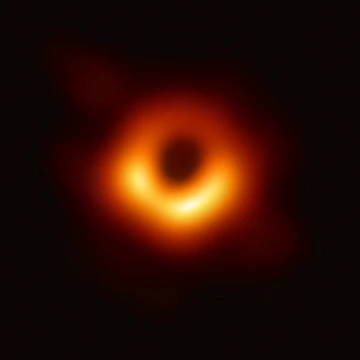
Further metrics described other black hole types: the Reissner-Nordstrom metric for charged, non-spinning black holes; the Kerr metric for spinning, uncharged ones; and the Kerr-Newman metric for spinning, charged black holes. Werner Israel showed that any black hole must be described by only three properties: charge, mass, and spin. The first widely recognized black hole, Cygnus X-1, was discovered in 1972 and accepted by most scientists by 1973. The Hubble Space Telescope later revealed supermassive black holes in nearly all galactic centers. Recent advances in interferometry produced the first photograph of a black hole and detected black hole mergers via gravitational waves.
Reader's Guide
The history of black hole physics illustrates a dramatic shift from theoretical rejection to empirical confirmation. Early work by Michell and Laplace anticipated the concept, but it was general relativity that provided the mathematical foundation. The Schwarzschild solution introduced singularities, but resistance from leading physicists delayed acceptance. Oppenheimer and Snyder's 1939 analysis was pivotal, showing collapse could not be universally prevented. The subsequent development of the Kerr, Reissner-Nordstrom, and Kerr-Newman metrics, along with Israel's no-hair theorem, established a complete theoretical framework. Observational milestones—the identification of Cygnus X-1, the ubiquity of supermassive black holes revealed by Hubble, and direct imaging and gravitational wave detection—transformed black holes from theoretical constructs into observable objects. This history demonstrates how theoretical predictions, despite initial skepticism, can be validated by advancing technology and observation, fundamentally altering our understanding of the universe.
Did You Know?
- John Michell in 1784 calculated that a star with the same density but 500 times the Sun's radius would have a surface escape velocity exceeding the speed of light.
- In 1939, Einstein himself used general relativity in an attempt to prove black holes were impossible, missing the possibility of implosion driving the system below the critical radius.
- Werner Israel discovered that any black hole can only have three properties: charge, mass, and spin.
More in Black holes 1-24
Spotted an error? Know more?
Reader corrections go straight into our review queue. Suggest an edit · How this site is sourced