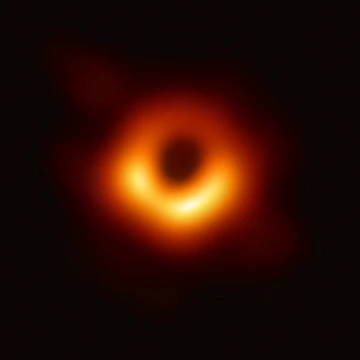
Hawking radiation
Theoretical radiation emitted by black holes due to quantum effects.
Hawking radiation is a theoretical process by which black holes emit thermal radiation due to quantum effects near the event horizon. Predicted by Stephen Hawking in 1974, this radiation was not accounted for in earlier models, which assumed that nothing could escape a black hole once inside the event horizon. The effect implies that black holes can lose mass and eventually evaporate, though for most black holes this occurs extremely slowly.
- Field
- Theoretical physics
- Known for
- Prediction of black hole radiation (Hawking radiation)
Lore & Background
Hawking radiation was developed by Stephen Hawking in 1974, building on earlier work by Yakov Zeldovich and Alexei Starobinsky, who proposed in 1971 that rotating black holes could create and emit particles. Jacob Bekenstein in 1972 theorized that black holes should have entropy proportional to their surface area, a concept Hawking initially argued against. After meeting Zeldovich in Moscow in 1973, Hawking combined quantum field theory with general relativity to show that black holes radiate as blackbodies.
The radiation temperature, known as Hawking temperature, is inversely proportional to the black hole's mass, meaning smaller black holes emit more intensely and dissipate faster. For micro black holes, if they exist as primordial black holes, the process would accelerate as they shrink, ending in a burst of high-energy radiation. Such bursts have not yet been detected, as Hawking radiation is extremely faint and below current telescope sensitivity.
The emission process is linked to vacuum fluctuations: a fluctuation can produce a photon pair near the event horizon, with one particle escaping and the other falling inward. This effectively drains energy from the black hole, reducing its mass and rotational energy.
Reader's Guide
Hawking radiation fundamentally changed the understanding of black holes, transforming them from objects that only consume matter and energy into entities that can slowly evaporate. The theory resolved a paradox by showing that black holes have a temperature and entropy, consistent with thermodynamic laws. This result emerged from the combination of quantum field theory and general relativity, a synthesis that had not been achieved before.
The prediction has profound implications for black hole physics and cosmology. If primordial black holes exist, their evaporation could produce detectable gamma-ray bursts, though none have been observed. The radiation is many orders of magnitude too faint for current telescopes to detect directly, so experimental confirmation remains elusive. Nonetheless, the mathematical derivation has been verified through multiple approaches, including path integrals.
The concept also connects to the Unruh effect and the equivalence principle, as an observer accelerating near a black hole's horizon perceives a thermal bath of particles. Hawking radiation remains a cornerstone of theoretical physics, bridging quantum mechanics and gravity, and continues to inspire research into quantum gravity and the ultimate fate of black holes.
Did You Know?
- Hawking radiation was not predicted by earlier models, which assumed that once electromagnetic radiation is inside the event horizon, it cannot escape.
- The radiation temperature, called Hawking temperature, is inversely proportional to the black hole's mass, so micro black holes are predicted to emit more radiation than larger ones.
- Hawking radiation would reduce the mass and rotational energy of black holes, causing them to evaporate over time.
- The theory was supported by Jacob Bekenstein's earlier work, which theorized that black holes should have finite entropy proportional to their surface area.
More in Black holes 1-24
Spotted an error? Know more?
Reader corrections go straight into our review queue. Suggest an edit · How this site is sourced