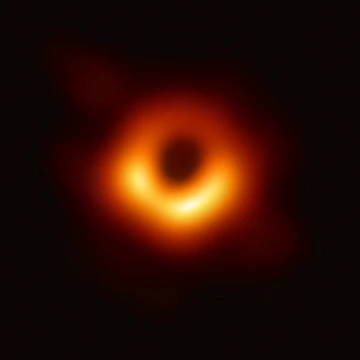
Gravitational collapse
Gravitational collapse shapes stars, remnants, and black holes.

Illustration by R.J. Hall. Redrawn in Inkscape by Magasjukur2 · via Wikipedia: Gravitational collapse · CC BY-SA 3.0
Gravitational collapse happens when an astronomical object contracts under its own gravity, pulling matter inward toward its center. This process is a key way structures form in the universe. Over time, a once relatively smooth spread of matter, after gathering enough material, can collapse into denser pockets, like stars or black holes.
Star formation begins with the gradual gravitational collapse of interstellar medium into clumps of molecular clouds and potential protostars. The compression from the collapse heats things up until thermonuclear fusion ignites at the star's core. At that point, the collapse slows and stops because outward thermal pressure balances the inward gravitational pull, and the star settles into thermodynamic equilibrium. Later in its life, a star may collapse again, reaching several new equilibrium states.
For star formation, an interstellar gas cloud stays in hydrostatic equilibrium as long as the kinetic energy from gas pressure balances the potential energy from gravity. The virial theorem expresses this mathematically: to stay balanced, the gravitational potential energy must equal twice the internal thermal energy. If a gas pocket is massive enough that its gas pressure can't support it, the cloud undergoes gravitational collapse. The critical mass for this collapse is called the Jeans mass, which depends on the cloud's temperature and density, typically ranging from thousands to tens of thousands of solar masses.
When a star dies—having used up its fuel—it contracts, and this contraction can only stop if it reaches a new equilibrium. Depending on the star's mass during its lifetime, the remnant takes one of three forms: a white dwarf, where electron degeneracy pressure opposes gravity; a neutron star, where neutron degeneracy pressure and short-range repulsive neutron-neutron interactions (mediated by the strong force) hold it up; or a black hole, where no force is strong enough to resist collapse. Theoretically, compact exotic stars made of quarks or preons could exist, but these remain hypothetical.
For isolated stars with one to seven times the Sun's mass, the final stage is a white dwarf. The core collapses into a white dwarf over tens of thousands of years, while the star blows off its outer layers as a planetary nebula. A white dwarf may have a magnetic field, a fossil remnant of its original stellar field.
- Field
- Astrophysics, General Relativity
- Known for
- Fundamental mechanism for structure formation; star formation; stellar remnants; black hole formation
Lore & Background
Gravitational collapse begins when an interstellar cloud of gas can no longer maintain hydrostatic equilibrium, meaning the kinetic energy of gas pressure is insufficient to balance the gravitational potential energy. The critical mass for such collapse is the Jeans mass, which depends on temperature and density and typically ranges from thousands to tens of thousands of solar masses. During star formation, collapse raises temperature until thermonuclear fusion begins, halting further contraction as outward thermal pressure balances gravity. Later in a star's evolution, collapse may resume, leading to new equilibrium states or to stellar remnants.
For stars with initial masses between one and seven solar masses, the final stage is a white dwarf, supported by electron degeneracy pressure. If a white dwarf accretes matter from a companion, it can approach the Chandrasekhar limit (about 1.5 solar masses), triggering a runaway carbon detonation that destroys the star in a Type Ia supernova. More massive stars collapse into neutron stars, supported by neutron degeneracy pressure and short-range repulsive interactions, or into black holes if the mass exceeds the Tolman–Oppenheimer–Volkoff limit (roughly double the solar mass).
Black holes form when no known force can oppose gravity, and the collapsing object passes within its Schwarzschild radius, creating an event horizon from which light cannot escape. According to general relativity, a singularity is inevitable inside the horizon, though quantum theories suggest that at Planck density, gravitational collapse may cease and a singularity may not form. The nature of the singularity remains controversial, with competing theories such as loop quantum gravity predicting a Planck star.
Reader's Guide
Gravitational collapse is central to understanding the life cycle of stars and the formation of compact objects. It explains how diffuse interstellar gas condenses into stars, how stars maintain equilibrium through fusion, and how they end as white dwarfs, neutron stars, or black holes. The concept also underpins the Chandrasekhar limit and the Tolman–Oppenheimer–Volkoff limit, which define the mass thresholds for different remnants. In black hole physics, collapse leads to event horizons and singularities, with ongoing debate about the role of quantum gravity at extreme densities. The process is also invoked in cosmological scenarios such as the Big Crunch. Gravitational collapse thus bridges classical mechanics, thermodynamics, and general relativity, and remains a key area of research in astrophysics.
Did You Know?
- The critical mass for gravitational collapse of a gas cloud is called the Jeans mass, typically thousands to tens of thousands of solar masses.
- A white dwarf can detonate repeatedly as a nova by accreting hydrogen from a companion, without being disrupted.
- Neutron stars have a density of about 6.65×10^17 kg/m³ and are composed almost entirely of neutron matter.
- Black holes are thought to have no magnetic field of their own; any precursor magnetic field is dispelled during collapse.
More in Black holes 1-24
Spotted an error? Know more?
Reader corrections go straight into our review queue. Suggest an edit · How this site is sourced