Fuzzball (string theory)
Hypothetical string-theory objects replacing black hole singularities.
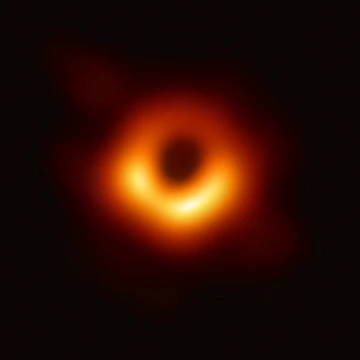
Fuzzballs are hypothetical objects in superstring theory that provide a fully quantum description of black holes. They dispense with the singularity at the heart of a black hole by positing that the entire region within the event horizon is an extended object composed of strings, the ultimate building blocks of matter and light.
- Field
- Superstring theory, quantum gravity
- Known for
- Proposing that black holes are sphere-like extended objects made of strings, resolving the black hole information paradox and avoiding singularities
Lore & Background
The fuzzball hypothesis was developed through eight scientific papers published between 2001 and 2012 by Samir D. Mathur of Ohio State University, assisted by postdoctoral researcher Oleg Lunin, who contributed to the first two papers. The concept is rooted in Type IIB superstring theory, which holds that strings are both open and closed and that there are 9+1 spacetime dimensions, with five of the six extra spatial dimensions compactified. Unlike the classic view of black holes with a zero-dimensional singularity at their center, fuzzballs have a definite volume and are composed of strings. Mathur calculated that the physical surfaces of fuzzballs have radii equal to the event horizon of classic black holes, and that the event horizon would be fuzzy at a very tiny scale, likely on the order of a few Planck lengths. A small fuzzball can be thought of as an extra-dense neutron star in which neutrons have decomposed, liberating their constituent quarks, making fuzzballs the terminal phase of degenerate matter.
Reader's Guide
Fuzzballs are significant because they address two major open problems in black hole physics. First, they avoid the gravitational singularity that general relativity predicts exists within a black hole's event horizon, where spacetime curvature becomes infinite and known physics breaks down. Second, they resolve the black hole information paradox: in the fuzzball model, quantum information of matter falling into a black hole is not lost but becomes part of larger, more complex strings on the fuzzball's surface, preserving the quantum mechanical law that information must be conserved. The fuzzball and classic black hole models diverge only at the quantum level, affecting virtual particles near the event horizon differently. As no direct experimental evidence supports string theory or fuzzballs, both remain products of theoretical research, though their existence may be testable through gravitational-wave astronomy. The fuzzball model also predicts that black hole density decreases as the inverse square of mass, meaning supermassive black holes can have surprisingly modest densities—for example, a non-spinning fuzzball with the mass of Sagittarius A* would have a mean density only 51 times that of gold.
Did You Know?
- Fuzzballs become less dense as their mass increases due to fractional tension, with string tension decreasing exponentially as strings become more complex.
- A typical 6.8 solar mass fuzzball would have a mean density of 4.0×10^17 kg/m³, with a bit the size of a water drop having a mass of twenty million metric tons.
- The fuzzball hypothesis was developed by Samir D. Mathur and Oleg Lunin through eight papers published between 2001 and 2012.
- Fuzzballs are theorized to be the terminal phase of degenerate matter, following a phase transition in neutron stars.
More in Black holes 1-24
Spotted an error? Know more?
Reader corrections go straight into our review queue. Suggest an edit · How this site is sourced