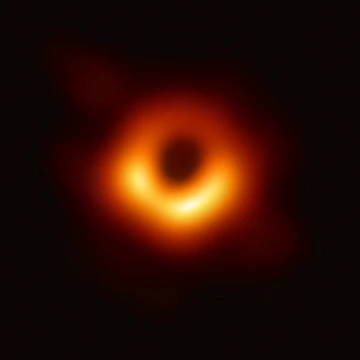
Extreme mass ratio inspiral
A compact object spiraling into a supermassive black hole.

NASA · via Wikipedia: Extreme mass ratio inspiral · Public domain
An extreme mass ratio inspiral (EMRI) is the orbit of a relatively light compact object around a much heavier object—typically a stellar-mass black hole or neutron star orbiting a supermassive black hole—that gradually spirals inward due to the emission of gravitational waves. These systems are likely to be found in the centers of galaxies and are considered one of the most promising sources for future space-based gravitational wave detectors such as the Laser Interferometer Space Antenna (LISA).
- Field
- Astrophysics
- Known for
- Gravitational wave source for testing general relativity in strong gravity
Lore & Background
EMRIs form in the dense nuclear star clusters surrounding supermassive black holes at galactic centers. The orbits of objects in these clusters are perturbed by two-body interactions, and occasionally an object passes close enough to the central black hole for gravitational wave emission to become the dominant orbital correction. The inspiralling object must be compact—a star would be torn apart by tidal forces—and the orbit must be finely balanced: too close leads to a direct plunge, too far and gravitational wave emission is negligible. Current estimates suggest a typical supermassive black hole of one million solar masses captures an EMRI once every million to one hundred million years. The initial orbits of captured EMRIs tend to be highly eccentric, with eccentricities exceeding 0.9999. As the orbit shrinks due to gravitational wave emission, it becomes more circular; by the time the signal is continuously detectable, eccentricity is typically around 0.7. A proposed impediment called the 'Schwarzschild Barrier'—an upper limit on eccentricity due to relativistic precession quenching torques—has since been shown to be an illusion.
Reader's Guide
The scientific significance of EMRIs lies in their ability to provide a detailed map of the spacetime geometry around a supermassive black hole. Because an EMRI completes roughly ten thousand cycles before plunging, its gravitational waveform encodes precise information about the central object's mass and angular momentum—measurable to an accuracy of one part in ten thousand—as well as the mass of the orbiting object, the orbit's eccentricity, and its inclination. This allows unprecedented tests of general relativity in the strong gravity regime, a regime that is otherwise untested. In particular, the quadrupole moment of the gravitational field can be measured to a fraction of a percent, testing whether the central object is indeed a Kerr black hole.
Each detection also yields the luminosity distance (to within five percent) and sky position of the system, providing a self-contained distance measurement that does not rely on the cosmic distance ladder. If an optical counterpart is identified, this offers an independent way to determine the Hubble parameter at cosmic distances. The statistics of supermassive black hole spins gathered from many EMRIs can reveal their formation history: high spin suggests growth via gas accretion, moderate spin indicates mergers of similar-mass objects, and low spin points to accretion of smaller objects from random directions. LISA is expected to detect between a few and a few thousand EMRIs per year, offering a transformative view of galactic nuclei and strong-field gravity.
Did You Know?
- An EMRI completes about 10,000 orbital cycles before the smaller object plunges into the supermassive black hole.
- The mass and angular momentum of the central black hole can be measured to an accuracy of 1 in 10,000 from an EMRI signal.
- The initial eccentricity of an EMRI can exceed 0.9999, becoming more circular as gravitational waves carry away energy.
- The 'Schwarzschild Barrier' was once thought to limit eccentricity but is now considered an illusion.
More in Black holes 1-24
Spotted an error? Know more?
Reader corrections go straight into our review queue. Suggest an edit · How this site is sourced