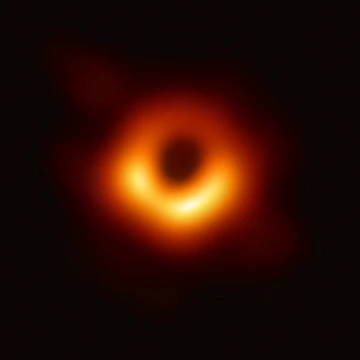
Event horizon
A spacetime boundary from which no signal can escape.

Sandstorm de · via Wikipedia: Event horizon · CC BY-SA 4.0
An event horizon is a boundary in spacetime beyond which no signal can ever reach a given observer. The term was coined in the 1950s by Wolfgang Rindler. In astrophysics, the concept is most famously associated with black holes, where it marks the point of no return for matter and radiation.
- Field
- Astrophysics, General Relativity
- Known for
- Boundary beyond which events cannot affect an outside observer
Lore & Background
The idea of a region from which light cannot escape dates to 1784, when John Michell proposed that gravity could be strong enough near massive compact objects that even light would be unable to escape, based on Newtonian gravity and corpuscular light theory. In 1958, David Finkelstein used general relativity to define a local black hole event horizon as a boundary beyond which no events can affect an outside observer, leading to later paradoxes involving information and firewalls. Stephen Hawking suggested using an apparent horizon instead, stating that gravitational collapse produces apparent horizons but no event horizons, and later concluded that the absence of event horizons means there are no black holes in the sense of regimes from which light cannot escape to infinity.
Objects approaching the horizon from the observer's side appear to slow down and never quite cross it, while their image reddens over time due to gravitational redshift. In an expanding universe, a cosmic event horizon exists where the expansion speed reaches or exceeds the speed of light, preventing signals from reaching some regions. This horizon affects all signals, including gravitational waves.
Reader's Guide
The event horizon remains a central concept in black hole physics and cosmology, though its definition and existence have been subjects of debate. The distinction between absolute and apparent horizons, as well as other types such as Cauchy, Killing, particle, and cosmological horizons, reflects the complexity of spacetime geometry. In black hole research, isolated and dynamical horizons are important for current studies. The cosmic event horizon in an expanding universe determines the maximum distance from which light emitted now can ever reach an observer, differing from the particle horizon which concerns past light. The existence of an event horizon depends on the nature of cosmic expansion: universes dominated by matter or radiation lack one, while a universe dominated by a cosmological constant (de Sitter universe) possesses one. For an accelerating particle, an apparent horizon appears at a distance of c²/a, though a true event horizon requires indefinite acceleration. The Schwarzschild radius acts as an event horizon for non-rotating black holes, proportional to mass, with the Sun's radius being about 3 kilometers and Earth's about 9 millimeters.
Did You Know?
- Wolfgang Rindler coined the term 'event horizon' in the 1950s.
- John Michell proposed in 1784 that gravity could be strong enough to prevent light from escaping.
- The cosmic event horizon affects all signals, including gravitational waves.
More in Black holes 1-24
Spotted an error? Know more?
Reader corrections go straight into our review queue. Suggest an edit · How this site is sourced