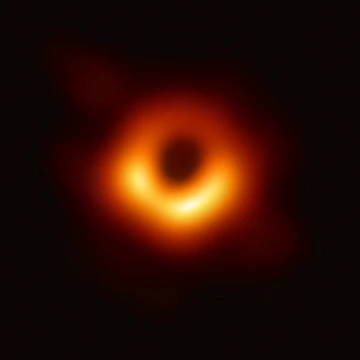
Black holes in fiction
Black holes in fiction: hazards, time dilators, and cosmic gateways.
Black holes—objects with gravity so intense that not even light can escape—have appeared in science fiction since the pulp era, even before the term "black hole" existed. Early stories often depicted them as dangers to space travelers, a theme that continued in later works. The concept gained traction in both science and fiction during the 1960s, and writers quickly latched onto gravitational time dilation, where time slows down near a black hole due to its immense gravity. Black holes also became a common plot device for space travel, especially after wormholes emerged as a plausible way to achieve faster-than-light journeys. In this setup, a black hole connects to its theoretical opposite, a white hole, acting as a gateway to another location in space—possibly very far away. More exotic versions show the exit point as a different time, enabling time travel, or even an entirely separate universe.
Some depictions take creative liberties that don't match known or predicted properties. Since nothing inside the event horizon—the point where escape velocity exceeds light speed—can be observed from outside, authors have freely imagined what lies within. A few works even portray black holes as sentient beings. Beyond stellar-mass black holes, supermassive and micro black holes also appear occasionally. Supermassive black holes are common in modern space opera, while micro black holes show up in stories about spaceship propulsion, threats to Earth, or as sources of gravity in space settlements.
Early portrayals of black holes predate the term itself. The general idea—an object so dense that light cannot escape—was first proposed by John Michell in 1783 and later refined within Einstein's general relativity by Karl Schwarzschild in 1916. Serious scientific interest remained limited until the 1960s, when the term "black hole" was coined, but fictional versions appeared earlier. Examples include E. E. Smith's 1928 novel *The Skylark of Space* with its "black sun," Frank K. Kelly's 1935 short story "Starship Invincible" with its "Hole in Space," and Nat Schachner's 1938 short story "Negative Space"—all treating black holes *avant la lettre* as hazards.
- Field
- Science fiction
- Known for
- Portrayal of black holes as hazards, time-dilation devices, and gateways for space travel
Lore & Background
Early depictions of black holes in fiction include E. E. Smith's 1928 novel The Skylark of Space with its 'black sun', Frank K. Kelly's 1935 short story 'Starship Invincible' with its 'Hole in Space', and Nat Schachner's 1938 short story 'Negative Space'—all portraying black holes avant la lettre as hazards to spacefarers. Later works that predate the current terminology include Fred Saberhagen's 1965 short story 'Masque of the Red Shift' with its 'hypermass' and the 1967 Star Trek episode 'Tomorrow Is Yesterday' with its 'black star'. Once black holes gained mainstream popularity, many early works focused on gravitational time dilation, as in Poul Anderson's 1968 short story 'Kyrie', Brian Aldiss's 1976 short story 'The Dark Soul of the Night', and Frederik Pohl's 1977 novel Gateway. Later sequels in Pohl's Heechee Saga and David Brin's 1984 short story 'The Crystal Spheres' portray time dilation being exploited by aliens.
Reader's Guide
Black holes in fiction have served multiple narrative functions, evolving from simple hazards to complex plot devices. The concept of gravitational time dilation became a central theme, allowing authors to explore relativistic effects such as the apparent freezing of objects at the event horizon, as seen in works like Anderson's 'Kyrie' and Aldiss's 'The Dark Soul of the Night'. Time dilation also enabled stories about aliens or humans using black holes to experience time differently, as in Pohl's Heechee Saga and Brin's 'The Crystal Spheres'. Black holes as gateways for space travel became prominent with the rise of wormhole theory, appearing in works like Joe Haldeman's The Forever War (using the term 'collapsars'), George R. R. Martin's 'The Second Kind of Loneliness', and Joan D. Vinge's The Snow Queen. More fanciful depictions include black holes as sentient beings, as portals to other times or universes, and as threats or power sources involving micro black holes. Supermassive black holes are common in modern space opera, while micro black holes appear in stories about spaceship propulsion, Earth's destruction, or as gravity sources in settlements. The interior of black holes, being unobservable, has allowed authors considerable artistic license.
Did You Know?
- The term 'black hole' was not coined until the 1960s, though objects with similar characteristics appeared in fiction decades earlier.
- In Poul Anderson's 1968 short story 'Kyrie', a telepathic scream from a being falling into a black hole becomes drawn out for eternity due to time dilation.
- In the 2014 film Interstellar, a planet orbits a black hole so closely that time passes approximately 60,000 times slower than on Earth.
- Micro black holes in fiction have been used for spaceship propulsion, threatening Earth's destruction, and as sources of gravity in outer-space settlements.
More in Black holes 1-24
Spotted an error? Know more?
Reader corrections go straight into our review queue. Suggest an edit · How this site is sourced